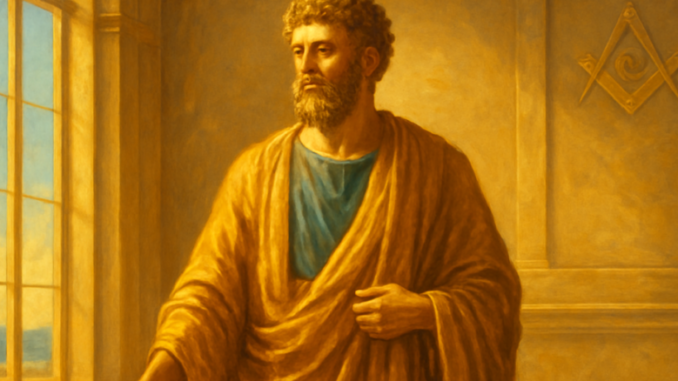
Picture a Roman emperor — surrounded by court intrigues, military campaigns, and the endless demands of governing an empire — writing by candlelight about the art of inner stillness. Marcus Aurelius never sought refuge in mountain cabins or coastal villas. Instead, he discovered a sanctuary that no one could ever take from him: the retreat into his own mind. In the fourth book of his Meditations, he unfolds this insight with a clarity that still resonates nearly two thousand years later.
The Inner Chamber as Sanctuary
Marcus Aurelius opens Book IV with an observation that strikes at the heart of his philosophy: people seek retreats in the countryside, at the seashore, or in the mountains, yet the truest sanctuary is always within reach. The human mind, when properly trained, offers a space where external chaos cannot enter. This is not escapism — it is a deliberate choice to locate the source of peace within rather than without.
The emperor compares this inner space to a citadel that stands firm regardless of what unfolds beyond its walls. The image of the citadel serves as a powerful symbol: not a fortress against the world, but a place of order and reflection. Those who learn to enter this inner chamber find principles there that guide their actions — not abstract rules, but living guidelines rooted in the Stoic teachings on virtue and nature.
Impermanence as the Great Teacher
A recurring theme throughout Book IV is the meditation on impermanence. Marcus Aurelius invokes the great names of history: Alexander the Great, Pompey, Julius Caesar. Where are they now? Their bodies have returned to dust, their empires have transformed beyond recognition, their fame reduced to echoes in history books. The emperor does not use these examples to preach nihilism but to offer perspective. If even the most powerful figures the world has ever known ultimately perish, why should anyone cling to fleeting recognition or material possessions?
The retreat into yourself is not a flight from the world, but the discovery of a fixed point from which you can meet the world with clarity.
This contemplation of death functions as a symbolic mirror. Just as a mirror shows what is truly there without embellishment, the thought of mortality reveals what is genuinely valuable. The daily dramas that consume our attention lose their urgency when placed against the backdrop of eternity.
The Web of Connection
Despite the emphasis on inner retreat, Marcus Aurelius is careful to stress that human beings are not isolated creatures. He writes about the cosmic order in which everything is interconnected. An action here has consequences elsewhere; a thought planted now bears fruit later. The Stoics called this the logos — the ordering principle that flows through all things.
This awareness of interconnection translates into an ethics of responsibility. The retreat inward does not serve to escape the world but to act more effectively from a centered position. Marcus Aurelius saw himself as a link in a chain, a part of a greater whole that extends far beyond individual existence. Inner work, in this view, is never purely personal — it radiates outward into every interaction and decision.
The Discipline of Judgment
One of the most practical elements of Book IV concerns the training of judgment. The emperor argues that much of our suffering arises not from events themselves but from the judgments we impose upon them. An insult wounds not because of the words spoken but because of the meaning we attach to them. A setback becomes a catastrophe only when we label it as such.
Marcus Aurelius outlines several disciplines for the mind: distinguishing between what lies within our control and what does not; suspending judgment until all facts are clear; viewing events as neutral material for growth; and treating our own reactions as the true field of work. These exercises require discipline and repetition. The emperor wrote these meditations not for publication but as personal reminders of principles he himself was in danger of forgetting. The book thus functions as a mirror he held up to himself — an instrument of self-transformation.
The Rough Stone and the Inner Temple
For those familiar with the symbolic language of Freemasonry, the philosophy of Marcus Aurelius resonates in a particularly striking way. The rough ashlar that must be shaped into a perfect cube finds its parallel in the Stoic conviction that each person must actively form and refine themselves. The inner chamber Marcus Aurelius describes is akin to the silence of the Masonic temple — a space where the work on the self takes place, set apart from the noise and distraction of the outer world.
The square and compasses — symbols of measure and balance — mirror the Stoic emphasis on proportion in all things. Do not attach too much, do not reject too much. Do not speak too much, do not remain too silent. The golden mean that Aristotle described and that the Stoics embraced finds a tangible expression in these enduring symbols. The inner retreat and the temple work share the same ultimate aim: the construction of a more balanced, more conscious, more purposeful human being.
Why Book IV Still Matters
In an age of constant stimulation — digital notifications, social media noise, and societal unrest — Book IV offers a powerful antidote. The retreat into yourself is not a luxury reserved for philosophers; it is a necessity for anyone seeking clarity and purpose. Marcus Aurelius wrote for himself, yet his words reach across the centuries to anyone willing to listen. The inner chamber stands open. The only key required is the willingness to enter.
Marcus Aurelius’ fourth book is ultimately an invitation to practice inner architecture. It teaches that we need not depend on external circumstances for inner peace. The citadel of the mind, once built upon sound principles, offers shelter in any storm. Those who internalize this insight carry a sanctuary with them — one that no emperor can confiscate and no chaos can disturb. For the Freemason and the seeker alike, the message is the same: the most important building you will ever work on is the one within.
Copyright text & image: devrijmetselaar.nl
Texts are based on the ideas and content of the author of devrijmetselaar.nl, reviewed, corrected, and supplemented with the assistance of OpenAI. Images are created based on the ideas of the author of devrijmetselaar.nl using OpenAI/DALL-E.
Frequently Asked Questions
What does Marcus Aurelius mean by 'retreating into yourself' in Book IV of Meditations?
Marcus Aurelius describes retreating into yourself as accessing an inner sanctuary of the mind that cannot be disturbed by external chaos. This is not escapism, but a deliberate practice of locating peace and order within oneself. He compares the mind to a citadel where principles and virtue guide your actions, regardless of external circumstances like court intrigues or military demands.
How does Marcus Aurelius use the concept of impermanence in Book IV?
Marcus Aurelius reflects on the deaths of powerful historical figures like Alexander the Great, Pompey, and Julius Caesar to illustrate that even the most accomplished people ultimately perish. He uses impermanence as a teaching tool to provide perspective on what truly matters, helping readers recognize that fleeting recognition and material possessions are not worth clinging to, and that daily dramas lose urgency when viewed against eternity.
Is the inner retreat a form of isolation or detachment from the world?
No. While Marcus Aurelius emphasizes the importance of inner retreat, he carefully stresses that this practice is not about fleeing the world. Rather, it is about discovering a fixed point of clarity and order within yourself from which you can engage with the world more effectively. The retreat into yourself enables you to meet external challenges with wisdom and virtue, not to avoid them.


Be the first to comment