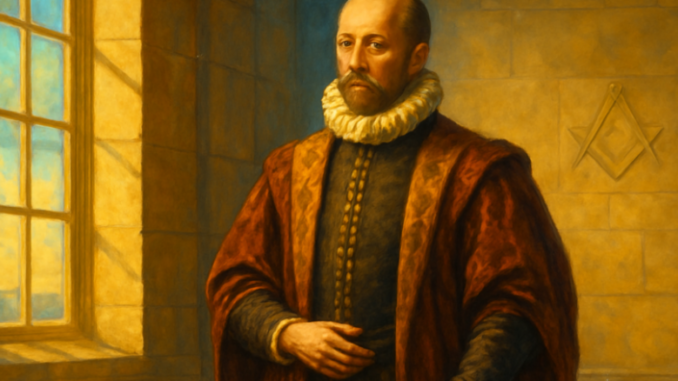
Imagine living in the sixteenth century, surrounded by plague epidemics, religious wars, and a life expectancy that barely reached forty. How would you relate to death? Michel de Montaigne chose not to avoid this question but to confront it head-on. In his celebrated essay “That to Philosophize Is to Learn to Die,” he drew upon a rich tradition of ancient wisdom. But which thinkers and philosophical currents whispered in his ear as he wrote? Let us descend together into the philosophical sources that shaped this masterwork — and discover why they still resonate deeply within Freemasonry today.
The Stoic Legacy: Seneca as Guiding Light
If there is one philosopher whose presence shimmers through every page of Montaigne’s essay, it is Seneca. The Roman statesman and philosopher wrote extensively about the art of dying in his Letters to Lucilius. For Seneca, death was not an enemy to be feared but a natural boundary that gives our lives meaning. He taught that we should live each day as though it could be our last — not out of gloom, but in order to be truly present.
Montaigne absorbed this Stoic insight and made it deeply personal. Where Seneca sometimes remained abstract, Montaigne filled his reflections with lived experience: a fall from his horse that nearly killed him, the death of his closest friend Étienne de La Boétie, and the devastating loss of five of his six children. In Montaigne’s hands, Stoic wisdom became flesh and blood.
Epicurus and the Liberation from the Fear of Death
Alongside the Stoics, Montaigne leaned heavily on Epicureanism. Epicurus formulated his famous argument: as long as we exist, death is not present, and when death arrives, we no longer exist. There is therefore no moment at which we actually experience death. This insight permeates Montaigne’s essay. He quotes Lucretius — the Roman poet who cast Epicurean philosophy into verse — repeatedly and with great approval.
To philosophize is to learn to see death not as an endpoint, but as the horizon that gives direction to every step of our lives.
For Montaigne, this was no abstract philosophical game. Liberation from the fear of death meant concrete freedom — freedom to think, to write, to live without the paralyzing grip of anxiety. Here, philosophy touches something that also stands at the heart of Freemasonry: the symbolic confrontation with one’s own mortality as a precondition for authentic living.
Cicero and the Rhetorical Tradition
The very title of Montaigne’s essay is a direct echo of Cicero, who wrote in his Tusculan Disputations that the entire life of the philosopher is a preparation for death. Cicero — not an original philosopher himself, but a masterful translator of Greek wisdom into Roman context — provided Montaigne with a rich vocabulary for thinking about mortality.
What Montaigne borrowed from Cicero was not only content but also method: the art of making philosophical ideas accessible, of weaving personal reflection together with classical wisdom. Montaigne, however, went further than Cicero by placing the first person at center stage. Where Cicero still spoke on behalf of a tradition, Montaigne spoke on behalf of himself.
Plutarch and the Power of the Moral Example
Plutarch, the Greek biographer and moral philosopher, was Montaigne’s favorite author. In the Parallel Lives, Montaigne found a treasury of examples showing how people faced death. Socrates calmly draining the cup of hemlock. Cato choosing death over a life under tyranny. For Montaigne, these stories were not dusty history but living inspiration.
Plutarch taught Montaigne that philosophy does not exist in abstractions but in concrete lives. This insight explains why Montaigne’s essays are so rich in anecdotes and personal observations. Wisdom is not proven by arguments alone, but by the lived example.
Skepticism as a Liberating Force
In later years, Montaigne would lean ever more strongly on Pyrrhonist skepticism — the philosophical current that calls all certainties into question. Although this particular essay falls relatively early in his writing career, the seeds of this attitude are already present: the willingness to examine his own convictions, the openness to contradictions in human thought.
This skepticism made Montaigne immune to dogmatism. He presented Stoic, Epicurean, and Platonic insights not as absolute truths but as perspectives to be considered. This intellectual humility characterizes his entire body of work and is precisely what makes his writing feel so refreshingly modern, even centuries later.
Renaissance Humanism and the Rediscovery of Antiquity
Montaigne wrote during a time when classical antiquity was being brought back to life. The Renaissance literally meant “rebirth,” and for intellectuals like Montaigne, it opened up a world of wisdom that had been hidden for centuries. Petrarch, Erasmus, and Thomas More had paved the way. Montaigne walked gratefully onward.
Several philosophical traditions converged in his thinking: the Stoic emphasis on inner freedom and acceptance of fate; the Epicurean insight that the fear of death is irrational; the Platonic idea that philosophy prepares the soul for what lies beyond; and the skeptical humility about the limits of human knowledge. Montaigne melted these traditions together into something entirely new. His essay is not a commentary on the classics — it is a personal dialogue with them. He read not in order to quote, but in order to live.
Death as a Symbol of Transformation
What does all of this have to do with Freemasonry? In the Masonic tradition, symbolic death plays a central role. The candidate dies to his old self in order to be reborn as a new person. This is not a morbid fascination but a powerful symbol of inner transformation. Montaigne’s insight — that to philosophize is to learn to die — resonates profoundly with this symbolism.
The philosophical sources from which Montaigne drew all flow together into one fundamental insight: whoever dares to look death in the face lives more freely and more consciously. This is not pessimism — it is the deepest kind of affirmation. Just as the Masonic initiate must pass through the darkness of the Chamber of Reflection before entering the light, Montaigne understood that genuine wisdom begins precisely where we stop running from our own mortality.
Montaigne’s essay on death remains a timeless invitation — to examine our lives honestly, to draw wisdom from those who came before us, and to face our mortality not with dread but with courage. The ancient philosophers he conversed with across the centuries — Seneca, Epicurus, Cicero, Plutarch — all pointed toward the same liberating truth: it is only by befriending death that we truly learn to live. For Freemasons, this resonance runs especially deep. The symbolic journey from darkness to light, from the profane to the sacred, mirrors the very transformation Montaigne discovered in the pages of antiquity. To philosophize, to reflect, to confront the finite nature of our existence — this is not the end of meaning, but its very beginning.
Copyright text & image: devrijmetselaar.nl
Texts are based on the ideas and content of the author of devrijmetselaar.nl, reviewed, corrected, and supplemented with the assistance of OpenAI. Images are created based on the ideas of the author of devrijmetselaar.nl using OpenAI/DALL-E.
Frequently Asked Questions
What are the main philosophical sources that influenced Montaigne's essay on death?
Montaigne drew upon three primary philosophical traditions: Stoicism (particularly through Seneca's Letters to Lucilius), Epicureanism (via Lucretius and Epicurus), and the rhetorical tradition of Cicero. These thinkers provided him with different perspectives on confronting mortality and understanding death's role in meaningful living.
How did Montaigne differ from Seneca in his approach to Stoic philosophy?
While Seneca provided abstract Stoic insights about living each day as if it were our last, Montaigne personalized these teachings through his own lived experiences, including a near-fatal fall from his horse, the death of his closest friend Étienne de La Boétie, and the loss of five of his six children. This made Stoic wisdom tangible and emotionally resonant rather than merely theoretical.
Why does Montaigne emphasize the Epicurean argument about death?
Montaigne valued Epicurus's logical argument that death cannot be experienced because when we exist, death is not present, and when death arrives, we no longer exist. This insight provided concrete psychological liberation from the fear of death, enabling people to think, write, and live freely without anxiety—a principle that aligns with Freemasonry's symbolic confrontation with mortality.


Be the first to comment