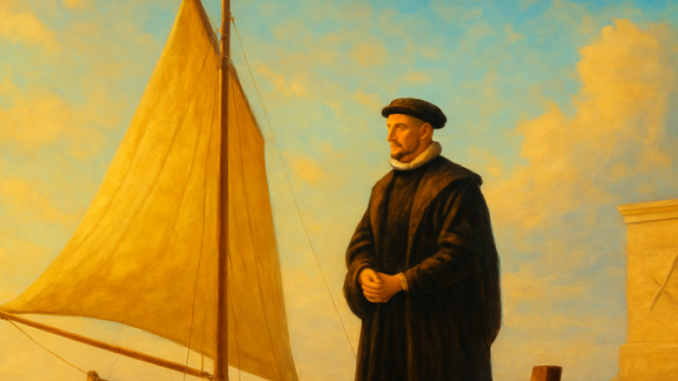
What makes us consider certain customs perfectly natural while other peoples do the exact opposite? And why is it so difficult to change laws, even when they are clearly flawed? Michel de Montaigne posed these questions more than four centuries ago, and his answers remain strikingly relevant today. In this twenty-second essay from his first book, the French philosopher examines the extraordinary power that custom holds over our thoughts and actions — a theme that resonates deeply with anyone who values self-examination and the role of ritual in shaping human life.
The Core of the Essay: Custom as Tyrant
Montaigne opens with a deceptively simple observation: custom determines nearly everything we consider normal. What we eat, how we sleep, the clothes we wear, the way we bury our dead — all of this varies radically from culture to culture. Yet people everywhere experience their own practices as the natural, even the only correct way to live. Custom, Montaigne argues, is a tyrannical mistress who takes possession of us by stealth.
The essay weaves together two interconnected themes. The first explores how custom clouds our judgment and blinds us to the arbitrariness of our own practices. The second applies this insight to legislation and social order. Montaigne warns that laws, however imperfect, should not be changed lightly, because the chaos of reform is often worse than the discomfort of the status quo.
A Wealth of Examples from Antiquity and Beyond
One of the great pleasures of this essay is the avalanche of examples Montaigne draws from classical antiquity and his own era. He refers to peoples who ate their deceased parents as a mark of honor, to Spartans who raised their children with brutal severity, to Persians who considered incestuous marriages perfectly normal. His point is always the same: what seems abhorrent to us may be considered the most sacred duty elsewhere.
Particularly striking is his reference to Plato, who observed that children exposed to certain practices from an early age come to experience them as entirely natural. Montaigne also cites Aristotle, who compared custom to a second nature. Habit shapes us so thoroughly that we can no longer distinguish what is truly natural from what has been learned.
“Custom is a violent and treacherous schoolmistress. She establishes in us, little by little and by stealth, the foothold of her authority.”
Why We Should Be Cautious About Changing Laws
Here Montaigne becomes remarkably cautious — almost conservative. He freely acknowledges that many laws are imperfect, sometimes even absurd. Yet he counsels restraint when it comes to reform. His argument is not that bad laws are good, but that the disruption caused by change often inflicts greater damage than the original flaw. A flawed law to which people have grown accustomed often functions better than a perfect law that nobody knows or accepts.
Montaigne wrote this essay during a period of religious wars and civil unrest in France. He had witnessed firsthand how attempts at reform spiraled into bloodshed. His warning is therefore not a blind defense of the status quo, but a call for wisdom and patience. Change should grow organically, not be imposed by force.
What This Essay Teaches Us About Ourselves
Perhaps Montaigne’s most powerful insight is his call for self-examination. If custom governs us so completely, we must ask ourselves which of our convictions are truly thought through and which have merely been handed down. This is not an invitation to relativism — Montaigne does believe in moral standards — but a summons to intellectual humility. We are all children of our upbringing, our culture, our time.
At the same time, this recognition also offers freedom. By acknowledging that much of what we think and do is the product of habit, we open up the possibility of conscious choice. Not everything needs to change, but everything deserves to be examined. This is the heart of what Montaigne calls the art of living: looking at ourselves and the world with open eyes.
Custom, Ritual, and Conscious Practice
For those familiar with ritual traditions, this essay holds a special lesson. Rituals are, by their very nature, forms of custom that are deliberately maintained. They give shape to what cannot easily be put into words and create continuity between generations. Montaigne’s analysis helps us understand why rituals are so powerful: they work not in spite of repetition, but precisely because of it. The custom that Montaigne describes as tyrannical can also serve a deeper purpose when it is practiced with awareness and intention.
The essay invites a dual attitude: respect for inherited forms, combined with the capacity to understand their origin and meaning. Anyone who practices ritual without ever asking why is a slave to custom. Anyone who reflects deeply on the ritual and still chooses to continue it transforms habit into conscious practice — a cornerstone of genuine self-development.
This distinction matters enormously within Freemasonry. The Craft’s rituals are not preserved out of mere nostalgia or inertia. They are maintained because, when engaged with thoughtfully, they serve as tools for moral and philosophical growth. The repetition of degree work, the recurrence of symbols, the rhythm of the lodge meeting — all of these gain their transformative power through the very mechanism Montaigne describes. But they fulfill their purpose only when the practitioner brings conscious reflection to bear upon them.
Montaigne’s essay on custom and law remains a masterwork of nuance. It teaches us to recognize the power of the taken-for-granted and invites self-examination without lapsing into cynicism. The question he poses — which of my convictions are truly my own? — is one every seeker must continue to ask. In a world that clamors for change, Montaigne reminds us that wisdom sometimes lies in preserving what works, and that the greatest freedom is found in choosing our customs consciously rather than merely inheriting them.
Copyright text & image: devrijmetselaar.nl
Texts are based on the ideas and content of the author of devrijmetselaar.nl, reviewed, corrected, and supplemented with the assistance of OpenAI. Images are created based on the ideas of the author of devrijmetselaar.nl using OpenAI/DALL-E.
Frequently Asked Questions
What is Montaigne's main argument about custom in this essay?
Montaigne argues that custom is a tyrannical force that determines nearly everything we consider normal and natural, from what we eat to how we dress and bury our dead. He contends that custom takes possession of us by stealth, clouding our judgment and making us blind to the arbitrariness of our own practices. What seems natural to one culture may be considered abhorrent to another, yet people everywhere experience their own customs as the only correct way to live.
How does Montaigne use examples from antiquity to support his thesis?
Montaigne draws extensively from classical antiquity and his own era to demonstrate that cultural practices vary radically across societies. He references peoples who ate their deceased parents as a mark of honor, Spartans who raised children with brutal severity, and Persians who considered incestuous marriages normal. Through these examples, he illustrates his central point: what seems abhorrent to us may be considered a sacred duty elsewhere, and this variation proves that custom, not nature, determines our values.
Why does Montaigne warn against changing laws too easily?
Montaigne argues that laws should not be changed lightly, even when they are imperfect, because the chaos and disruption caused by reform can be worse than the discomfort of the existing status quo. He emphasizes caution in legislative change, recognizing that custom and habit shape society so thoroughly that sudden alterations can create unforeseen problems. This reflects his broader concern about how deeply entrenched custom is in human life.


Be the first to comment