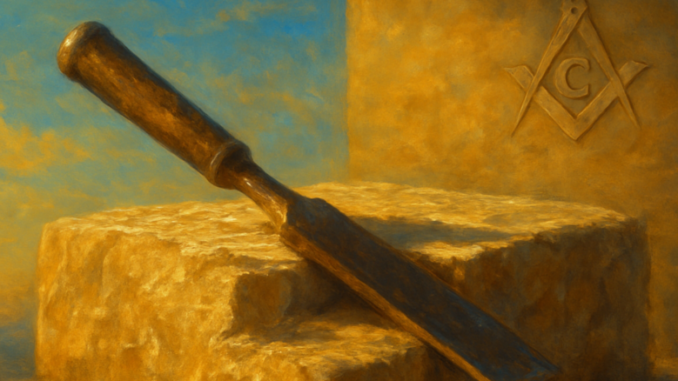
When a world-class athlete once again misses the podium at a major championship, an inevitable question arises: what does this tell us about their character? Is failure a sign of weakness — or does it reveal something far deeper about inner strength? In Freemasonry, there is an ancient teaching that the rough ashlar only reveals its true form through persistent work. Today, we explore what repeated adversity can teach us about personality and growth — not through the lens of sports commentary, but through a more profound question about human development.
Why Does Adversity Strike Us So Deeply?
There is something deeply fascinating about watching someone who belongs to the absolute elite in one arena fail repeatedly in another. It raises questions that reach far beyond sport. Why does a person keep returning to a discipline where success remains elusive? What drives someone to expose themselves to public failure again and again?
The Greek philosopher Aristotle wrote extensively about what he called thumos — the driving force of ambition and spirited pride within the human soul. This is not blind ego but a deep longing to achieve something of genuine value. When that longing is repeatedly frustrated, a crucial choice emerges: give up or carry on. It is in that very choice, Aristotle argued, that true character reveals itself.
Is Perseverance a Virtue or a Trap?
This is where the conversation becomes truly interesting. The Roman Stoic philosopher Seneca warned that perseverance without wisdom can degenerate into mere stubbornness. There is a real difference between pressing on because you are growing and pressing on because you cannot let go. How do you tell the two apart?
In Freemasonry, we speak of the rough ashlar that must be shaped into a perfect cube. This powerful image suggests that personal development is never a linear process. Sometimes you must chip away a piece you held dear. Sometimes an edge you believed was perfect turns out to be crooked. The real question is not whether you fail, but what you do with that failure.
Character is not forged by success, but by what you do when success remains out of reach.
What Does Adversity Reveal About Who We Truly Are?
The French essayist Michel de Montaigne wrote that we only come to know ourselves in moments of trial. Not when everything goes our way, but when the wind blows against us does it become clear what we are truly made of. He compared human character to a river: only when the water crashes against the rocks can you see the true current beneath the surface.
This insight resonates powerfully with the Masonic conviction that self-knowledge is the first and most important task of every seeker. The goal is not to be perfect but to be honest about your own limitations and possibilities. An athlete who keeps returning to a discipline where they struggle demonstrates something that transcends sporting ambition — a refusal to deny a part of themselves.
How Do Defeat and Honor Relate to Each Other?
In modern culture, success is often equated with worth. Winning means you are good; losing suggests the opposite. But the ancient wisdom traditions — from the Greek philosophers to the medieval cathedral builders — held a very different understanding of honor.
Honor did not lie in the result but in the effort. The stonemason who spent his entire life working on a cathedral he would never see completed was not considered a failure. He contributed to something greater than himself. His character was not measured by completion but by devotion.
Adversity, when met with the right spirit, reveals the qualities that matter most:
Courage shows itself not in the certainty of success but in the willingness to take risks. Humility emerges through the honest recognition of one’s own limits. Integrity is proven by consistency of action, not by outcomes. Wisdom grows through thoughtful reflection on setbacks.
What Can We Learn From This for Our Own Lives?
Perhaps the most important lesson is that personality is not a fixed attribute but a process of continuous formation. The Freemason sees himself as a work in progress — never finished, always evolving. In this view, adversity is not an obstacle but a tool.
Johann Wolfgang von Goethe, himself a Freemason, wrote that a person only truly becomes human through struggle. Not the struggle against others, but the inner wrestle to become better than one was yesterday. In this sense, every setback is an invitation to grow — provided we are willing to accept the invitation.
The question we should ask ourselves is not: how do I avoid failure? Rather, it is: what do I do with the failure that inevitably comes? Which part of my character is being shaped by it? And am I willing to engage consciously in that process of formation?
Adversity is not the enemy of character — it is character’s most faithful ally. Whether we are talking about an athlete who once again narrowly misses the podium or about our own daily struggles, every moment of failure contains the seed of deeper self-knowledge. Freemasonry reminds us that the rough ashlar only reveals its true form through patient, persistent work. Perhaps the willingness to keep chipping away, despite every setback, is the purest expression of human character there is.
Copyright text & image: devrijmetselaar.nl
Texts are based on the ideas and content of the author of devrijmetselaar.nl, reviewed, corrected, and supplemented with the assistance of OpenAI. Images are created based on the ideas of the author of devrijmetselaar.nl using OpenAI/DALL-E.
Frequently Asked Questions
What is the difference between perseverance and stubbornness according to the article?
The article, drawing from Roman Stoic philosopher Seneca, explains that perseverance without wisdom can degenerate into mere stubbornness. True perseverance involves growing through challenges, while stubbornness is pressing on simply because you cannot let go. The Masonic image of the rough ashlar illustrates this—sometimes personal development requires letting go of beliefs or approaches you held dear, recognizing that what seemed perfect may actually be flawed.
How does Freemasonry view the process of personal development through adversity?
Freemasonry uses the metaphor of the rough ashlar (unfinished stone) that must be shaped into a perfect cube to represent personal development. This teaching emphasizes that growth is not linear and adversity is essential to the shaping process. Like a stone being chiseled, personal character is refined through persistent work and the willingness to remove imperfections, even those we thought were valuable.
According to the article, when does true character reveal itself?
True character reveals itself not during success, but in moments of adversity and repeated failure. Drawing from Aristotle's concept of thumos and Michel de Montaigne's philosophy, the article argues that we only come to know ourselves in trials—not when everything goes our way, but when we face wind and resistance. Character is forged by the choices we make when success remains out of reach, not by the victories themselves.

Be the first to comment