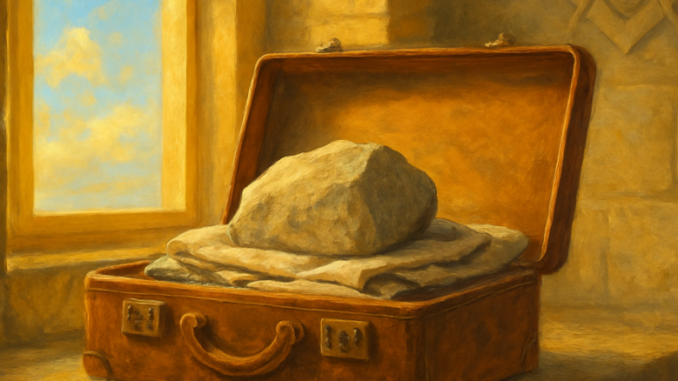
The suitcase stands packed by the door. A Freemason gazes out the window, ready to depart for a distant destination. Perhaps this trip will finally bring the peace he seeks — distance from daily worries, a chance to rediscover himself. But as he reaches for his keys, an ancient voice echoes in his mind: “Why do you think a new place will cure what you carry inside?” It is the voice of Lucius Annaeus Seneca, the Stoic philosopher who understood nearly two thousand years ago that changing your geography rarely solves your inner turmoil.
The Illusion of the Distant Horizon
In his twenty-eighth letter to his friend Lucilius, Seneca poses a question that still burns today: why do people keep traveling in the hope that a new environment will solve their problems? The first-century philosopher describes how people drift from city to city, from landscape to landscape, endlessly searching for something they cannot find — not because it doesn’t exist, but because they are looking in the wrong place. “You change your sky, not your soul,” he writes with characteristic sharpness. The baggage we most wish to leave behind always travels with us: ourselves.
For Freemasons, this observation rings deeply familiar. The Craft has emphasized for centuries that true transformation must come from within. The ritual work in the lodge is not a tourist excursion through exotic symbols — it is a systematic descent into one’s own interior. The rough ashlar is not polished by moving it to a different workshop. It is shaped through patient, purposeful labor, right where you stand.
Seneca’s Diagnosis of the Restless Soul
Seneca goes beyond mere observation. He offers a diagnosis: the urge to flee is a symptom, not a solution. Those who constantly need new stimulation, who depart again the moment novelty fades, suffer from what he calls taedium vitae — a profound weariness of life that stems from a lack of inner anchoring. The philosophical therapy Seneca prescribes is not more travel, but better stillness. Not seeing more, but looking deeper.
The true journey is not a change of place, but a change of perspective on yourself.
This resonates powerfully with the Masonic conviction that self-knowledge is the highest form of wisdom. The Delphic maxim “Know Thyself,” inscribed above the temple of Apollo, also lies at the heart of the Masonic endeavor. A brother who walks this path seriously learns that the most valuable discoveries are not found in distant lands, but in the unexplored chambers of his own heart.
The Lodge as an Antidote to Escapism
Where Seneca recommends philosophical contemplation as a remedy for restlessness, Freemasonry offers something concrete: the lodge. The lodge is a space where time works differently. There is no rushing, no distraction, no escape. The ritual demands presence. The symbols — from compass to square, from rough ashlar to tracing board — invite a quality of reflection that cannot remain superficial.
The brotherhood also functions as an anchor. In a world that glorifies mobility and presents constant change as a virtue, the bonds between brethren offer a form of connection that is independent of location. Whether a Freemason sits in London or in Sydney, the principles remain the same and the work continues. This continuity is precisely what Seneca means when he writes about the importance of a stable inner foundation.
Connection as an Alternative to Flight
Seneca’s letter is not only about what we should avoid — it is equally about what we should cultivate. Rather than endlessly seeking new impressions, he advises us to form deeper bonds with what is already present: with friends, with study, with our own inner life. The quality of our attention determines the quality of our existence, not the quantity of our experiences.
Freemasonry translates this principle into the practice of brotherhood. The regular meetings, the shared meals, the conversations that follow the closing of the ritual — all of this forms a fabric of connection far stronger than superficial contacts. In an age when social media give us the illusion of thousands of friends while we feel lonelier than ever, the lodge offers something precious: genuine presence, genuine exchange, genuine community.
The Journey Inward
What Seneca and Freemasonry share is the insight that the most important journey a person can undertake is not horizontal but vertical. Not across the surface of the earth, but into the depths of the soul. This is no easy journey. It requires courage to stand still when everything inside us screams to move. It requires honesty to face what we would rather avoid. It requires perseverance to work on the same stone, day after day.
Yet this is the only journey that truly transforms. The Freemason who understands this will discover that every lodge meeting is an expedition, that every meditation on the symbols is a voyage of discovery, and that the brotherhood itself is a map for the uncharted territory of the human heart. Seneca would recognize it immediately: it is not the world around us that must change, but the way we stand within it.
Seneca’s Letter XXVIII is not a condemnation of travel — it is an invitation to be honest about our motives. Are we running from something we carry inside, or are we traveling from a place of inner peace that feels at home anywhere? For Freemasons, the lodge offers a space where this question can be asked again and again, in the safety of brethren who walk the same path. The rough ashlar is not polished by relocation, but by devotion. And the true traveler is not the one who covers the most miles, but the one who dares to journey the farthest inward.
Copyright text & image: devrijmetselaar.nl
Texts are based on the ideas and content of the author of devrijmetselaar.nl, reviewed, corrected, and supplemented with the assistance of OpenAI. Images are created based on the ideas of the author of devrijmetselaar.nl using OpenAI/DALL-E.
Frequently Asked Questions
What does Seneca mean when he says 'You change your sky, not your soul'?
Seneca argues that traveling to new places cannot solve internal problems or spiritual emptiness. While the external environment changes, the internal struggles, fears, and unhappiness we carry within ourselves travel with us regardless of geography. True transformation requires inner work, not geographical relocation.
How does Seneca's philosophy connect to Freemasonry?
Both Seneca's Stoicism and Freemasonry emphasize that genuine transformation comes from within through self-reflection and systematic inner work. Just as Seneca advocates for stillness and self-examination, Freemasonry teaches that true enlightenment comes from working on oneself through ritual and self-knowledge, not from external changes or experiences.
What is 'taedium vitae' and how does it relate to constant travel?
Taedium vitae is Seneca's term for a profound weariness of life that stems from lacking inner stability or purpose. Those who constantly travel seeking novelty and new stimulation suffer from this condition. Seneca prescribes not more travel, but deeper self-examination and stillness as the remedy for this restless dissatisfaction.

Be the first to comment