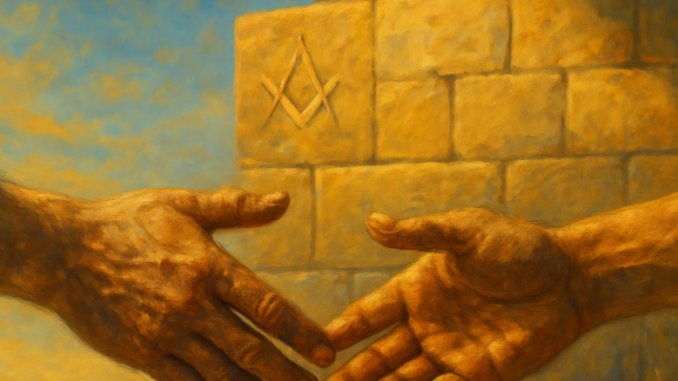
A handshake. So simple, yet so deeply charged with meaning. When opposing parties suspend hostilities because the other side has made concessions, we witness more than a political compromise. We see two sides that, after weeks of tension, can once again extend a hand to one another. That handshake — so ordinary that we barely give it a second thought — carries a symbolic power rooted in humanity’s deepest need for connection and reconciliation.
The Gesture Behind the Gesture
A handshake is never just a handshake. In Freemasonry, the grip is one of the oldest forms of recognition between brethren — a gesture that says: I trust you, I acknowledge you as my equal, we share something that goes beyond words. When two opposing parties reach agreement after a conflict, the same ritual takes place, even if unconsciously. The outstretched hand is a sign of mutual recognition.
Aristotle wrote that man is by nature a political animal, meant to live in community. But community does not arise on its own. It is built, stone by stone, gesture by gesture. The philosopher understood that cooperation does not begin with agreement — it begins with the willingness to build despite differences. That willingness is what we call brotherhood.
Conflict as a Building Block
It is tempting to see conflict as the opposite of brotherhood. But that is a misconception. In lodge work, Freemasons learn that differences of opinion are not avoided — they are ritually channeled. The rough ashlar is not made smooth by gazing at it carefully; it must be worked with hammer and chisel. The same applies to human community: it grows stronger through the friction of opposing interests, provided a shared foundation exists.
Montaigne warned against the person who never disagrees. Those who always agree build nothing; they merely reflect. True brotherhood can withstand the discomfort of difference. When opposing parties have stood against each other for weeks and then come together, it does not prove that the conflict was unnecessary — it proves the conflict did its work.
Brotherhood is not the absence of conflict. It is the willingness to extend your hand again after the conflict is over.
The Invisible Chain
In Masonic ritual, brethren often form a chain at the close of a meeting, standing hand in hand. This chain of union symbolizes the invisible bond between all members, even beyond the walls of the lodge. It is a reminder that we are all links in a greater whole. When one link breaks, the entire chain is weakened.
Social security, considered philosophically, is an attempt to forge that same chain at a societal level. It embodies the idea that we stand up for one another — not because we know each other personally, but because we recognize that together we form a community. Any debate about reforming such systems touches on a fundamental question: how strong do we want our chain to be? Whom do we include? And what are we willing to give in return?
Reconciliation as Ritual
Voltaire understood that social peace is not a natural state but a continuous effort. Reconciliation is not a destination; it is a ritual that must be performed anew, again and again. Every generation, every government, every community must learn it for itself.
Seen in this light, the suspension of hostilities is not a conclusion but a new beginning. The real question is not whether the conflict is over, but whether both parties are willing to close the chain of brotherhood once more. Whether they can say: we differ, but we are connected.
The Outstretched Hand: A Personal Reflection
It takes courage to extend your hand after a conflict. Not the courage of the hero marching into battle, but the quieter courage of the person who says: I choose connection over being right. In Freemasonry, that courage is not commanded — it is cultivated, week after week, ritual after ritual. It is the conviction that the other person, however different, is a fellow human being with whom we share something essential.
Perhaps that is the deeper lesson in any moment of reconciliation. Not that the opposing sides have reached agreement, but that after weeks of struggle they were willing to sit across from each other once more. The handshake with which such conversations begin and end is ancient and simple. But in that simplicity lies a promise that strikes at the very heart of what it means to live together.
The rough ashlar is made smooth through work. The chain is made strong by every link. And brotherhood does not emerge despite our differences — it emerges precisely because we learn to move through them together.
Time will tell whether any particular reconciliation holds. But regardless of the outcome, such moments remind us of something essential: every community — whether a nation or a lodge — is built on the willingness to extend a hand after disagreement. That handshake, so ordinary and so indispensable, is the foundation upon which brotherhood rests.
Copyright text & image: devrijmetselaar.nl
Texts are based on the ideas and content of the author of devrijmetselaar.nl, reviewed, corrected, and supplemented with the assistance of OpenAI. Images are created based on the ideas of the author of devrijmetselaar.nl using OpenAI/DALL-E.


Be the first to comment