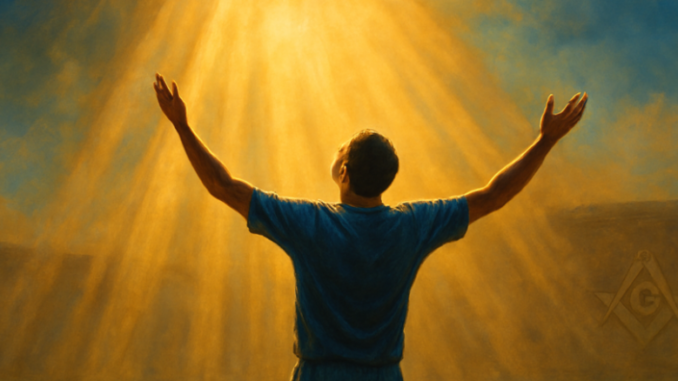
A striker scores multiple goals on a remarkable afternoon, looks skyward, and thanks God. In the same breath, he expresses the hope that Finnish football legend Jari Litmanen witnessed his performance. Two seemingly simple statements — yet together they touch on something far deeper than sport: the human need for gratitude toward something greater, and the longing to be seen by those who walked the path before us. These two driving forces also form the beating heart of the Masonic tradition.
Why Does a Footballer Thank God After Scoring?
It’s a scene familiar from stadiums across the world: a player points to the sky after scoring, makes the sign of the cross, or openly thanks God in a post-match interview. For some viewers it’s a natural gesture; for others it raises questions. What does it mean to pause in the frenzy of a match and acknowledge something greater than yourself?
At its core, this is about recognition. The player acknowledges that his achievement is not solely the product of his own effort. There is training, talent, and teamwork — but also something intangible: the right moment, the right instinct, the ball that just clips the inside of the post. That recognition of a force beyond oneself is what we might call spirituality. It’s not a theological argument but a spontaneous expression of wonder and humility.
What Does Gratitude Have to Do with Freemasonry?
Within Freemasonry, gratitude holds a special place — even though the word itself may be spoken less often than you’d expect. Freemasons refer to the Great Architect of the Universe, a deliberately open concept that every Brother is free to interpret through the lens of his own faith or worldview. It is not about a specific deity or a rigid dogma. It is about acknowledging that we are part of something that transcends us.
This attitude of humility before the greater whole is precisely what we witness when an athlete, after an extraordinary performance, does not beat his chest but looks upward. Marcus Aurelius, the Stoic emperor-philosopher who continues to inspire Freemasons, wrote in his Meditations that a person should begin every morning with gratitude for life itself — not because everything is going well, but because conscious existence is already a gift.
True spirituality begins where the ego ends: in the recognition that our greatest moments do not belong to us, but flow through us.
Why Do We Long to Be Seen by Those Who Came Before?
Just as fascinating as the upward gaze of gratitude is the backward glance. The wish that a great footballer from the past — someone like Jari Litmanen — witnessed your achievement speaks to a deeply human desire. We don’t just want to perform; we want our performance acknowledged by those who walked the path before us. It is a longing for connection across time.
In Freemasonry, this longing is formalized through the concept of the chain of tradition. Every Freemason stands on the shoulders of Brothers who came before him. The initiation ritual makes this tangible: the candidate is symbolically connected to a lineage stretching back to the legendary Master Builder Hiram Abiff and beyond — through the medieval stonemason guilds to the operative masons who built the great cathedrals. James Anderson, who compiled the first Constitutions of Freemasonry in 1723, emphasized that the Brotherhood must always honor its roots — not out of nostalgia, but because the past forms the foundation upon which the present is built.
The Chain of Master and Apprentice
In the Lodge, this principle takes concrete form. A Master Mason guides an Apprentice — not only through the rituals, but in the broader search for self-knowledge. That Master was himself once guided by another Master, and so on back through the generations. When an Apprentice achieves a breakthrough — a moment of genuine insight — it is not his victory alone. It is also a tribute to everyone who showed him the way. Just as a striker who scores also scores on behalf of his coach, his youth trainers, and the role models from his past.
Is Spirituality on the Sports Field Authentic?
A critical question worth asking: is a gesture of gratitude after a goal genuinely heartfelt, or is it a learned ritual — a habit without substance? The answer depends on the individual, but the question itself is valuable. Within Freemasonry, this same tension is openly acknowledged. A ritual performed without inner engagement is an empty form. Johann Wolfgang von Goethe, himself a Freemason, wrote that a person truly lives only when he connects the outward gesture with an inner truth. The ritual is the cup; the spirituality is the wine.
Whether an athlete’s gratitude is sincere is not something we can judge from the outside. But the fact that he voices it — that in an interview he speaks not only of tactics and statistics but also of God and of heroes from the past — reveals a need that runs deeper than sport. It is the same need that draws people to a Lodge, to a church, to a meditation cushion, or to a philosophical conversation in the small hours of the night.
What Can We Learn from This?
Freemasonry teaches that spirituality is not a matter of grand words or complicated theologies. It lives in the small gesture: the silence before a meal, the handshake that lingers a moment longer than necessary, the glance upward after a moment of joy. Spinoza, the Amsterdam philosopher who radically reimagined the relationship between God and nature, might say that gratitude is a form of clear insight — you see how everything is connected to everything else, and you feel that you are part of it.
Gratitude is not weakness; it is a sign of awareness. And the desire to be seen by those who came before is not vanity — it is an expression of respect for the chain of which we are a link.
Whether on the football pitch or in the Lodge, the deepest human impulses remain the same: to acknowledge that we are part of something greater, and to honor those who paved the way. The next time you see a player look skyward after a goal, consider that you may be witnessing something more than a sporting celebration. You may be watching one of the oldest spiritual gestures known to humanity — the simple, profound act of saying thank you to forces seen and unseen, past and present.
Copyright text & image: devrijmetselaar.nl
Texts are based on the ideas and content of the author of devrijmetselaar.nl, reviewed, corrected, and supplemented with the assistance of OpenAI. Images are created based on the ideas of the author of devrijmetselaar.nl using OpenAI/DALL-E.
Frequently Asked Questions
What is the spiritual significance of athletes thanking God after scoring?
When athletes thank God after scoring, they are acknowledging that their achievement is not solely the product of their own effort. This gesture recognizes the intangible elements of success—the right moment, instinct, and circumstance—that flow through them. It is a spontaneous expression of wonder and humility before something greater than oneself, which represents true spirituality at its core.
How does the concept of gratitude connect Freemasonry to spirituality?
In Freemasonry, gratitude is central to spiritual practice, though often unspoken. Freemasons acknowledge the Great Architect of the Universe—a deliberately open concept that each member interprets through their own faith or worldview. This attitude of humility before something greater transcends specific dogma and reflects the Masonic principle that true spirituality begins where the ego ends, in recognition that our greatest moments flow through us rather than belong to us.
What does Freemasonry teach about recognizing forces beyond ourselves?
Freemasonry teaches that conscious recognition of forces beyond ourselves is fundamental to spiritual growth. The tradition emphasizes that we are part of something that transcends individual effort. Drawing on Stoic philosophy, Freemasons are encouraged to approach life with gratitude for existence itself—not because everything is perfect, but because the simple fact of conscious existence is already a gift and a connection to something greater.


Be the first to comment