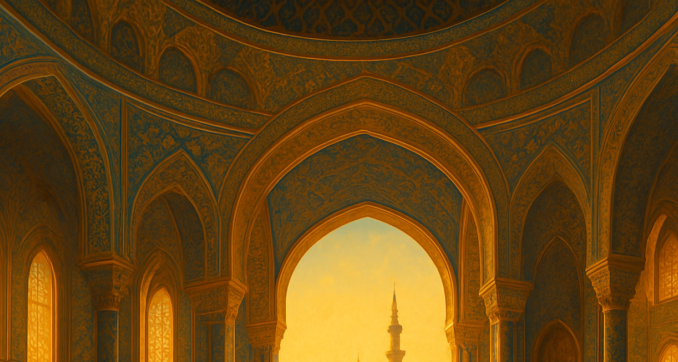
A brother sits quietly in the back row of the lodge. The ritual has just begun, and the Worshipful Master’s words echo through the room: ‘Let there be light within you.’ He closes his eyes and thinks of Abraham — the patriarch who stood beneath a canopy of stars thousands of years ago, searching for something greater than himself. That ancient search for light and truth connects them across the centuries.
The Patriarch as a Universal Symbol
Ibrahim — as Abraham is known in the Quran — is one of the most revered figures in Islamic tradition. The fourteenth surah of the Quran bears his name and opens with a powerful declaration: this book was sent to lead people out of darkness and into the light. This theme of illumination, of the passage from ignorance to insight, resonates deeply with the spiritual quest that lies at the heart of Freemasonry.
In the Quran, Abraham is described as a hanif — a pure monotheist who turned away from the idols of his forefathers. He literally smashed the images worshipped by his community to demonstrate that they held no power. This act of spiritual courage demanded inner strength and a willingness to abandon inherited certainties in pursuit of a deeper truth.
From Darkness Into Light
The central motif of Surah Ibrahim is the movement from darkness to light. The Arabic words dhulumat (darknesses, plural) and nur (light, singular) appear repeatedly throughout the text. This choice of language is deeply significant: darkness comes in many forms, but light is one and indivisible. For the Freemason, this immediately evokes the symbolism of the hoodwink removed during initiation — that transformative moment when the candidate first beholds the light of the lodge.
The light Abraham sought beneath the stars is the same light the Freemason seeks within himself: a universal truth that binds all traditions together. In Freemasonry, light is consistently associated with knowledge, wisdom, and moral enlightenment. The Entered Apprentice’s journey through the degrees is a symbolic passage from the darkness of ignorance toward the light of self-knowledge. Surah Ibrahim describes the same journey, though framed within the context of faith, surrender, and the recognition of a higher reality.
The Tree as a Symbol of Inner Growth
One of the most evocative passages in Surah Ibrahim compares a good word to a good tree. Its roots are firmly planted in the earth, its branches reach toward the sky, and it bears fruit in every season. This image is universal in scope — from the Tree of Life found in ancient mystical traditions to the acacia that in Masonic symbolism represents immortality and rebirth.
The tree as a metaphor for spiritual growth speaks directly to the Freemason working on his rough ashlar. Just as a tree must send its roots deeper in order to reach higher, the brother must deepen his self-reflection in order to grow in virtue and wisdom. The fruit the tree bears represents the deeds that flow from a sincere heart — actions rooted in genuine understanding rather than mere outward show.
Surrender and Building the Temple
The Arabic word islam literally means surrender or submission to the will of the Divine. Abraham is praised in the Quran for his total surrender — even when he was asked to sacrifice his own son. This willingness to commit fully, however painful, reflects a spiritual attitude that Freemasonry also holds in high regard: the readiness to set aside the ego in service of something greater than oneself.
Tradition tells us that Abraham, together with his son Ishmael, rebuilt the Kaaba — the sanctuary in Mecca that symbolizes the center of the world for Muslims. This act of building a sacred space finds a powerful parallel in the Masonic ideal of the temple: not merely a physical structure, but above all the inner temple of the heart. Both traditions recognize building as a profoundly spiritual act — the shaping of sacred space through disciplined labor and devotion.
Brotherhood Beyond Boundaries
Abraham is the patriarch who unites Jews, Christians, and Muslims. His figure stands at the foundation of three great world religions and reminds us that spiritual seeking is far more universal than the boundaries human beings have drawn in the centuries since. Freemasonry, which welcomes brethren of all faiths, recognizes in Abraham a symbol of that original unity — a common ancestor of the spirit.
Consider the threads that run through this single surah and the Craft alike: Abraham as a seeker of light and truth; the tree as a symbol of inner growth and fruitfulness; the building of the Kaaba as spiritual labor; and surrender as a path toward enlightenment. Each of these themes transcends any single religious framework.
In the lodge, men from different backgrounds meet as brothers, united in their commitment to self-improvement and service to others. Surah Ibrahim reminds us that this aspiration is nothing new — it is rooted in ancient traditions that have inspired humanity for millennia. The patriarch who stood beneath the stars and opened his heart to the light is, in a very real sense, the first seeker — the archetypal brother of all who have since undertaken the same journey.
Surah Ibrahim offers a window into a spirituality that transcends borders and creeds. The themes of light, growth, building, and surrender that it contains find resonance within Freemasonry without either tradition claiming ownership of the other. Both invite us on an inward journey: away from the darkness of ignorance and toward the light of wisdom and connection. Abraham, the patriarch who stood with empty hands beneath a vast night sky, continues to remind us of what truly binds us together — the search for truth, the courage to build, and the willingness to surrender to something greater than ourselves.
Copyright text & image: devrijmetselaar.nl
Texts are based on the ideas and content of the author of devrijmetselaar.nl, reviewed, corrected, and supplemented with the assistance of OpenAI. Images are created based on the ideas of the author of devrijmetselaar.nl using OpenAI/DALL-E.
Frequently Asked Questions
What is the connection between Surah Ibrahim and Freemasonry?
Surah Ibrahim and Freemasonry share a common spiritual theme of passage from darkness to light. Both traditions use this symbolism to represent the journey from ignorance to enlightenment and self-knowledge. The Quranic description of Abraham as a seeker of truth who abandoned inherited certainties parallels the Freemason's symbolic journey through the degrees, where the removal of the hoodwink represents the candidate's first encounter with light and spiritual awakening.
Who was Ibrahim and why is he significant in Islamic tradition?
Ibrahim, known as Abraham in English, is one of the most revered figures in Islamic tradition and is honored as a hanif—a pure monotheist who rejected the idols of his forefathers. He demonstrated spiritual courage by literally smashing the images worshipped by his community, showing his commitment to abandoning inherited certainties in pursuit of deeper truth. The fourteenth surah of the Quran bears his name and uses his life as a framework for exploring themes of faith and spiritual surrender.
What does the tree symbolize in Surah Ibrahim?
In Surah Ibrahim, a good word is compared to a good tree with roots firmly planted in the earth and branches reaching toward the sky, bearing fruit in every season. This image represents inner growth and spiritual development, symbolizing how moral and spiritual principles are grounded in solid foundations while aspiring toward higher truths. The tree serves as a universal symbol of balanced growth that connects earthly existence with transcendent purpose.

Be the first to comment