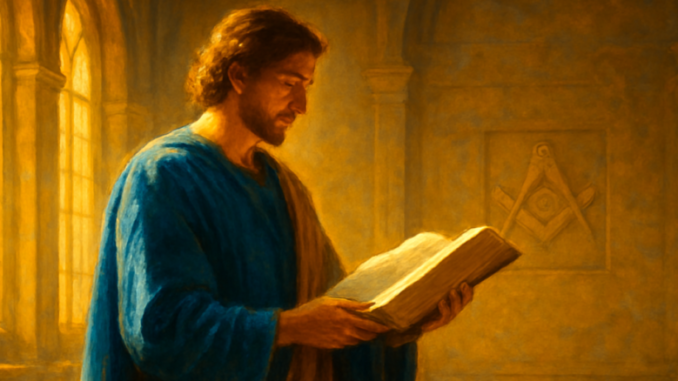
You know the moment: someone enthusiastically tells you about a book that “turns everything upside down” about religion and science. Chances are they’re talking about Dan Brown’s Origin. The sixth installment in the Robert Langdon series, published in 2017, sparked immediate debate. But what does the book actually claim? And how do its central ideas connect to lines of thought that Freemasonry has been exploring for centuries? In this article, we break down the core premise of Origin and offer practical ways to engage with its provocative themes yourself.
The Central Question of Origin
Origin revolves around two questions that have occupied humanity for millennia: where do we come from, and where are we going? Dan Brown places his protagonist Robert Langdon at the center of a scientific presentation that claims to answer both. The fictional scientist in the novel, Edmond Kirsch, says he has developed a computer simulation that explains the origin of life without any divine intervention. At the same time, this simulation predicts a future in which technology and humanity merge into one.
The book suggests that artificial intelligence can not only explain how life began but also predict how religion will become obsolete. This is the heart of the controversy: Origin presents technology as a new meaning-making system that could replace traditional religions. It’s important to understand that this is a fictional premise, not a scientific claim.
Science Versus Faith: A False Dichotomy?
What Origin does effectively is create tension between scientific discovery and religious belief. The book positions them as opposites, as though you must choose one or the other. But something doesn’t quite add up. Thinkers like Baruch Spinoza recognized centuries ago that nature and the divine don’t have to be in opposition. Spinoza described a universe in which natural laws and the divine are one and the same. This nuance is largely absent from Origin’s premise, which favors dramatic conflict over philosophical depth.
The real question isn’t whether science replaces religion, but whether both illuminate different aspects of human meaning-making.
For Freemasons, this is familiar territory. The fraternity has never demanded that its members choose between science and spirituality. On the contrary: the Enlightenment thinking championed by figures like Voltaire — which resonated strongly within the lodges — emphasized the importance of reason alongside tolerance for diverse beliefs. Freemasonry, at its core, encourages the harmonious pursuit of knowledge from many sources.
Artificial Intelligence as the New Oracle
One of the most striking elements of Origin is the role played by artificial intelligence. The novel introduces a sophisticated computer system that doesn’t just calculate but appears to “understand.” Dan Brown taps into contemporary fascinations and anxieties about technology. The suggestion is that machines might one day provide answers to questions that religions have tried to address for centuries.
But here’s the crucial point: this is a literary device, not a prediction. The book uses technology as a narrative tool to generate suspense. In the real world, no computer system has “solved” the origin of life. What Origin does accomplish, however, is inviting you to think about where you place your authority. Do you trust ancient texts, scientific methods, or perhaps — in the near future — algorithms?
Practical Steps: What Can You Do With These Ideas?
Origin is fiction, but the questions it raises are very real. Here are three concrete steps you can take to engage meaningfully with these themes:
1. Examine your own assumptions. Which sources do you consider authoritative when it comes to life’s big questions? Write them down, and ask yourself why you trust them. Are they based on evidence, tradition, personal experience, or something else entirely?
2. Seek out different perspectives. Have a conversation with someone who thinks differently than you about the relationship between technology and meaning. Listen more than you speak. You may be surprised by what you learn — and by how the exchange sharpens your own thinking.
3. Read more broadly. Alongside Origin, pick up a work by Spinoza or an introduction to the philosophy of science. Compare how different thinkers approach the same fundamental questions. The contrasts and overlaps will enrich your understanding considerably.
Freemasonry and the Search for Truth
Within Freemasonry, the search for truth is a core value. This search doesn’t happen by claiming definitive answers but by continually asking questions and remaining open to new insights. The tension Origin depicts between ancient faith and new technology is, in many ways, a modern version of an age-old challenge: how do you relate to knowledge that shakes the foundations of your worldview?
The building symbolism central to Freemasonry offers a useful framework here. Just as a master builder combines different materials and techniques to create something enduring, a seeker can combine different sources of knowledge. Science, philosophy, spirituality, and yes, even fiction like Origin — all of these can serve as building blocks in your personal development. The goal is not to settle on a single answer but to construct a worldview that is both resilient and adaptable.
Critical Reading as an Essential Skill
One final practical lesson: learn to read critically. Dan Brown is a master at blending fact and fiction. Origin features real locations, references genuine scientific concepts, and weaves an invented narrative through them. This makes the book thrilling but also potentially misleading if you’re not paying close attention.
With any book, ask yourself: what here is proven and what is speculation? What interests or motives might the author have? How do experts in the relevant fields respond to these claims? Asking these questions isn’t a sign of distrust — it’s healthy curiosity. It’s precisely the attitude encouraged by both the scientific method and Freemasonry: accept nothing uncritically, but examine everything with an open and discerning mind.
Dan Brown’s Origin is not a scientific manifesto — it’s a thriller that plays with big questions. Through fiction, it suggests that technology could render religion obsolete. That premise is provocative but also one-sided. The real challenge lies not in choosing between science and faith but in integrating different sources of knowledge into a personal, thoughtful worldview. So by all means, pick up the book and enjoy the ride — but bring your critical thinking along with you. That spirit of inquiry is what Freemasonry has always championed, and it remains as relevant today as it has ever been.
Copyright text & image: devrijmetselaar.nl
Texts are based on the ideas and content of the author of devrijmetselaar.nl, reviewed, corrected, and supplemented with the assistance of OpenAI. Images are created based on the ideas of the author of devrijmetselaar.nl using OpenAI/DALL-E.

Be the first to comment