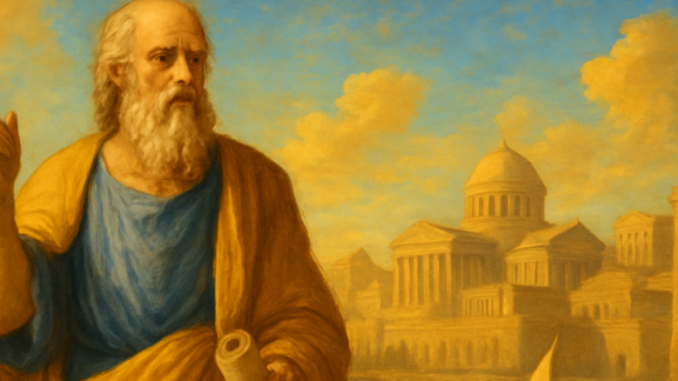
Imagine standing with a group of people before an empty plot of land. Your shared task: build a city from scratch — not just any city, but a community where everyone can thrive. Where do you begin? What values do you lay as the foundation? This is precisely the challenge Plato takes on in Book II of The Republic, and it is the very same question that Freemasons have been grappling with for centuries whenever they speak of building a better world.
The City as a Mirror of the Soul
In The Republic Book II, Plato makes a surprising move. Rather than diving straight into a debate about the nature of justice, he proposes designing an ideal city first. His reasoning is beautifully practical: justice is easier to recognize in a larger system than in a single individual, just as large letters are easier to read than small ones. The city becomes a magnifying glass for the human soul.
For Freemasons, this approach feels immediately familiar. In the lodge, we work on two structures simultaneously: the inner temple of the self and the collective brotherhood. What we learn inside the lodge about cooperation, harmony, and virtue, we carry into the outside world. The small community of the lodge serves as a training ground for society at large.
Everyone Has a Unique Contribution
Plato begins constructing his ideal city with a simple observation: no person is self-sufficient. We need one another. One person bakes bread, another builds houses, yet another weaves clothing. From this mutual dependence, the city is born. It is not abstract theory — it is a concrete reality you can observe any day.
This principle of specialization and cooperation forms the heart of what Plato calls justice: each person does what they do best and contributes to the whole. Not because someone forces them, but because it reflects the natural order of things. Freemasonry embodies the same idea. A lodge functions because every member fulfills a specific role. The Worshipful Master, the Secretary, the Director of Ceremonies — each has distinct responsibilities that together ensure both ritual and organizational harmony.
A just community emerges when every individual puts their unique talent to work for the well-being of all — not out of compulsion, but out of understanding.
From Necessity to Civilization
Plato describes how a simple city born of necessity gradually evolves into a more complex society. Artists, poets, teachers, and guardians enter the picture. With this growth come challenges: How do you prevent greed from taking over? How do you keep the city from falling prey to internal division or external threats?
This is where education and character come into play. The guardians of the city must be not only strong but also wise and disciplined. They must be able to distinguish friend from foe, real danger from perceived danger. This requires a deliberate formation of both body and soul.
Freemasonry places a similar emphasis on formation. Progressing through the degrees is not a formality — it is a process of inner development. Each degree brings new insights and new responsibilities. Like Plato’s guardians, Freemasons are trained to discern: between truth and illusion, between self-interest and the common good.
Practical Steps for Daily Life
How do you translate this ancient wisdom into your own life? Here are some practical starting points:
Identify your unique talent and ask yourself how you can put it to greater use for others, not just for yourself.
View your immediate surroundings as a small city. What role do you play? What roles are missing?
Invest in your own formation. Read, reflect, and seek conversation with people who challenge your thinking.
Practice discernment. Not everything that seems urgent is truly important. Not everyone who offers criticism is an adversary.
The Lodge as a Practice City
A Masonic lodge is, in a very real sense, a miniature version of Plato’s ideal city. It is a defined space where Brethren work together toward a shared purpose. There are rules and rituals that maintain order. There is a hierarchy based not on power, but on experience and wisdom. And there is a collective aspiration toward improvement — both individual and communal.
When you leave a lodge meeting and head home, you carry something of that experience with you. The way people truly listened to one another. The care with which rituals were performed. The atmosphere of mutual respect. These are not abstract ideals — they are lived experiences that shape your behavior in the world beyond the lodge doors.
Building Connection
Plato’s great insight is that a just city does not arise by accident or by force, but through the conscious cooperation of people who understand and value their own role. This requires both self-knowledge and recognition of others. It demands the willingness to sometimes place your own interests below those of the greater whole.
For Freemasons, this is hardly a foreign concept. The entire structure of the fraternity is designed to bring together men of different backgrounds, professions, and convictions in a shared endeavor. Differences are not smoothed over — they are embraced and put to use. Just as in Plato’s city, each person contributes from their own strength.
Plato’s Republic Book II is far more than an abstract philosophical thought experiment. It is an invitation to reflect on the foundations of every community — including our own. Freemasonry offers a concrete space in which these principles can be practiced, not as a final destination but as a point of departure. The ideal city is never finished, just as the inner temple is never truly complete. But every stone we lay, every connection we forge, brings us closer to the ideal that Plato — and generations of Freemasons after him — have always strived toward.
Copyright text & image: devrijmetselaar.nl
Texts are based on the ideas and content of the author of devrijmetselaar.nl, reviewed, corrected, and supplemented with the assistance of OpenAI. Images are created based on the ideas of the author of devrijmetselaar.nl using OpenAI/DALL-E.

Be the first to comment