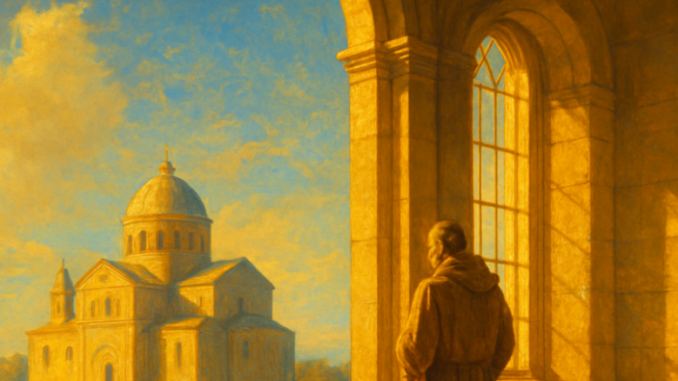
It’s a quiet evening after lodge. A brother settles into his chair, coffee in hand, and asks with a half-smile: “So, that Priory of Sion from Dan Brown’s book — is that basically the same thing as Freemasonry?” The question lingers. It’s one many Freemasons have heard before, because ever since The Da Vinci Code hit bookshelves, all secret societies tend to get lumped together in the public imagination. But does that picture hold up? And what can Freemasons learn from the stubborn confusion between fiction and reality?
The Origins of a Modern Myth
In The Da Vinci Code, Dan Brown presents the Priory of Sion as an ancient secret society dating back to the Crusades. According to the novel, this organization guards an explosive secret about the bloodline of Jesus Christ. Illustrious figures from art and science are listed as its supposed Grand Masters: Leonardo da Vinci, Isaac Newton, Victor Hugo. It sounds fascinating — almost too good to be true. And that is precisely the point.
The historical reality is far more mundane. The Priory of Sion was founded in 1956 in the small French town of Annemasse by Pierre Plantard, a man with a highly questionable reputation. It was originally a minor civic association with no connection whatsoever to medieval knightly orders or Renaissance artists. Plantard later fabricated documents and had them deposited in the Bibliothèque nationale de France, creating a fictitious history stretching back to the eleventh century. These forgeries were debunked as early as the 1980s, but they continued to float through popular culture until Dan Brown placed them at the heart of his thriller.
Freemasonry Versus Fictional Societies
For Freemasons, the distinction between their fraternity and organizations like the alleged Priory of Sion is fundamental. Freemasonry is a documented, transparent organization with a history that demonstrably reaches back to the seventeenth century. The first Grand Lodge was established in London in 1717, and figures like James Anderson and Jean Théophile Désaguliers laid the groundwork for modern Freemasonry. Their work has been preserved, studied, and remains publicly accessible.
Where the fictional Priory of Sion supposedly concerned itself with guarding dynastic secrets and orchestrating political conspiracies, Freemasonry focuses on personal development, brotherhood, and ethical conduct. The lodge is not a secret organization with hidden agendas — it is a private society where men work on what Masons call “the rough ashlar”: their own character, refined through reflection and ritual.
Freemasonry guards no dynastic secrets. Instead, it cherishes a method of self-improvement that is accessible to anyone who sincerely seeks it.
Why the Confusion Persists
The appeal of stories about secret societies is entirely understandable. They tap into a deeply human longing for hidden knowledge and meaningful patterns behind the apparent chaos of history. Dan Brown exploits this masterfully in The Da Vinci Code by weaving together authentic artworks, real locations, and actual historical figures with pure fiction.
The problem arises when readers lose sight of the boundary between fact and invention. Freemasonry has regularly suffered from this blurring of lines. After the book — and later the film — appeared, lodges were flooded with questions about supposed connections to the Priory of Sion or the Knights Templar. Some people genuinely expected that Freemasons were custodians of secret documents or had access to hidden knowledge about the history of Christianity.
The Symbolism Behind the Myth
Interestingly, both the fictional Priory and real-world Freemasonry use symbolism as a core element of their identity. But the function of that symbolism differs profoundly. In Dan Brown’s novel, symbols serve as codes — riddles to be solved in order to reveal a concrete secret. They are puzzle pieces in a detective story.
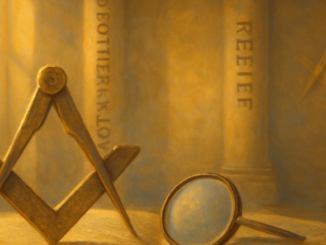
For Freemasons, symbolism works in a fundamentally different way. Tools like the square and compasses, the rough and perfect ashlars, the temple under construction — these are not codes leading to buried treasure. They are metaphors for inner processes. The compasses that set boundaries for the mind, the square that guides moral conduct, the stone refined through labor. These symbols invite contemplation, not decipherment.
What Remains After the Unmasking
The Priory of Sion as Dan Brown describes it never existed. The documents were forgeries, the membership list featuring famous Grand Masters was fabricated, and the claimed medieval origin is a twentieth-century invention. This is not a matter of interpretation — it is a matter of documented historical research that has been available for decades.
Yet The Da Vinci Code has also had an unexpectedly positive effect. The novel prompted millions of people to think about symbolism, about the relationship between art and spirituality, and about the question of which stories we accept as truth. For Freemasons, this offers a valuable opening. The curiosity the book generated can be redirected toward an honest conversation about what organizations like Freemasonry actually are: not guardians of conspiracy secrets, but communities of people striving for personal growth and civic engagement.
Key Takeaways
The Priory of Sion was founded in 1956, not in the Middle Ages. The supposedly historical documents are proven forgeries. Freemasonry is transparent about its origins and objectives. And symbolism in the lodge serves as a mirror for self-reflection, not as a code to be cracked.
The brother in the lodge eventually gets his answer. No, the Priory of Sion has nothing to do with Freemasonry. It is an invention cleverly packaged as history. But the question itself is valuable, because it compels us to be clear about who we are and what we stand for — and to distinguish, with patience and honesty, the enduring craft of self-improvement from the fleeting allure of fiction.
Copyright text & image: devrijmetselaar.nl
Texts are based on the ideas and content of the author of devrijmetselaar.nl, reviewed, corrected, and supplemented with the assistance of OpenAI. Images are created based on the ideas of the author of devrijmetselaar.nl using OpenAI/DALL-E.

Be the first to comment