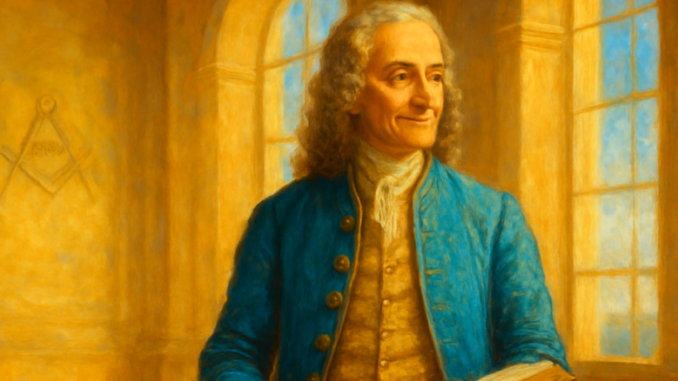
In 1764, Voltaire published his Philosophical Dictionary, a collection of sharp essays tackling the great questions of human existence. His entry on virtue reveals a thinker deeply rooted in classical philosophy yet looking forward to a new kind of morality. What intellectual traditions shaped his thinking? And why do his ideas continue to resonate within Freemasonry centuries later?
The Legacy of Stoicism
Voltaire grew up intellectually immersed in the works of Seneca, Epictetus, and Marcus Aurelius. These Stoic thinkers had a profound influence on his conception of virtue. For the Stoics, virtue was not an abstract ideal but a practical way of life. They taught that a person could shape their character through rational self-discipline, regardless of external circumstances.
In his essay on virtue, Voltaire echoes this conviction. He rejects the notion that virtue is innate or that it can only be obtained through divine grace. Instead, he emphasizes that every individual can develop their moral compass through personal effort. This message resonated powerfully in the eighteenth century, a time when the autonomy of the individual was becoming an increasingly central concern.
Locke and the Empirical Approach to Morality
Beyond the classical philosophers, Voltaire was profoundly influenced by John Locke, the English thinker he encountered during his years of exile in England. Locke’s Essay Concerning Human Understanding (1689) proposed that the human mind at birth is a blank slate. All knowledge — including moral knowledge — arises from experience and reflection.
Voltaire applied this empirical framework to his understanding of virtue. Where the Catholic tradition often linked virtue to the Fall and redemption, Voltaire saw moral goodness as something people could learn through education, deliberation, and social interaction. This made him a champion of learning and enlightenment as the primary means of improving humanity.
Montaigne’s Humanist Influence
Another crucial source for Voltaire was Michel de Montaigne, the sixteenth-century essayist whose skeptical humanism left deep marks on French intellectual life. Montaigne examined human nature without dogmatic prejudice. He demonstrated that different cultures hold different conceptions of virtue, which inspired Voltaire to adopt a more open-minded perspective on morality.
Yet Voltaire was no moral relativist in the modern sense. He believed in universal values such as justice, compassion, and honesty. What set him apart from the ecclesiastical tradition was that he derived these values not from revelation but from human reason and the common good. For Voltaire, virtue was whatever contributes to a just society.
In Voltaire’s view, virtue is not obedience to dogma but the capacity to contribute to the common good through reason and experience.
Virtue in the Broader Enlightenment
Voltaire’s essay on virtue must be understood within the wider context of the Enlightenment. The eighteenth century gave rise to a new image of humanity: the rational being capable of improving both itself and society. Thinkers like Jean-Jacques Rousseau and Denis Diderot shared this optimism, though they disagreed considerably about what virtue actually meant.
Voltaire distinguished himself through his practical orientation. Where Rousseau dreamed of a return to nature, Voltaire focused on concrete reform: combating superstition, promoting religious tolerance, and improving the justice system. For him, virtue was not a sentimental ideal but an active force in the world — something to be practiced, not merely contemplated.
The Connection to Freemasonry
In 1778, shortly before his death, Voltaire was initiated into the Parisian lodge Les Neuf Sœurs (The Nine Sisters). This was no coincidence. The Freemasonry of his era shared many of his philosophical convictions: a belief in human perfectibility, an emphasis on moral self-development, and a commitment to brotherhood that transcended religious divisions.
Within Freemasonry, tools like the compass and the square serve as symbols of moral self-discipline. The rough ashlar that is shaped into a perfect cube embodies the same idea Voltaire explores in his essay: the individual as sculptor of their own character. It is no accident that so many Enlightenment thinkers were drawn to this fraternity and its symbolic language of self-improvement.
Plutarch and the Power of Moral Examples
Finally, Plutarch deserves mention as a significant source for Voltaire’s thinking on virtue. The Greek biographer wrote his famous Parallel Lives as moral exemplars — stories of great men whose virtues and failings served as mirrors for future generations. Voltaire appreciated this approach and frequently used historical examples to illustrate his philosophical arguments.
This method of learning through example aligns closely with Masonic practice, which encourages the study of exemplary figures. Hiram Abiff, the central figure in Masonic ritual, functions in a similar way as a moral archetype. In this regard, classical tradition, Enlightenment thought, and Freemasonry converge in a shared pursuit of virtue.
Voltaire’s essay on virtue stands at the crossroads of classical wisdom and Enlightenment optimism. From Seneca he learned the discipline of the soul, from Locke the importance of experience, and from Montaigne a critical eye for human customs and conventions. Together, these influences form a vision of virtue that depends not on dogma but on rational self-development. It is precisely this vision that continues to inspire Freemasonry today: the conviction that every person has the capacity to build and improve themselves, stone by stone, into something greater.
Copyright text & image: devrijmetselaar.nl
Texts are based on the ideas and content of the author of devrijmetselaar.nl, reviewed, corrected, and supplemented with the assistance of OpenAI. Images are created based on the ideas of the author of devrijmetselaar.nl using OpenAI/DALL-E.

Be the first to comment