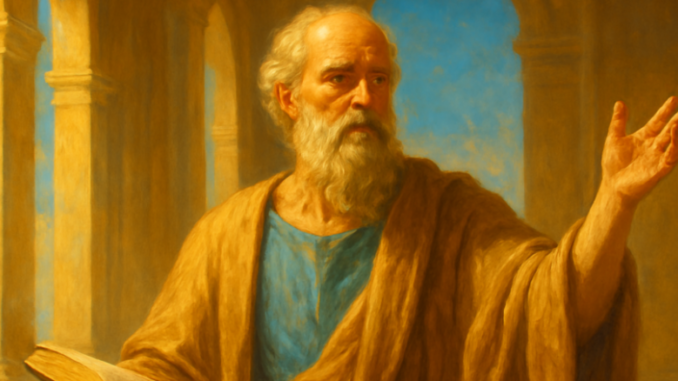
Picture yourself sitting in a circle with people you haven’t known for very long. Each person carries a different background, different beliefs, a different life story. And yet, something feels shared. Something connects you despite all the differences. This sense of unity amid diversity is precisely what Plato explored in his dialogue Parmenides — and it’s an experience that Freemasons around the world recognize instantly.
What Is Plato’s Parmenides Really About?
In the Parmenides, Plato stages a conversation between a young Socrates and the aged philosopher Parmenides of Elea. The central question is radical: how do the One and the many relate to each other? If one ultimate reality exists, how can the countless individual things in our world also exist? And conversely, if everything is multiple and different, what holds it all together?
Parmenides pushes Socrates through a series of thought experiments that dig ever deeper. The result isn’t a neat, ready-made answer — it’s an exercise in thinking itself. Plato demonstrates that truth cannot simply be grasped. You have to wrestle with it, keep asking questions, and accept that some paradoxes will remain unresolved.
The Practical Question: How Do You Live with Difference?
This might sound abstract, but the question touches your daily life directly. How do you engage with people who think differently? How do you connect with someone whose worldview seems completely at odds with your own? And more importantly, how do you discover that you still share something essential?
In Freemasonry, this is not a theoretical puzzle — it’s daily practice. A lodge brings together people of widely varying backgrounds, professions, religions, and political convictions. The challenge is to look beyond those surface-level differences and discover what connects us as human beings. Plato’s question about the One and the many becomes a concrete exercise in brotherhood.
Three Steps Toward Connection Despite Differences
What can you do, practically, to experience that sense of unity amid diversity? Here are three steps drawn from both Plato’s dialogue and Masonic practice:
1. Ask questions instead of passing judgment. Parmenides doesn’t interrogate Socrates to tear him down — he does it to dig deeper. Ask the person you’re speaking with why they hold a particular view. You’ll often discover that beneath differing opinions lie the same concerns and values.
2. Seek the common starting point. In the lodge, every conversation begins from shared values such as a love of truth and mutual respect. Name explicitly what you share before you address what differs. This creates a foundation for genuine exchange.
3. Accept that unity does not mean uniformity. The One in Plato’s philosophy is not flat sameness. It’s a deeper coherence that makes room for diversity. Connection doesn’t arise from erasing differences but from acknowledging them within a greater whole.
The Search for Truth as a Unifying Force
What binds Freemasonry and Plato’s philosophy together is the conviction that truth is not something you possess — it’s something you seek together. In the Parmenides, Socrates doesn’t emerge from the conversation as a victor. He is challenged to revise his own ideas. That’s not weakness; it’s strength.
True connection arises not in spite of our differences, but because we dare to search together for what transcends us.
In the lodge, this principle is given ritual form. The symbolism of light and darkness, of rough and polished stone, of individual labor and collective building — all of it points to the same tension between the many and the One. Each brother works on himself, but the goal is a temple no one can build alone.
Do You Recognize This in Your Own Life?
Think of a moment when, despite great differences, you felt genuinely connected to someone. Perhaps it was a conversation that turned unexpectedly deep. Or a shared experience that went beyond words. That moment touched on what Plato was pointing toward: the multiplicity of your backgrounds dissolved, if only briefly, into something larger.
Freemasonry provides a structure to seek out such moments intentionally — not as lucky accidents, but as regular practice. The rituals and conversations in the lodge are designed to confront you, again and again, with the question: what truly connects us? And how can I contribute to that connection?
From Plato to Everyday Practice
Plato wrote the Parmenides more than two thousand years ago, but the questions he raised are as relevant as ever. In an era of polarization and division, the art of finding unity without denying differences may be more urgent than it has ever been. Freemasonry doesn’t offer definitive answers, but it does offer a method: by searching together, by listening, by ritually reflecting on what connects us, we draw closer to the One that Plato envisioned.
The Parmenides invites you to look beyond visible differences. Behind the diversity of opinions, backgrounds, and personalities lies a deeper coherence. You don’t discover that coherence by debating who is right — you discover it by seeking together what is true.
Try it this week: in a conversation, ask one more question than you normally would. Listen to the answer as if it has something to teach you. And notice how that small step connects you to something greater than yourself.
Copyright text & image: devrijmetselaar.nl
Texts are based on the ideas and content of the author of devrijmetselaar.nl, reviewed, corrected, and supplemented with the assistance of OpenAI. Images are created based on the ideas of the author of devrijmetselaar.nl using OpenAI/DALL-E.

Be the first to comment