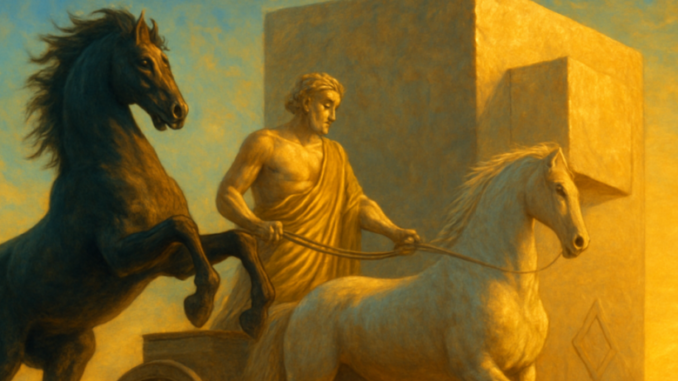
A charioteer grips the reins of two horses. One is fiery and untamable, the other calm and obedient. Only when the driver keeps both horses in balance can the chariot reach its destination. This image, drawn from Plato’s work, perfectly mirrors what the philosopher sets out in Book IV of The Republic about the human soul. For those familiar with Masonic values, a striking parallel emerges: the work on the rough ashlar turns out to be deeply connected to the ordering of forces within our own souls.
Plato’s Tripartite Soul
In The Republic, Plato identifies three distinct parts of the human soul: the rational part, the spirited part, and the appetitive part. The rational part seeks truth and wisdom. The spirited part craves honor and recognition. The appetitive part is drawn toward bodily pleasures and material satisfaction. Plato argues that justice within the soul arises when each part fulfills its proper function and reason takes command over the other two.
This is far from abstract theory. Plato describes something we all experience daily — the tension between what we know to be right, what our pride demands, and what our desires whisper to us. The philosopher invites us to recognize these inner voices and consciously orchestrate them. Here, his thinking touches on something Freemasons know well: the ideal of self-knowledge as the foundation for moral growth.
The Rough Ashlar and the Disordered Soul
In Freemasonry, the rough ashlar symbolizes the individual in his original, unworked state. The Entered Apprentice’s task is to shape this stone — to smooth its rough edges and gradually work toward a perfect cube that fits into the greater structure. This image takes on remarkable depth when placed alongside Plato’s analysis of the soul.
A disordered soul, one in which appetites reign supreme or where pride overshadows reason, resembles a rough stone full of irregularities. The process of self-perfection requires us to understand the different forces within ourselves, to acknowledge where they clash, and then to create order. Not through suppression, but through harmony. Plato would say: by giving each part its rightful place under the guidance of reason.
Justice as Inner Harmony
True justice is not an outward act but an inward condition — a harmony in which each part of the soul fulfills its proper role and reason serves as the compass.
Plato’s definition of justice differs from how we typically understand the concept. For him, justice is primarily an inner quality: the state in which the soul is in equilibrium. Only when someone is inwardly just can they act justly in the world. This resonates powerfully with the Masonic conviction that moral perfection begins with self-reflection. You cannot be a building block for society if your own foundation is unstable.
The Freemason who sits in silence reflecting on his conduct, examining his motives and working on his shortcomings, essentially follows the same path Plato charted for the philosopher. Both strive toward a state in which lower impulses are not denied but guided by a higher principle. The gavel and chisel then become more than tools for stone — they are symbols of the conscience that corrects and the will that shapes.
Brotherhood and the Ordered Community
Plato’s analysis of the soul cannot be separated from his vision of the ideal state. Just as the just soul experiences harmony among its parts, so too should a just community consist of individuals who each fulfill their proper role. Freemasonry shares a comparable structure: a lodge functions best when every member takes his responsibilities seriously — when the Apprentice learns, the Fellow Craft develops skill, and the Master Mason guides.
Yet the parallel runs deeper still. The brotherhood that Freemasons pursue is not superficial camaraderie but a bond rooted in shared values. When each member works on his own inner harmony, the collective is strengthened. The individual search for light and knowledge contributes to the enlightenment of all. Plato would recognize this immediately: the virtuous citizen makes the just state possible, and vice versa.
Reason as Compass and the Symbolic Light
In Freemasonry, light plays a central role. It represents knowledge, insight, and truth. The candidate who enters the lodge initially finds himself in darkness, gradually receiving more light as he progresses along his path. This symbolism aligns seamlessly with Plato’s conviction that reason must lead us toward the good and the true.
For Plato, the rational part of the soul is what enables us to behold the light of truth. When this part takes the lead, we no longer live in the shadows of our appetites or the illusions of our pride. We draw closer to reality. The Freemason who strives for more light chooses to sharpen his reason, to examine his prejudices, and to open himself to deeper understanding.
A Personal Reflection
Anyone who has experienced how sudden anger clouds the mind, or how a powerful desire distorts judgment, knows the reality of Plato’s tripartite soul firsthand. The challenge is not to deny these forces but to come to know them as parts of ourselves. The question then becomes: who holds the reins? Who sets the course?
Both Plato and the Masonic tradition point to the same truth: moral growth is not accidental development but a deliberate project. It demands daily attention — moments of silence in which we confront ourselves honestly. The square and compasses, the rough and perfect ashlar, the three parts of the soul: all of them are invitations to the same work — the work on yourself.
Plato’s vision of the soul and the Masonic path of self-improvement converge on a profound insight: true virtue is not about suppressing who we are, but about bringing our inner forces into conscious harmony. Whether we speak of the charioteer mastering his horses or the Mason shaping his rough stone, the message endures across millennia. The journey inward — guided by reason, sustained by discipline, and enriched by brotherhood — remains the most essential work any of us can undertake.
Copyright text & image: devrijmetselaar.nl
Texts are based on the ideas and content of the author of devrijmetselaar.nl, reviewed, corrected, and supplemented with the assistance of OpenAI. Images are created based on the ideas of the author of devrijmetselaar.nl using OpenAI/DALL-E.
Frequently Asked Questions
What is Plato's tripartite soul and how does it relate to Freemasonry?
Plato identifies three distinct parts of the human soul: the rational part (seeking truth and wisdom), the spirited part (craving honor and recognition), and the appetitive part (drawn toward bodily pleasures and material satisfaction). This concept parallels Masonic values by highlighting the importance of self-knowledge and moral growth. Just as Masons work on the rough ashlar to shape themselves, Plato invites individuals to consciously orchestrate these inner voices under the guidance of reason to achieve inner harmony and justice.
What does the rough ashlar symbolize in relation to Plato's philosophy?
In Freemasonry, the rough ashlar represents the individual in their unworked, original state. The Entered Apprentice's task is to shape and smooth this stone gradually toward perfection. This image parallels Plato's disordered soul—one dominated by appetites or pride without reason's guidance. Both symbols illustrate the process of self-perfection through understanding internal forces, acknowledging where they clash, and creating harmony rather than suppressing them.
How does Plato define justice, and why is it significant?
According to Plato, justice is not merely an outward act but an inward condition—a harmony in which each part of the soul fulfills its proper role under the guidance of reason. This definition is significant because it shifts the focus from external behavior to internal balance and self-ordering, making justice a personal, spiritual pursuit aligned with Masonic ideals of inner transformation and moral development.

Be the first to comment