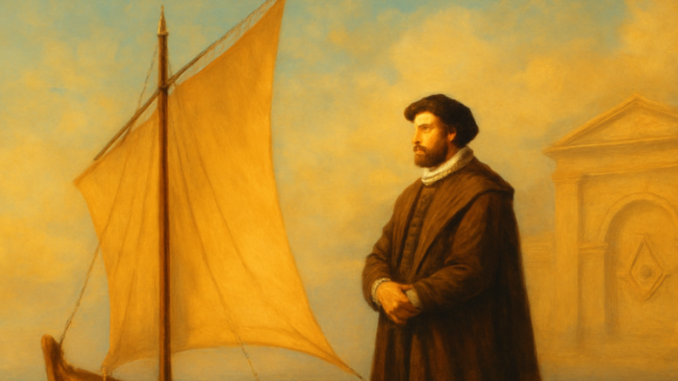
Two people witness the same event. One sees a disaster; the other sees an opportunity. Michel de Montaigne wrote about this very phenomenon in the sixteenth century, arguing that our perception of good and evil depends not on the facts themselves but on the opinions we hold about them. This idea touches on a fundamental question that also lies at the heart of Freemasonry: how do we arrive at moral judgment? And what connects the reflections of this French essayist to the search for light that Brethren have pursued for centuries?
The World Through Montaigne’s Eyes
Michel de Montaigne, the sixteenth-century French philosopher and writer, opens his essay with a simple but profound thesis: nothing is inherently good or evil. It is our mind that assigns value to the things around us. Banishment, which one person experiences as punishment, is embraced by another as liberation. Poverty drives some to despair, while others find genuine freedom in a life without possessions.
Montaigne drew heavily on the Stoic tradition, particularly the works of Epictetus and Seneca. But he went further than his predecessors by weaving this philosophy into personal experience and concrete examples from his own time. His approach was never abstract or purely academic — it was alive and deeply human. He didn’t ask: what does the doctrine say? He asked: what do I actually experience?
The World Through the Freemason’s Eyes
Within Freemasonry, there exists a similarly rich tradition of self-reflection and moral exploration. The Brother is not told what is good or evil in any absolute sense. Instead, he receives tools for his own spiritual labor. The square teaches him to examine his actions; the compasses remind him of the importance of measure and balance. But the judgment itself — the interpretation of what is right and what is crooked — remains with the individual.
The Freemason learns that truth is not imposed but sought. This connects seamlessly with Montaigne’s insight that our opinions color our reality. Where the outside world often seeks absolute answers, both the essayist and the Brother embrace uncertainty as the starting point for wisdom.
Where Both Traditions Meet
The parallels between Montaigne’s philosophy and the Masonic path are remarkable. Both traditions emphasize self-reflection as the foundation for moral growth. Both call for humility about one’s own knowledge and judgments. Both cultivate the ability to see things from multiple perspectives. And both recognize that inner freedom matters far more than outward circumstances.
Montaigne would have felt at home in a Lodge where the goal is not to debate who is right, but to seek deeper understanding together. His famous motto — “Que sçais-je?” (What do I know?) — reflects the same intellectual humility that a Freemason cultivates when he acknowledges that the perfect temple will never be fully completed.
The Freemason and Montaigne share the same conviction: it is not the world that must change to make us content, but our way of looking at it.
The Power of Perspective
Montaigne illustrates his thesis with stories of people who faced death with calm composure, while others crumbled at the slightest setback. The difference lay not in their circumstances but in their attitude. A Spartan mother, upon hearing that her five sons had been killed in battle, asked only whether Sparta had been victorious. Her perspective determined what she experienced as good and what she experienced as evil.
We find comparable symbolism in Freemasonry. The rough ashlar is not shaped by the outside world but by the Brother’s own labor. What appears as an obstacle to one person becomes raw material for refinement to another. Death itself, frequently symbolized in Masonic ritual, is not presented as an absolute evil but as part of a greater whole that the Brother learns to accept.
What This Comparison Teaches Us
The dialogue between Montaigne’s essay and Masonic philosophy reveals something essential about connection. Both traditions refuse to divide the world into simple categories. Both acknowledge that human experience is colored by our inner state. And both offer not ready-made answers but tools for thinking independently.
This may be the deepest connection of all: the conviction that moral perfection is not a destination but a process. Montaigne wrote his essays to understand himself. The Freemason enters the Lodge to work on himself. In both cases, the journey matters more than the arrival. The opinion we form today about good and evil may be refined tomorrow by new insights.
An Invitation to Ongoing Reflection
Montaigne wrote for himself, yet touched on universal themes in doing so. Freemasonry addresses the individual, yet builds Brotherhood through that very process. This apparent paradox reveals a deep truth: genuine connection arises not from uniformity of opinion but from a shared willingness to engage in honest self-examination.
Anyone who reads Montaigne’s Essays through a Masonic lens will recognize kindred tones. And anyone who approaches Freemasonry with the openness of Montaigne will discover a tradition that asks not for blind faith but for active participation in the eternal conversation about what it means to be a good person.
Michel de Montaigne and Freemasonry speak from different centuries and different traditions, yet their message resonates powerfully. Our perception of good and evil is not a fixed reality but the result of inner labor. This idea does not free us from responsibility — it deepens it. For if we determine how we see the world, then the key to transformation lies not outside us but within. And it is precisely there, in the dark chamber of self-reflection, that the real work begins — for the reader of Montaigne and the Freemason alike.
Copyright text & image: devrijmetselaar.nl
Texts are based on the ideas and content of the author of devrijmetselaar.nl, reviewed, corrected, and supplemented with the assistance of OpenAI. Images are created based on the ideas of the author of devrijmetselaar.nl using OpenAI/DALL-E.
Frequently Asked Questions
What is Montaigne's main argument about good and evil?
Montaigne argues that nothing is inherently good or evil. Instead, our perception of good and evil depends on the opinions we hold about things. Our mind assigns value to events and circumstances based on our perspective. For example, banishment may be experienced as punishment by one person and as liberation by another, demonstrating that the same event can be perceived very differently depending on one's viewpoint.
How does Montaigne's philosophy relate to Freemasonry?
Both Montaigne's philosophy and Freemasonry share a commitment to self-reflection and moral exploration. Neither imposes absolute answers about what is good or evil. Instead, both traditions provide tools for individuals to examine themselves and arrive at their own moral judgments. The Masonic tools (square and compasses) teach self-examination and balance, while Montaigne emphasizes personal experience and reflection as the path to wisdom.
What is the significance of the 'search for light' in Freemasonry according to this article?
The 'search for light' in Freemasonry represents the pursuit of truth and wisdom through self-reflection and moral growth. Similar to Montaigne's approach, Freemasons recognize that truth is not imposed but must be sought individually. This search connects to the broader Masonic principle that truth emerges through uncertainty and personal spiritual labor rather than through absolute doctrines or external authorities.

Be the first to comment