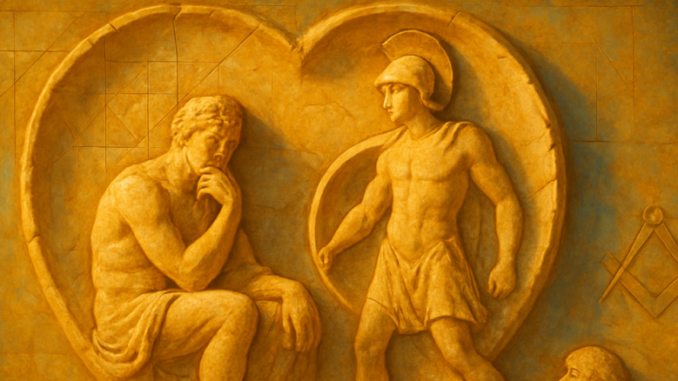
What truly drives a human being? Is it desire, reason, or something in between? These questions were posed by Plato more than two thousand years ago in Book IV of The Republic. His answers about the tripartite soul still form a philosophical bedrock for anyone engaged in the pursuit of self-knowledge and inner growth — and they resonate with particular force within traditions devoted to personal refinement, including Freemasonry.
Why Did Plato Divide the Soul into Three Parts?
Plato did not invent the question of what the soul is made of. Greek thinkers before him had already wrestled with the mystery of human behavior. Why do people sometimes act against their own best interests? Why do we experience inner conflict? Plato’s predecessors — most notably the Pythagoreans — had already speculated that the soul was something that needed to be purified and brought into order. Pythagoras viewed the cosmos as a harmonious whole in which numbers and proportions held the key to understanding. This cosmic harmony, he believed, should also be reflected within the individual soul.
Plato took this intuition and refined it. In Republic IV, he introduces his famous tripartite division: the rational part (logos), the spirited part (thumos), and the appetitive part (epithumia). This was no arbitrary classification — it was a response to a genuine philosophical problem. If the soul were one indivisible whole, how would you explain the fact that someone can feel thirst yet refuse to drink because the water is poisoned? There must be different forces at work within the soul, capable of opposing one another.
Which Thinkers Laid the Foundation for Plato’s Vision?
Beyond Pythagoras, Socrates played a decisive role. Although Socrates left no writings of his own, we know his ideas through Plato’s dialogues. Socrates was fascinated by the nature of virtue and whether virtue could be taught. He believed that no one does wrong willingly — whoever truly knows the good will do the good. Plato built upon this insight but also recognized a deeper complexity: knowledge alone is not enough. The soul must be properly ordered, with reason at the helm keeping the other parts in check.
Plato also drew from the Ionian natural philosophers, particularly Heraclitus, who spoke of the logos as a universal ordering principle. And the Eleatics — Parmenides above all — forced Plato to think carefully about the relationship between being and appearance, between the world of the senses and the world of pure forms. All of this culminated in Plato’s conviction that true knowledge lies not in the observable world but in the understanding of eternal forms, including the Form of the Good.
How Does the Tripartite Soul Fit into Broader Greek Philosophy?
Greek philosophy was deeply fascinated by order and measure. The word kosmos itself literally means “order” — the very opposite of chaos. The idea that the human soul is a microcosmic reflection of the greater order of the universe was widespread in the ancient world. Plato’s own student Aristotle would go on to develop his own theory of the soul, yet he too continued searching for that fundamental sense of structure and purpose.
Justice in the soul arises when each part fulfills its own function and does not take over the role of another.
This statement strikes at the very heart of Plato’s ethics. Justice is not an external law imposed from without — it is an inner condition. When reason leads, courage supports, and appetite obeys, harmony emerges. This ideal of inner ordering would reverberate through the centuries, from the Stoics to the Renaissance humanists and well beyond.
What Does This Have to Do with Freemasonry?
Freemasonry draws richly from classical philosophical sources, even though it is not a philosophical school in the strict academic sense. The emphasis on self-knowledge — the labor of transforming the “rough ashlar” into a “perfect ashlar” — mirrors precisely this Platonic ideal: inner order achieved through deliberate work upon oneself. The three degrees of Entered Apprentice, Fellow Craft, and Master Mason can be read as stages of development in which different aspects of the personality are engaged and refined.
Plato’s tripartite division resonates deeply with the Masonic principle that a person must learn to master lower impulses through wisdom and strength of will. The square and compasses, though symbols carrying their own rich layers of meaning, point toward measuring and ordering — toward bringing form to what is formless. This is precisely what Plato meant by justice: not the suppression of parts of the soul, but giving each part its rightful place.
Why Does Plato’s Theory of the Soul Remain Relevant?
In an age of constant stimulation and distraction, the call to inner order may speak more powerfully than ever. Plato’s analysis offers no ready-made solutions, but it does provide a framework for understanding why we struggle. Appetite grabs the wheel, emotions flare up, and somewhere in the background reason tries to make its voice heard. Recognizing this dynamic is the first step toward genuine change.
For those drawn to traditions of self-examination — Freemasonry chief among them — Plato’s Republic IV offers a philosophical anchor. It teaches us that the pursuit of harmony is not a modern self-help phenomenon but an ancient and honorable path. The question “Who am I, really?” gains profound depth when we realize it has been asked for two and a half millennia, and that every answer must be fought for anew in the arena of one’s own soul.
The philosophical lineage of Plato’s theory of the soul stretches from Pythagoras to Socrates, from cosmic harmony to personal virtue. His tripartite division is not an abstract theory but an invitation to self-knowledge. For Freemasons and all seekers alike, this message remains as relevant as ever: true justice begins within. It is the patient work of ordering — of giving each part of the soul what it is due — that ultimately leads to what Plato called the good life.
Copyright text & image: devrijmetselaar.nl
Texts are based on the ideas and content of the author of devrijmetselaar.nl, reviewed, corrected, and supplemented with the assistance of OpenAI. Images are created based on the ideas of the author of devrijmetselaar.nl using OpenAI/DALL-E.
Frequently Asked Questions
What are the three parts of Plato's tripartite soul?
According to Plato in Book IV of The Republic, the soul is divided into three parts: the rational part (logos), which governs reason and wisdom; the spirited part (thumos), which handles courage and emotion; and the appetitive part (epithumia), which drives desires and bodily needs. These three parts must work in harmony under the guidance of reason to achieve inner balance and virtue.
Why did Plato believe the soul needed to be divided into separate parts?
Plato divided the soul into three parts to explain the inner conflicts and contradictions in human behavior. He used the example of someone who feels thirst but refuses to drink poisoned water to demonstrate that different forces within the soul can oppose each other. If the soul were one indivisible whole, such internal conflicts would be impossible to explain.
How does Plato's tripartite soul connect to Freemasonry?
Plato's concept of the tripartite soul resonates strongly with Freemasonry's emphasis on personal refinement and self-knowledge. Both traditions view the pursuit of inner harmony and the proper ordering of the soul as central to human development. The philosophical framework Plato established about balancing reason, spirit, and desire forms a philosophical bedrock for those engaged in self-improvement and spiritual growth within Masonic practice.

Be the first to comment