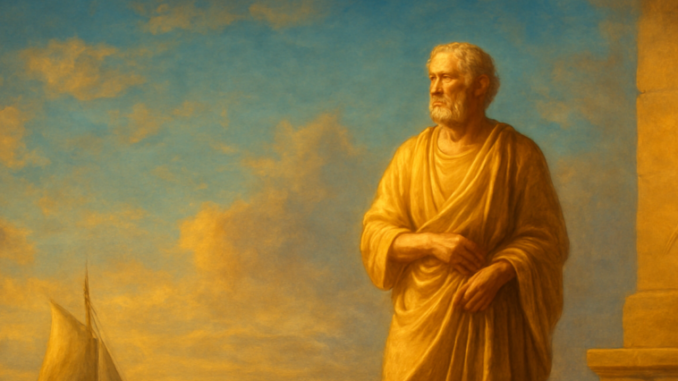
You may have felt it yourself — that strange moment at the end of a busy day when you wonder where the hours went. You did plenty of things, yet it feels as though you didn’t truly live any of them. Lucius Annaeus Seneca wrote about exactly this sensation nearly two thousand years ago in his celebrated essay on the shortness of life. But his ideas did not emerge from thin air. They were rooted in a rich philosophical tradition stretching back to ancient Greece. In this article, we trace those roots and discover why they still resonate so powerfully within Freemasonry today.
Stoicism as the Foundation
Seneca was a Stoic, and his essay is saturated with the core principles of this philosophical school. Stoicism, founded by Zeno of Citium around 300 BCE, revolved around a central conviction: we have no control over external circumstances, only over our response to them. It may sound like a truism, but the implications are far-reaching. If you genuinely accept that life is finite and that you have no power over its length, your attention naturally shifts toward the quality of each moment.
Seneca built upon the work of Chrysippus, the third leader of the Stoic school, who shaped Stoic logic and ethics into a coherent system. But where Chrysippus was primarily systematic and theoretical, Seneca was a practical philosopher. He did not write for academics — he wrote for ordinary people grappling with everyday questions. That is what makes his work so timeless, and so recognizable to anyone reflecting on what it means to live a good life.
The Shadow of Epicurus
What many people don’t realize is that Seneca regularly borrowed from a philosopher whom most Stoics regarded with suspicion: Epicurus. In his Letters to Lucilius, Seneca quotes the Greek thinker repeatedly and with undisguised admiration. Epicurus taught that the highest good consists of a state of inner tranquility, which he called ataraxia. The difference with the Stoics was subtle but essential: where the Stoics emphasized duty and virtue, Epicurus saw pleasure — understood as the absence of pain and disturbance — as the ultimate goal.
In his essay on the brevity of life, Seneca fuses both traditions. He argues that life is long enough if you spend it well. That is a Stoic argument about virtuous action, but the Epicurean element lies in his warning against pointless busyness. Seneca turns against those who fill their days with superficial occupations — precisely the kind of restlessness Epicurus also cautioned against. This synthesis makes the essay intellectually richer than a purely Stoic treatise would have been.
Aristotle and the Good Life
Even deeper in the philosophical soil of Seneca’s essay, we find the influence of Aristotle. The great Greek thinker introduced the concept of eudaimonia — often translated as “happiness” but better understood as human flourishing or the fulfillment of one’s potential. Aristotle argued that a good life is not simply a pleasant life, but one in which you fully develop your capacities in service to the community.
Seneca adopted this idea but gave it a far more urgent character. Where Aristotle had the leisure to philosophize calmly about the ideal city-state, Seneca wrote from within the political chaos of imperial Rome — first under Claudius, then under Nero. His call not to waste life is therefore no academic exercise but a cry from lived experience. He was exiled, threatened, and ultimately forced to take his own life. The transience of existence was not an abstract concept for Seneca; it was a daily reality.
The Roman Context: Cicero and the Ethics of Duty
Seneca did not operate solely within the Greek philosophical tradition. He was also an heir to Roman intellectual culture, particularly the work of Marcus Tullius Cicero. Cicero had brought Stoicism to Rome and translated it into Roman values such as pietas (devotion to duty) and virtus (moral courage). His treatise De Officiis, written as a letter to his son, stands as a direct precursor to Seneca’s own epistolary style.
What Seneca took from Cicero was the conviction that philosophy is not merely an intellectual pursuit but a way of life. Philosophy does not belong in an ivory tower. It belongs in the street, in the workshop, in the fabric of daily action. This principle would resurface centuries later in the work of Michel de Montaigne, who struck the same personal, searching tone in his famous Essais and named Seneca as one of his chief sources of inspiration.
What Freemasonry Learns from All This
You may be wondering what any of this has to do with Freemasonry. The answer lies at the very heart of the Masonic endeavor: self-knowledge and moral improvement. The Freemason is invited to work upon himself as upon a rough stone — not tomorrow, not someday, but now. That sense of urgency is precisely what Seneca means when he writes that life is not short; rather, we make it short by wasting it.
Life is long enough if you live it consciously. Seneca’s philosophy and Freemasonry share the same conviction: it is not the amount of time that matters, but what you do with it.
Within Masonic ritual, the awareness of mortality plays a vital role — not as a grim warning, but as an encouragement. It reminds the Brother that every moment is an opportunity to grow, to learn, and to serve. The philosophical roots of this awareness run through Seneca all the way back to Zeno, Epicurus, Aristotle, and Cicero. These are voices from a distant past that still speak with surprising clarity.
A Living Tradition
Philosophy is not a dusty archive. It is a living conversation that stretches across millennia. Seneca spoke with Epicurus and Aristotle across the centuries; Montaigne later spoke with Seneca; and Freemasonry, in its own symbolic language, continues this very same dialogue. Every time a Brother enters the Lodge and contemplates the great questions of life, death, and purpose, he joins a tradition that is as ancient as it is vital.
The brevity of life is not a cause for despair. It is, as Seneca and the Masonic tradition alike insist, an invitation — an invitation to stop drifting through your days and instead to live each one with intention, with virtue, and with an eye toward the enduring work of building something greater than yourself.
Seneca’s reflections on the brevity of life draw from the deepest wells of ancient philosophy — Stoicism, Epicureanism, Aristotelian ethics, and Roman civic thought. These ideas have not faded with time. They live on in Freemasonry’s call to self-improvement, in its ritual reminders of mortality, and in its conviction that a meaningful life is forged through conscious, purposeful action. The rough stone will not shape itself. The time to begin is always now.
Copyright text & image: devrijmetselaar.nl
Texts are based on the ideas and content of the author of devrijmetselaar.nl, reviewed, corrected, and supplemented with the assistance of OpenAI. Images are created based on the ideas of the author of devrijmetselaar.nl using OpenAI/DALL-E.



Be the first to comment