Imagine the world was created today. Imagine that all our memories, our history books, our fossil records and ancient manuscripts are nothing more than illusions — conjured into existence in this single moment of creation. It’s a thought that pulls the ground from beneath your feet, a question that destabilizes everything you think you know. And yet, this very disruptive question is one of the most powerful tools available to a thinking person.
The Question Mark as a Tool
In everyday life, we use question marks casually. We ask for directions, the time, the weather forecast. But there is another kind of question — one that doesn’t seek information but transformation. The philosopher René Descartes once subjected everything he believed to systematic doubt, until he arrived at his famous conclusion: “I think, therefore I am.” He wondered whether an evil demon might be deceiving him entirely about the nature of reality. It is no coincidence that precisely these kinds of radical questions laid the foundations of modern philosophy.
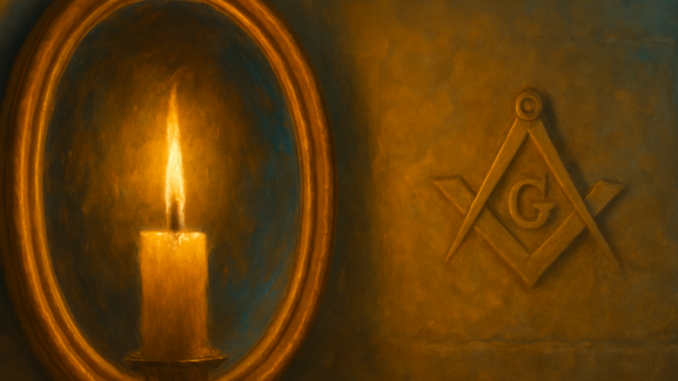
In Freemasonry, the question plays a distinctive and central role. The seeker who knocks at the door of the lodge arrives not with answers but with a question in the heart. The rituals are saturated with questions that do not call for factual responses but for inner movement. Why are you here? What do you seek? Who are you really? These are questions whose power lies not in the answer but in the very act of asking.
The Creation of Today
Let us take the thought seriously: what if everything only came into being today? The philosopher Bertrand Russell once entertained this idea, calling it the hypothesis of “apparent age.” If the world was created five minutes ago, complete with false memories and fabricated traces of a past that never existed, how would we ever know? The answer is: we couldn’t. There is no experiment, no observation, no logical argument that can definitively rule out this possibility.
The question is not the anteroom of the answer — it is the very house in which the seeker dwells.
This is not a nihilistic thought designed to relativize everything. It is an invitation to recognize how fragile our certainties are — and how precious at the same time. If our past could be an illusion, then it falls to us to create meaning in the present. Not as passive recipients of a given truth, but as active builders of purpose.
The Rough Stone and the Unanswered Question
In the symbolism of Freemasonry, the rough ashlar represents the unworked individual — full of imperfections and raw edges. The Mason’s task is to shape this stone, to refine it, to form it into something worthy of the greater structure. But what sets this process in motion? Not the answer — the question. The question “Who am I really?” is the first blow of the hammer upon the rough stone. Without that question, the stone remains untouched.
The Greek philosopher Socrates understood this better than anyone. He claimed to know nothing and merely asked questions. His method — maieutics, or the art of intellectual midwifery — was designed to help others give birth to their own insights. He did not see himself as a bearer of truth but as a catalyst for self-knowledge. The question was his tool, and with it he stirred all of Athens into reflection.
Illusion and Reality
If the past could be an illusion, what does that tell us about the nature of reality itself? The philosopher Immanuel Kant drew a distinction between the thing as it appears to us and the thing in itself. We never have access to naked reality — only to our perception of it. This is not cause for despair but for wonder. It means the world unfolds before us through our senses, our thinking, and our questions.
In the lodge, there is frequent reference to light and darkness. Light represents knowledge, insight, consciousness. But light does not ignite itself. It must be kindled. The question is the spark that sets the light aflame. Without the willingness to ask, the darkness remains undisturbed.
Living with the Open Question
There is a tendency in our culture to answer questions as quickly as possible and move on to the next matter. But some questions are not meant to be answered. They are meant to be lived with. The question of whether the world was created today is such a question. It solves nothing, but it opens everything. It invites humility about what we think we know, and courage to keep building nonetheless.
The poet Rainer Maria Rilke once wrote to a young poet that he should learn to love the questions themselves, as if they were locked rooms or books written in a foreign language. Live the questions, he advised, and perhaps someday, without noticing it, you will live your way into the answers. This is the posture of the seeker: not fixated on the destination, but filled with wonder about the journey.
The Question as Brotherhood
What unites Freemasons is not a shared answer but a shared search. In the lodge, people come together who are willing to explore the fundamental questions of existence without the pretense of possessing definitive answers. This humility creates space for genuine encounter. Where everyone claims to know, conflict arises. Where all are willing to ask, conversation begins.
The question of whether everything we know might be an illusion is ultimately an invitation to wakefulness. It reminds us that we are not passive recipients of a ready-made reality but active participants in the ongoing creation of meaning. Every day anew, with every question we dare to ask, we build upon the temple of our existence.
The question with which this article began remains unanswered. And perhaps that is exactly the point. Not every mystery demands a solution. Some questions exist to keep us awake, to remind us of the mysterious ground on which we stand. If the world began today, then today is all we have — and the questions we carry are the most honest stones we can lay in the temple we are building together.
Copyright text & image: devrijmetselaar.nl
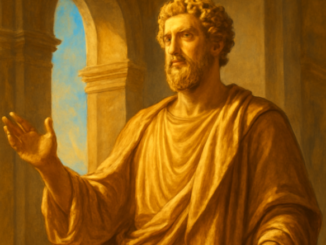
Texts are based on the ideas and content of the author of devrijmetselaar.nl, reviewed, corrected, and supplemented with the assistance of OpenAI. Images are created based on the ideas of the author of devrijmetselaar.nl using OpenAI/DALL-E.
Frequently Asked Questions
What is the significance of questions in Freemasonry?
In Freemasonry, questions serve as transformative tools rather than mere requests for information. Rituals are filled with profound questions like 'Why are you here?' and 'Who are you really?' that prompt inner reflection and personal growth. The power of these questions lies not in their answers, but in the act of asking itself, which sets the Mason on the path of self-discovery and refinement.
What does the rough ashlar (rough stone) represent in Masonic symbolism?
The rough ashlar symbolizes the unworked individual—full of imperfections and raw potential. A Mason's purpose is to shape and refine this stone into something worthy of contributing to a greater structure. This process of self-improvement is initiated by questioning oneself, which is the first and most important step in the Mason's journey of personal development.
How does Freemasonry encourage critical thinking?
Freemasonry embraces the philosophical tradition of questioning everything, much like Descartes and Socrates did, to arrive at deeper truths about oneself and reality. Rather than accepting information passively, Masons are invited to actively question their assumptions and beliefs, which transforms them from passive recipients of truth into active builders of meaning and purpose in their lives.
Why is it important to approach Freemasonry as a seeker with questions rather than answers?
A seeker who enters the lodge with questions rather than preconceived answers opens themselves to genuine transformation and inner movement. This receptive mindset allows individuals to engage meaningfully with Masonic teachings and symbolism, enabling personal growth and the development of wisdom that comes from honest self-inquiry.
Be the first to comment