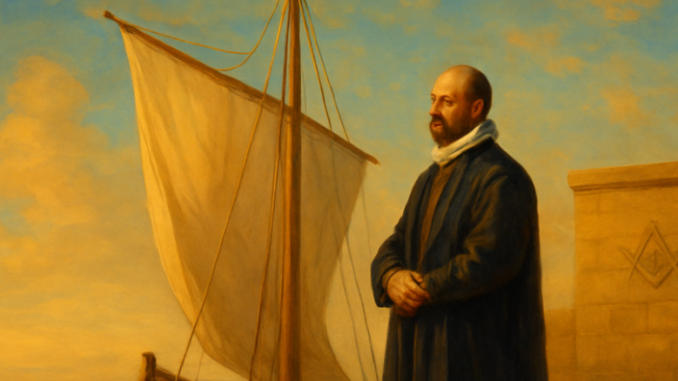
Somewhere around 1580, a man sits in a tower library in the Dordogne region of France. Surrounding him are the works of Seneca, Plutarch, and Lucretius, opened to passages about desire and deprivation. Michel de Montaigne reads, takes notes, and slowly begins an essay that poses a question still echoing through Masonic ritual centuries later: do we truly lack anything, or is it our own restlessness that creates the sense of shortage?
The Intellectual World of Sixteenth-Century France
When Michel de Montaigne composed his essays during the 1570s and 1580s, France was plunged into a period of profound religious and political division. The Wars of Religion between Catholics and Huguenots had shattered trust in absolute truths. It was precisely this crisis that drove Montaigne not to seek refuge in dogma, but in the wisdom of classical antiquity. His tower library held more than a thousand books, and the ceiling beams above his head were engraved with quotations from Sextus Empiricus, Lucretius, and the Bible. In that intellectual hothouse, the essay “That We Lack Nothing” was born — a text saturated with Stoic, Skeptic, and Epicurean influences.
Renaissance humanism had placed man at the center of philosophical inquiry, but Montaigne took things a step further. Where thinkers like Erasmus and Pico della Mirandola glorified human dignity, Montaigne questioned the human tendency toward arrogance. His essays are not triumphant hymns to reason but honest, groping explorations of human limitation. In that respect, he stood closer to the ancient Greeks than to his own contemporaries.
Stoic Roots: Seneca and the Art of Enough
The influence of Stoicism on this essay is unmistakable. Lucius Annaeus Seneca, the Roman philosopher and statesman, is one of Montaigne’s most frequently cited sources throughout his entire body of work. Seneca’s central insight — that we do not suffer from reality itself but from our judgment of reality — forms the philosophical foundation of Montaigne’s argument. When Montaigne writes that we lack nothing, he echoes Seneca’s famous proposition that poverty is not measured by possessions but by desire.
Yet Montaigne is no slavish follower of the Stoic school. Where the Stoics upheld a strictly rational ideal, Montaigne blended their insights with personal anecdotes and a healthy dose of self-deprecation. He adopted from Seneca the idea that nature provides man with everything he needs, but added his own observation: that we remain perpetually dissatisfied, not because nature fails us, but because our imagination plays tricks on us. This balance between philosophical rigor and personal honesty makes Montaigne remarkably accessible, even to modern readers — and especially to those on a Masonic path of self-knowledge.
Plutarch and the Mirror of Virtue
Alongside Seneca, Plutarch is a decisive influence on this essay. The Greek biographer and moral philosopher, whose “Lives” and “Moralia” were among Montaigne’s absolute favorites, offered a different perspective than the Stoics. Where Seneca abstracted and argued, Plutarch told stories. He presented virtue not as a theoretical ideal but as lived practice, illustrated through the concrete lives of Greek and Roman heroes. Montaigne admired this approach and adopted it. In “That We Lack Nothing,” he drew on examples from antiquity to demonstrate that peoples and individuals who lived with less were not poorer — they were often happier.
This is an insight that resonates deeply within the Masonic tradition. Freemasonry invites its members not to look outward for validation but inward. The work on the rough ashlar — the central image in Masonic ritual — is not about acquiring something new. It is about chiseling away the superfluous. Plutarch and Montaigne share this conviction: virtue does not lie in addition but in revelation, in uncovering what was already there beneath the excess.
Skepticism: The Power of Not-Knowing
The third great philosophical current feeding this essay is Pyrrhonian skepticism. Montaigne was profoundly influenced by Sextus Empiricus, whose works he studied intensively around 1576. Skepticism teaches that human beings have no access to absolute knowledge, and that the suspension of judgment — the so-called “epoché” — leads to inner peace. In “That We Lack Nothing,” Montaigne translates this into a practical attitude toward life: if we cannot know with certainty what we truly need, why exhaust ourselves chasing ever more?
Montaigne teaches us that the recognition of “enough” does not begin with what we possess. It begins with quieting the desire for what we do not need. This is not passive resignation but an active philosophical practice — one that requires the kind of sustained self-examination that Freemasonry also demands of its members.
This skeptical disposition also connects Montaigne to the Masonic quest. Freemasonry does not present itself as a system that provides answers but as a method that poses questions. The ritual offers no dogma; it offers a framework within which each individual Brother or Sister can arrive at their own insight. Montaigne’s famous motto, “Que sçay-je?” — What do I know? — would not look out of place above the entrance to many a Lodge.
Lucretius and Nature as Teacher
A less obvious but essential influence on this essay is Titus Lucretius Carus, the Roman poet-philosopher whose didactic poem “On the Nature of Things” is a masterful expression of Epicureanism. Lucretius argued that nature offers human beings everything necessary for a good life, and that fear of the gods and of death are the primary sources of human suffering. Montaigne shared this naturalistic outlook: in his essay, he observed that peoples living close to nature know no shortage of what truly matters. It is civilization, with its artificial needs and inflated expectations, that creates the feeling of lack.
Here too, philosophy touches the Masonic tradition in meaningful ways. The symbolism of Freemasonry is rooted in nature and craft — in stone, light, geometry, and the cycles of life. The Craft does not ask its members to transcend nature but to align themselves with it, to find the harmony that already exists in creation and to reflect it in their own character. Montaigne’s essay, nourished by Lucretius, reminds us that the most important truths are often the simplest: nature is generous, and the sense of scarcity is a product of the mind, not of the world.
The Philosophy of Enough and the Masonic Journey
What makes Montaigne’s essay so enduringly relevant for Freemasons is its refusal to offer easy answers. Drawing on Seneca’s Stoicism, Plutarch’s moral storytelling, Sextus Empiricus’s skepticism, and Lucretius’s naturalism, Montaigne constructs not a doctrine but a sensibility — a way of approaching life that values honesty over certainty, sufficiency over accumulation, and self-knowledge over external achievement.
The Masonic journey mirrors this approach in profound ways. From the moment a candidate enters the Lodge for the first time, they are invited to leave behind the metals — the external markers of status and wealth — and to begin a journey inward. The degrees of Freemasonry do not promise material gain or doctrinal certainty. They offer tools for reflection, symbols for contemplation, and a community of fellow seekers. In this sense, every Freemason who takes the Craft seriously is walking a path that Montaigne would have recognized: the path toward understanding what is truly enough.
Montaigne’s tower library may have been a solitary retreat, but the questions he asked there belong to all of us. The philosophy of enough — woven from Stoic discipline, Skeptic humility, and Epicurean trust in nature — is not a relic of the sixteenth century. It is a living practice, as relevant in the Lodge as it is in everyday life. When we stop chasing what we do not need and begin to see clearly what we already have, we are not diminishing ourselves. We are, in the deepest Masonic sense, working on the rough stone — shaping it not by adding, but by removing everything that conceals the form within.
Copyright text & image: devrijmetselaar.nl
Texts are based on the ideas and content of the author of devrijmetselaar.nl, reviewed, corrected, and supplemented with the assistance of OpenAI. Images are created based on the ideas of the author of devrijmetselaar.nl using OpenAI/DALL-E.

Be the first to comment