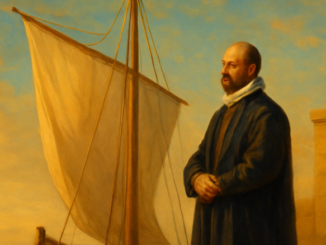
Tower library with ancient books evoking Montaigne and Masonic reflection
Michel de Montaigne – Philosophical Background

Montaigne and the Philosophy of Enough: Stoic and Skeptic

Somewhere around 1580, a man sits in a tower library in the Dordogne region of France. Surrounding him are the works of Seneca, Plutarch, and Lucretius, opened to passages about desire and deprivation. Michel de Montaigne reads, takes notes, and slowly begins an essay that poses a question still echoing through Masonic ritual centuries later: do we truly lack anything, or is it our own restlessness that creates the sense of shortage? The Intellectual World of Sixteenth-Century France When Michel de Montaigne composed his essays during the 1570s and 1580s, France was plunged into a period of profound religious and political division. The Wars of Religion between Catholics and Huguenots had shattered trust in absolute truths. It was precisely this crisis that drove Montaigne not to seek refuge in dogma, but in the wisdom of classical antiquity. His tower library held more than a thousand books, and the ceiling beams above his head were engraved with quotations from Sextus Empiricus, Lucretius, and the Bible. In that intellectual hothouse, the essay “That We Lack Nothing” was born — a text saturated with Stoic, Skeptic, and Epicurean influences. Renaissance humanism had placed man at the center of philosophical inquiry, but Montaigne took […]
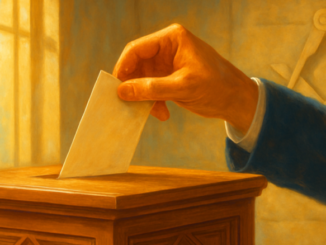
Symbolic representation of elections and Masonic self-reflection
Personal Development & Leadership

Complex Elections and Personality: Two Worlds Compared

As the world braces for what many consider the most complex elections in modern history, a fascinating question emerges: what does the way we vote reveal about who we truly are? The outside world sees elections as a democratic mechanism — a practical necessity. The Freemason recognises something deeper: a mirror of human personality, with all its contradictions and possibilities for growth. The Outsider’s View: Complexity as Obstacle For the average observer, complex electoral systems are above all confusing. Multiple parties, coalition-building, rounds of voting, electoral thresholds, and regional representation make it difficult to understand what a single vote actually means. The focus remains firmly on outcomes: who wins, who loses, which coalition emerges. The person behind the vote stays invisible, reduced to a statistical data point. In this worldview, the voter is a passive participant in a system larger than themselves. Complexity is treated as a problem to be solved, not as an invitation to reflect. People search for simple answers in a world that stubbornly refuses to be simple. Political commentators analyse voting behaviour as though it should be predictable, while the true motivations of millions of individuals remain elusive. The Freemason’s View: Choosing as an Inner Process […]