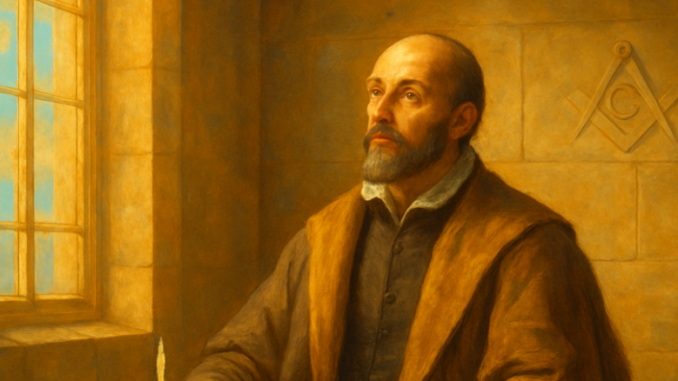
When Michel de Montaigne wrote his fifteenth essay on the punishment of cowardice, he touched upon a question that has occupied philosophers for centuries. What makes cowardice such a grievous vice that some societies punished it with death? To truly understand Montaigne’s reflections, we must descend into the philosophical wellsprings from which he drew: the Stoics, the Greek moral philosophers, and the humanist tradition of his own era. In exploring the intellectual background of his thought, we discover not only the roots of his argument but also why these questions still resonate deeply within any brotherhood that places virtue at its center.
The Stoic Legacy: Courage as a Cardinal Virtue
Montaigne’s thinking about cowardice and courage is deeply rooted in the Stoic tradition. Seneca, whom he read extensively and quoted often, regarded courage as one of the four cardinal virtues — inseparably linked to wisdom, justice, and temperance. For the Stoics, cowardice was not merely a lack of physical bravery; it was a fundamental disturbance of the soul. To flee from danger was ultimately to flee from oneself.
Marcus Aurelius wrote in his Meditations that a person must align his actions with nature and reason. From that perspective, cowardice was a form of irrationality: it placed personal survival above duty and honor. Montaigne absorbed this idea but added his characteristic nuance. He asked whether cowardice was truly a choice, or rather an involuntary reaction of body and mind over which a person had limited control.
Plutarch and the Moral Storytelling Tradition
Another vital source for Montaigne was Plutarch, whose Lives and Moralia he treasured. Plutarch told stories of great men who stood firm at decisive moments — or failed. This anecdotal approach to morality appealed greatly to Montaigne. Rather than offering abstract definitions, Plutarch provided concrete examples of courage and cowardice in action.
The Greek biographer showed that cowardice was often more complex than it appeared. Some commanders who fled in battle demonstrated great courage elsewhere. Others who died heroically had known moments of weakness earlier in their lives. This nuanced perspective fit perfectly with Montaigne’s own skeptical attitude toward absolute moral judgments. It also offers a valuable lesson for those of us who seek to judge character: a single moment does not define the whole of a man.
Cowardice is not the absence of fear, but the failure to act according to what virtue demands despite that fear.
Renaissance Humanism and the Revaluation of Man
Montaigne wrote during an age when humanism placed human dignity and the capacity for self-improvement at the forefront of intellectual life. Thinkers like Erasmus and Pico della Mirandola had sketched a new image of humanity: the human being as a creature capable of shaping itself, of refining its character through study and reflection. Cowardice did not fit within this ideal of the cultivated person.
Yet Montaigne was no naive optimist. His Pyrrhonist doubt, influenced by the ancient Greek skeptics, made him cautious about absolute pronouncements on human virtue. Could someone who fled in panic truly be held responsible for a reaction that perhaps ran deeper than conscious choice? His essay on the punishment of cowardice wrestles with precisely this tension between moral expectation and human reality — a tension that anyone engaged in serious self-examination will recognize.
The Military Context of the Sixteenth Century
We cannot understand Montaigne’s essay without the context of the Wars of Religion that tore France apart. Montaigne himself served as both a military man and as mayor of Bordeaux during a period of civil war and brutal violence. The question of how cowardice should be punished was not an academic matter but an urgent practical problem. Soldiers who fled could seal the fate of an entire army.
At the same time, Montaigne had witnessed how war brought out the worst in people. His essay reflects the tension between the necessity of military discipline and the recognition that war itself drove men to acts unthinkable in peacetime. The punishment for cowardice — sometimes death — seemed disproportionate to him when he considered the full complexity of human behavior under extreme duress.
Aristotle and the Golden Mean
Behind much of Montaigne’s moral reasoning we can detect the influence of Aristotle. In the Nicomachean Ethics, Aristotle defined courage as the mean between cowardice and recklessness. True courage was not the absence of fear but the ability to act rightly despite it. The coward allowed fear to dominate; the reckless person ignored it entirely. Both lacked the wisdom of the proper middle ground.
Montaigne valued this nuanced approach. He acknowledged that courage could take many forms and that what was courageous in one situation might be reckless in another. This flexibility in moral judgment characterizes his entire body of work and makes his essays relevant to this day for anyone who reflects seriously on character and virtue — whether in a lodge room or in the quiet of private contemplation.
Symbolic Depth: Cowardice as a Mirror of the Soul
When we read Montaigne’s essay symbolically, cowardice emerges as more than a military or moral failure. It becomes a mirror in which a person is confronted with his deepest fears and weaknesses. The flight from danger symbolizes the flight from self-knowledge — from the confrontation with who we truly are when everything is at stake.
In this symbolic layer, Montaigne’s thinking connects with traditions that place the inner journey at their heart. The rough ashlar that must be hewn into a perfect cube represents precisely this process: the willingness not to flee from one’s own imperfections but to face them squarely and work upon them. Cowardice, in this sense, is the refusal to take up the hammer and chisel — the rejection of the task of self-refinement.
For the Freemason, this symbolism carries particular weight. The working tools are not given to us as ornaments but as instruments of transformation. To use them requires courage: the courage to look honestly at the rough stone of our own nature, to acknowledge the flaws, and to persist in the labor of improvement even when the work is painful. Montaigne, though he wrote centuries before modern Freemasonry took shape, understood this principle intuitively. True cowardice lies not in a moment of weakness on the battlefield, but in the sustained refusal to engage with the work of becoming a better person.
Montaigne’s essay on the punishment of cowardice is far more than a simple moralistic tract. It is a rich meditation nourished by centuries of philosophical thought — from the Stoics and Aristotle to Plutarch and the Renaissance humanists. Its enduring power lies in its refusal to offer easy answers. Instead, it invites us to examine our own relationship with fear, duty, and moral growth. For those who walk a path of self-improvement and brotherhood, Montaigne’s questions remain as vital as ever: not whether we have known fear, but whether we have had the courage to face ourselves honestly and continue the work of shaping the rough stone into something worthy of the temple we are building together.
Copyright text & image: devrijmetselaar.nl
Texts are based on the ideas and content of the author of devrijmetselaar.nl, reviewed, corrected, and supplemented with the assistance of OpenAI. Images are created based on the ideas of the author of devrijmetselaar.nl using OpenAI/DALL-E.
Frequently Asked Questions
What is the main focus of Montaigne's essay on cowardice?
Montaigne's fifteenth essay examines cowardice as a serious vice and explores the philosophical question of what makes it worthy of severe punishment in some societies. He investigates whether cowardice is a deliberate choice or an involuntary reaction of body and mind, drawing on philosophical traditions from the Stoics, Greek moral philosophers, and humanist thinkers of his era.
How did the Stoic philosophers influence Montaigne's understanding of courage and cowardice?
Montaigne drew heavily from Stoic thinkers like Seneca and Marcus Aurelius, who viewed courage as one of the four cardinal virtues. The Stoics saw cowardice not merely as physical timidity, but as a fundamental disturbance of the soul and a form of irrationality that places personal survival above duty and honor. However, Montaigne added his own nuance by questioning whether cowardice was truly a choice or an involuntary reaction beyond personal control.
Why did Montaigne value Plutarch's approach to teaching about morality?
Montaigne appreciated Plutarch's anecdotal method of moral storytelling through the Lives and Moralia, which provided concrete examples of courage and cowardice in action rather than abstract definitions. Plutarch's nuanced accounts showed that cowardice was complex—some military commanders who fled in battle showed courage elsewhere, and great heroes had experienced moments of weakness. This aligned with Montaigne's skeptical view that a single moment does not define a person's entire character.


Be the first to comment