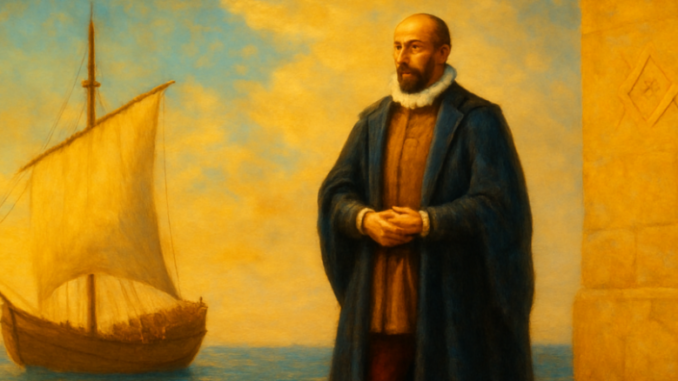
What if our deepest convictions are nothing more than habits, worn into us by time and culture? In his essay on custom and convention, Michel de Montaigne poses an uncomfortable question that strikes at the heart of human connection: how can we truly live together when each of us is trapped in the web of our own traditions? Written in the sixteenth century, this question proves remarkably relevant for anyone who reflects on a brotherhood that transcends borders.
The Paradox of the Familiar
Montaigne opens with an observation that is at once simple and deeply unsettling: we regard whatever is unfamiliar to us as barbarous. The Greek calls the Persian a barbarian; the Persian does the same to the Greek. Both are utterly convinced that their own customs represent the standard of civilization. Here lies a paradox that Montaigne explores with undisguised curiosity — the familiar feels self-evident, but only because we happened to grow up with it.
This insight resonates deeply with Freemasonry, which from its very origins has brought together men of different religious and cultural backgrounds. In the lodge, men meet who might never have crossed paths outside its walls. The question Montaigne raises is the same question that must be implicitly answered in every lodge: can we see beyond our learned prejudices?
Custom as a Veil Over the Mind
Montaigne warns that custom forms a veil preventing us from seeing clearly. What we consider natural is often merely culturally determined. He offers countless examples — eating habits, clothing, forms of greeting, marriage rituals. Every people believes its way is the right one, while elsewhere that same way may be considered absurd or even reprehensible. The veil of habit is so dense that we rarely even notice it.
Freemasonry employs a strikingly similar concept: the search for light. This light does not refer solely to knowledge in the abstract, but to the ability to see through the veils of prejudice and ignorance. The candidate who first enters the lodge is symbolically blindfolded. When that blindfold is removed, a process of seeing begins — one that extends far beyond the physical. It is an invitation to continually examine one’s own assumptions.
True connection does not arise despite our differences, but through the willingness to recognize those differences as equally valid expressions of the human endeavor.
The Counterweight: Are All Customs Equal?
Here an important counterpoint presents itself. If every custom is merely culturally determined, do we not slide into a boundless relativism where nothing holds value anymore? Montaigne seems to anticipate this problem. He does not claim that all customs are morally equivalent. Rather, he invites us toward humility about our own position. The person who regards his own habits as absolute lacks the wisdom to truly learn from others.
Freemasonry makes a subtle distinction here. It does not ask its members to abandon their own convictions, but it does ask that they refrain from judging others on the basis of differing practices. The brotherhood is not a melting pot in which all differences dissolve, but a workshop in which difference is made productive. Members come together not in spite of their backgrounds, but with them.
Self-Reflection as the Foundation of Brotherhood
At its core, Montaigne’s essay is an exercise in self-reflection. By studying the customs of others, he learns something about himself. This is not a narcissistic impulse but a form of intellectual humility. The question “why do I do this?” turns out to be far harder to answer than “why does the other person do that?” Our own behavior becomes visible as a choice, not a law of nature.
In Freemasonry, self-reflection is a central value. The rough ashlar that the Mason works upon is a metaphor for the unrefined self. The labor consists not of changing the world, but of chipping away at one’s own imperfections. Montaigne would have recognized this immediately: self-knowledge is the precondition for genuine connection with others. Those who do not know themselves merely project onto the other.
Customs as Bridges, Not Walls
Where Montaigne begins with customs as dividing walls, his argument ends with an opening. It is precisely the awareness that our habits are relative that makes genuine encounter possible. When I acknowledge that my way is not the only right one, I can approach the other without a sense of superiority. This is not weakness — it is strength. It takes courage to release the familiar and approach the unfamiliar with good will.
Freemasonry institutionalizes this principle. Ritual creates a shared language that transcends individual backgrounds. The symbols are universal enough to allow different interpretations, yet specific enough to provide a common frame of reference. In this way, customs are not abolished but transformed into bridges.
Montaigne does not leave us with a definitive answer — and that is entirely fitting for a thinker whose thought is always in motion. The question he raises remains relevant: can we ever fully escape the veil of our own customs? Or is the best we can achieve a constant vigilance, a willingness to test our assumptions again and again against the experience of others? For the Freemason, this is no academic matter. It is the daily practice of the lodge, where brethren with different convictions come together in shared ritual. The question is not whether we should abandon our customs. The question is whether we are willing to recognize that the customs of others are as deeply rooted as our own. In that recognition lies the possibility of true connection. Montaigne offers no instruction manual in his essay on custom — he offers a mirror. And whoever looks into it sees not only the strangeness of others, but above all, the strangeness of the self.
Copyright text & image: devrijmetselaar.nl
Texts are based on the ideas and content of the author of devrijmetselaar.nl, reviewed, corrected, and supplemented with the assistance of OpenAI. Images are created based on the ideas of the author of devrijmetselaar.nl using OpenAI/DALL-E.
Frequently Asked Questions
How does Montaigne's concept of custom relate to Freemasonry?
Montaigne argues that our deepest convictions are often habits worn into us by culture, and that we regard the unfamiliar as barbarous. Freemasonry addresses this by bringing together men of different religious and cultural backgrounds in the lodge, implicitly asking whether members can see beyond learned prejudices. The Masonic search for light mirrors Montaigne's idea of removing the veil of custom that prevents clear seeing.
What does Montaigne mean by custom forming a 'veil over the mind'?
Montaigne contends that what we consider natural or self-evident is often merely culturally determined. This veil of habit is so dense that we rarely notice it, making us believe our own customs represent the standard of civilization while viewing others as absurd. Freemasonry symbolically addresses this through the blindfold worn by candidates, which when removed initiates a process of seeing through prejudice and examining one's own assumptions.
How can Freemasonry help overcome the prejudices Montaigne describes?
Freemasonry creates spaces where men from different backgrounds meet who might never cross paths otherwise. The brotherhood operates on the principle that true connection arises not despite differences, but through the willingness to recognize those differences as equally valid expressions of the human endeavor. This directly addresses Montaigne's central question about how we can truly live together when trapped in our own traditions.

Be the first to comment