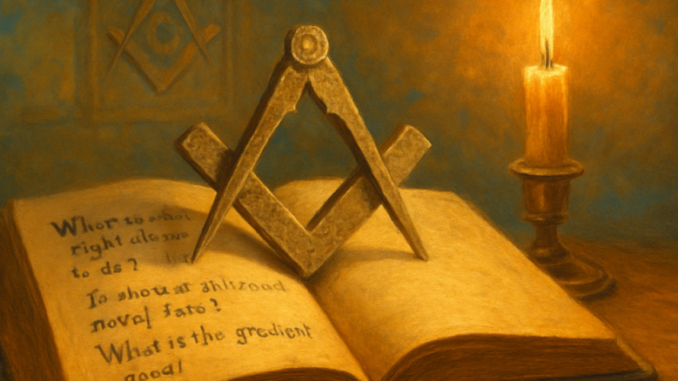
In an age where ethical debates are increasingly reduced to rigid positions and online discussions devolve into moral tribunals, a pressing question emerges: is there still room for nuanced thinking about right and wrong? Freemasonry offers a surprising answer — not by prescribing ready-made rules, but by practicing an ancient philosophical method in which doubt is not a weakness, but the first step toward wisdom.
The Return of the Great Ethical Conversation
The societal debate about ethics has reached a new intensity. From artificial intelligence to climate justice, from genetic modification to the boundaries of free speech — moral convictions clash at every turn. What stands out is not so much the diversity of opinions, but the absolute certainty with which they are proclaimed. Nuance has become a rare commodity.
Yet there is a place where the ethical conversation unfolds differently. Within the privacy of the Masonic lodge, the goal is never to have the final word, but to reach the next insight. Here, philosophy is not practiced as an academic discipline but as a living art. The question is not who is right, but what does justice to human dignity.
Philosophy as a Tool, Not a Doctrine
Freemasonry has no ethical handbook. There is no list of commandments or prohibitions that members must follow. Instead, brothers and sisters are invited to think for themselves, to question, and to grow. The symbols found in the lodge — the square and compasses, the rough and perfect ashlar — serve as philosophical instruments. They invite reflection without dictating the answer.
“Know thyself, and thou shalt know the universe and the gods.”
This ancient maxim from the Temple of Delphi lies at the heart of Masonic philosophy. Ethics does not begin with judging others but with examining one’s own conduct. The primary question is not “what is right?” but rather: “Am I acting in accordance with my deepest values? And do I have the courage to question those values?”
Three Philosophical Traditions Within the Lodge
Several philosophical traditions converge within Freemasonry. They are not seen as contradictory but as complementary perspectives on human existence. This makes the lodge a uniquely fertile ground for ethical exploration.
The Socratic Method
Like Socrates in the streets of Athens, Freemasons ask questions — not to provoke, but to understand. In ritual lectures and discussions, assumptions are challenged. Why do we think what we think? What foundations underlie our convictions?
The Stoic Art of Living
From Marcus Aurelius to Epictetus, Stoic philosophy resonates deeply within Freemasonry. The distinction between what we can control and what we cannot, the emphasis on inner tranquility amid external chaos, the pursuit of virtue for its own sake — these principles find a powerful echo in the Masonic commitment to self-improvement.
Enlightenment Philosophy
Modern Freemasonry emerged in the eighteenth century, at the height of the Enlightenment. The belief in reason, the value of tolerance, and the conviction that human beings can better themselves through knowledge and reflection — these are core values that continue to shape lodge life to this day.
Ethics in Dialogue: The Lodge as a Laboratory
What sets Freemasonry apart from other philosophical traditions is its emphasis on dialogue as practice. In the lodge — which is fittingly also called a “workshop” — people from vastly different backgrounds come together. Believers and atheists, progressives and conservatives, scientists and artists. They do not necessarily share the same views, but they share a common disposition: the willingness to listen and to be taught.
Several guiding principles shape this dialogue:
- Every viewpoint deserves honest examination.
- Truth unfolds in conversation, not in monologue.
- Respect for others is a prerequisite for self-knowledge.
- Doubt is not a deficiency — it is a virtue.
These principles do not constitute an ethical system in the traditional sense. Rather, they offer a method — a way of being in the world that makes it possible to continually reconsider what right action truly means. In a society growing ever more polarized, this disposition may be more valuable than any moral prescription.
The Stone That Is Never Finished
One of the central symbols in Freemasonry is the rough ashlar — the unworked stone. It represents the individual at the beginning of their journey: raw, full of potential, but also full of imperfections. The Freemason’s task is to gradually shape this stone, to polish it, to refine it. But — and this is crucial — the stone is never finished. There is always a new angle to examine, a new roughness to smooth.
This image perfectly illustrates the Masonic view of ethics. Moral perfection is not a destination but a direction. The goal is not to arrive at a state of flawlessness, but to engage in the ongoing process of reflection, correction, and growth. In this understanding, failure is not a disgrace — it is an indispensable part of the journey.
In a world that craves simple answers, Freemasonry offers something different: an invitation to sustained philosophical reflection. Ethics here is not a matter of being right, but of searching honestly. It is a path walked together, with the understanding that the destination is never fully reached — but that the journey itself shapes the person. Perhaps that is exactly what we need in this era of moral confusion: not more certainties, but the courage to keep asking questions.
Copyright text & image: devrijmetselaar.nl
Texts are based on the ideas and content of the author of devrijmetselaar.nl, reviewed, corrected, and supplemented with the assistance of OpenAI. Images are created based on the ideas of the author of devrijmetselaar.nl using OpenAI/DALL-E.
Frequently Asked Questions
Does Freemasonry require members to follow a specific set of moral rules or commandments?
No, Freemasonry has no ethical handbook or list of commandments that members must follow. Instead, Freemasons are invited to think for themselves, question their beliefs, and grow through philosophical exploration. The lodge uses symbols like the square and compasses as philosophical instruments to encourage reflection rather than dictate answers.
How does Freemasonry approach ethical debates differently than mainstream society?
Within the lodge, the goal is not to declare a final answer or prove who is right, but to reach the next level of insight through nuanced discussion. Rather than advancing rigid positions, Freemasons practice the ancient Socratic method, asking questions to challenge assumptions and deepen understanding of complex moral issues.
What philosophical traditions influence Masonic ethics?
Freemasonry draws from three complementary philosophical traditions: the Socratic method of questioning assumptions, Stoic philosophy's focus on virtue and self-improvement, and Enlightenment ideals emphasizing reason and personal growth. These traditions work together to create a unique environment for exploring ethics without dogma.
Is doubt acceptable in Freemasonry, or must members have absolute faith?
Doubt is not only acceptable in Freemasonry—it is valued as the first step toward wisdom. Rather than requiring absolute certainty, the fraternity encourages members to question their values and convictions, understanding that self-examination and intellectual curiosity are essential to ethical development and personal integrity.


Be the first to comment