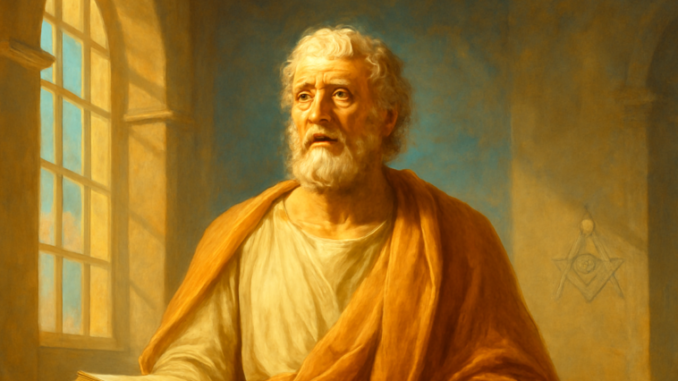
There comes a moment when the cheeks flush without permission. A wave of heat rises through the face, as uncontrollable as the tide. In his eleventh letter to Lucilius, the Stoic philosopher Seneca examines this remarkable phenomenon — the blush of shame. But beneath this physical reaction lies a far deeper inquiry: one about the nature of virtue, the inner voice that guides our conduct, and the presence of a wise witness within our minds. What does this blushing reveal about who we truly are?
The Involuntary Blush as a Mirror of the Soul
Seneca opens his letter with an observation that is both simple and profound: even the most seasoned orators can blush when they stand before a crowd. Even those accustomed to public performance sometimes feel that irresistible warmth rising to their faces. This is not a weakness, the Stoic philosopher insists, but a quality of nature that even the wisest person cannot entirely suppress.
The body has its own language — a language that does not always obey the commands of reason. The blush reveals something essential about our humanity: that we are not purely rational beings, but also creatures of flesh with reactions rooted deep within our nature. The shame that manifests as blushing is like a crack in the mask we so often present to the world. It is a reminder that beneath the polished exterior, something authentic still stirs.
The Inner Witness and the Power of Exemplars
The beating heart of Letter 11 lies in Seneca’s counsel to always live as though someone is watching. He advises Lucilius to keep a wise teacher in mind — an inner witness before whom one would not wish to feel ashamed. This figure could be a historical character such as Cato, Laelius, or any person whose moral character serves as a beacon. The mere thought of such a person has a purifying effect on our actions.
Live always as though a wise master observes your conduct, for the presence of a virtuous example keeps the soul in check.
This principle of the inner witness forms a cornerstone of Stoic ethics. It is not the fear of being judged by others that should guide us, but the standard we set for ourselves by measuring our conduct against great souls. The shame we feel when we fall short of that standard is a sign of moral health, not of frailty. For the Freemason, this idea resonates powerfully — the concept of conducting oneself with integrity even when no lodge is in session, even when no Brother stands beside you.
Moral Nobility as Inner Architecture
In this letter, Seneca introduces a concept we might translate as moral nobility — an aristocracy of character that has nothing to do with birth, wealth, or social standing. This inner nobility is comparable to the foundations of a well-built structure: invisible to the casual observer, yet absolutely essential to the strength and stability of the whole.
The Stoic philosopher emphasizes that this nobility requires deliberate cultivation. Just as a skilled craftsman maintains his tools and continually hones his abilities, so must the student of wisdom work daily on his character. The exemplars one chooses to follow, the thoughts one permits to take root, the actions one performs in quiet moments when no one is watching — all of these contribute to the construction of inner nobility. It is an architecture built not of stone and mortar, but of discipline, self-awareness, and persistent moral effort.
The Rough Stone and the Labor of Self-Improvement
From a symbolic perspective, Seneca’s insights connect beautifully with the ancient image of the rough ashlar — the unworked stone that must be shaped and refined. In traditional building arts and in the philosophical traditions preserved within Freemasonry, the rough stone represents the individual in his unpolished state: full of sharp edges, irregularities, and imperfections. The labor of chiseling and smoothing that stone represents the ongoing work of character development.
The shame Seneca describes functions in this metaphor as the blow of the chisel that exposes an unwanted protrusion. It is a painful but invaluable moment of recognition. Without this sense of shame, without that inner witness confronting us with our shortcomings, there would be no impulse to keep refining — no drive to bring the stone closer to its ideal form. Every Mason who has contemplated the rough ashlar will recognize this truth: discomfort is not the enemy of progress; it is its prerequisite.
Practical Applications of Seneca’s Wisdom
What can we take from Letter 11 and apply to our own lives? Seneca offers several concrete practices that remain remarkably relevant today:
Choose a wise figure as your inner guide — someone whose judgment you take seriously and whose character you admire. This could be a philosopher, a mentor, or a historical figure whose life embodies the values you aspire to.
Act as though this person is always present when you make decisions. Would you still make the same choice if Cato were standing beside you? If your most respected mentor were watching?
Regard feelings of shame not as an enemy, but as a teacher. Shame, rightly understood, is a moral compass pointing toward growth. It tells you that you still care about something higher than convenience or applause.
Accept that certain bodily reactions lie beyond your control. Blushing, trembling, a quickened heartbeat — these belong to the domain of nature, not of will. Do not waste energy fighting what you cannot change.
Direct your energy toward what is within your power: your character, your choices, your responses to circumstance. This is the true arena of moral life.
These practical Stoic exercises are timeless. They require no special circumstances, no expensive tools — only the willingness to look honestly at yourself and the courage to keep working on who you are.
The Blush as Evidence of Moral Life
Ultimately, Seneca redeems what is often dismissed as weakness. The blush of shame is not a deficiency but a sign that something within us still cares about virtue — that we aspire to something higher than comfort or approval. It is proof that we have not yet become entirely hardened, that the voice of conscience still echoes within.
In a world that often rewards brazenness and shamelessness, this sensitivity to moral discomfort may be rarer and more precious than we realize. It is, to borrow Leonard Cohen’s luminous phrase, the crack where the light gets in — the opening through which genuine growth becomes possible. Seneca invites us not to flee from this discomfort but to embrace it as an instrument of self-improvement.
Seneca’s Letter 11 is a meditation on the intersection of body and spirit, of shame and nobility. The crimson on our cheeks tells a story about our attachment to values greater than ourselves. By keeping a wise witness in mind, by accepting shame as a compass rather than a torment, we work step by step on our inner architecture. The rough stone is slowly shaped — not into perfection, for that belongs to the divine alone, but into a form that lies closer to virtue than where we began. For anyone walking the path of self-improvement, whether through Stoic philosophy or the Craft, this ancient letter remains a powerful guide.
Copyright text & image: devrijmetselaar.nl
Texts are based on the ideas and content of the author of devrijmetselaar.nl, reviewed, corrected, and supplemented with the assistance of OpenAI. Images are created based on the ideas of the author of devrijmetselaar.nl using OpenAI/DALL-E.
Frequently Asked Questions
What is the main topic of Seneca's Letter 11?
Seneca's Letter 11 examines the phenomenon of blushing and shame, exploring what this involuntary physical reaction reveals about human nature, virtue, and our moral character. Rather than viewing blushing as weakness, Seneca sees it as a natural response that demonstrates we are not purely rational beings, and that something authentic stirs beneath our exterior.
What does Seneca mean by 'the inner witness'?
The inner witness is a concept where one should live as though a wise teacher or virtuous exemplar is observing their conduct. This figure—whether historical like Cato or Laelius, or a personal moral standard—serves as an internal guide. The presence of this virtuous example purifies our actions and helps keep the soul in check, allowing us to judge ourselves by the standards of great souls rather than fear external judgment.
How does Seneca's teaching on shame relate to Freemasonry?
For Freemasons, Seneca's principle of the inner witness resonates deeply with the Masonic ideal of conducting oneself with integrity and moral nobility at all times—whether in lodge or alone. The shame felt when falling short of a high moral standard is seen not as frailty but as a sign of moral health, reflecting the Masonic emphasis on building character and virtue from within, regardless of external observation.

Be the first to comment