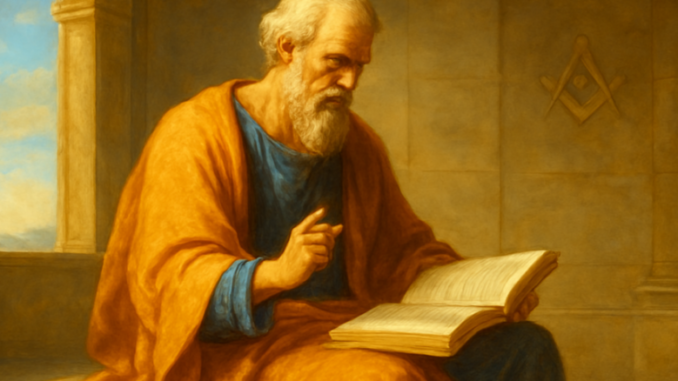
What is the value of persuasion when it is not rooted in truth? This question lies at the beating heart of Plato’s dialogue Gorgias, a work in which the Greek philosopher examines the very foundations of rhetoric and exposes its relationship to justice. The dialogue invites us to reflect on a timeless dilemma: is it better to suffer injustice or to commit it? For those familiar with the symbolic language of Freemasonry, this ancient text opens a fascinating door to deeper reflection on inner righteousness and the architecture of the soul.
The Setting and the Interlocutors
The dialogue takes place in Athens, where Socrates engages with three distinctive figures: Gorgias, the famous orator from Leontini; Polus, his fiery student; and Callicles, an ambitious Athenian aristocrat. Each represents a different attitude toward power, persuasion, and morality. Gorgias presents himself as a master of the art of speaking, capable of convincing any audience regardless of the subject. Polus glorifies the power that rhetoric bestows. Callicles goes furthest of all, openly defending the right of the strongest to rule.
Socrates assumes the role of the searching questioner — the one who, through apparent ignorance, systematically dismantles the certainties of his conversation partners. What begins as an innocent inquiry into the nature of rhetoric unfolds into a profound investigation of the human soul and what it truly means to live a good life.
Rhetoric: Art or Mere Flattery?
The first part of the dialogue centres on a deceptively simple question: what exactly is rhetoric? Gorgias claims it is the highest art, because it grants power over others. Socrates dissects this claim with surgical precision. He draws a distinction between genuine arts — those grounded in knowledge of the good — and forms of flattery that merely pursue pleasure without any understanding of what is truly beneficial.
Rhetoric, Socrates argues, is not a true art but a species of flattery, comparable to cookery that pleases the palate without any knowledge of health. Real medicine, by contrast, understands what the body needs, even when the remedy is unpleasant. This analogy strikes at something essential: the difference between appearance and reality, between the superficial and the substantive. It is a distinction that resonates deeply with anyone who has ever sought to look beyond the surface of things.
Suffering Injustice Versus Committing It
The most provocative section of the dialogue revolves around Socrates’ startling claim that it is better to suffer injustice than to commit it. For Polus and Callicles, this is absurd. They point to tyrants who do whatever they please and therefore appear happy. Socrates turns the argument on its head: the tyrant who commits injustice with impunity is in reality the most miserable of all people, for his soul is diseased and he knows no cure.
The soul that commits injustice without atonement is like a body that remains sick without ever seeking healing.
This insight lies at the core of Plato’s ethics: the good life does not consist of power over others, but of harmony within one’s own soul. Punishment and correction are not evils but medicines. The person who commits injustice and escapes consequence only worsens his own condition as a human being. It is a radical proposition that challenges every conventional notion of success and happiness.
Callicles and the Right of the Strongest
With Callicles, the dialogue reaches its sharpest confrontation. This young aristocrat rejects all conventional morality as the invention of the weak. According to him, natural right dictates that the strong should rule over the weak. Socrates listens carefully, then demonstrates that this position is inherently contradictory. If the many are stronger than the individual, then whatever the majority considers just must also be natural right. Moreover, what does “stronger” actually mean? Is it physical strength, cunning, or wisdom?
Callicles grows confused and eventually retreats into silence. His unwillingness to continue the conversation reveals that his philosophy of life cannot withstand rational examination. It is one of the most dramatic moments in all of Plato’s work: the apparent strength of cynicism dissolves in the light of honest inquiry.
The Symbolic Dimension: Building Inner Righteousness
For those acquainted with the symbolic language of Freemasonry, the Gorgias resonates in a particularly meaningful way. The dialogue treats the soul as a structure that must be maintained and refined through deliberate effort. Just as the rough ashlar is shaped through labour into the perfect ashlar, so too must a person work on their inner architecture. Committing injustice damages this structure; practising justice strengthens it.
The level and the plumb line — symbols of uprightness and honesty — find their philosophical echo in Socrates’ plea for inner order. The point is not to persuade others through clever words, but to bring one’s own soul into alignment with the good. The orator who practises flattery builds with soft materials that cannot endure. The wise person who pursues justice lays foundations that will bear weight for eternity.
This parallel between Platonic philosophy and Masonic symbolism is not accidental. Both traditions insist that true moral progress is an interior process — a matter of self-examination, discipline, and the patient refinement of character. The Temple that matters most is the one we build within ourselves.
The Myth of Judgement After Death
The dialogue concludes with a powerful myth about the judgement that awaits the soul after death. Socrates recounts how souls appear naked before the judges, stripped of all outward signs of power and wealth. Only the condition of the soul itself is examined. The tyrants, their souls disfigured by injustice, face the harshest punishments. The righteous find peace.
This myth is not intended as literal cosmology but as a symbol — a reminder that all external power is transient. What endures is the quality of our inner life. In the silence of self-reflection, far from the applauding crowd, the true measure of a person is taken. It is a message that speaks as clearly today as it did in ancient Athens.
Plato’s Gorgias remains, after more than two thousand years, an invitation to rigorous self-examination. The dialogue does not ask us to convince others — it asks us to know ourselves. It reminds us that true strength lies not in the ability to manipulate, but in the courage to live justly, even when that path is uncomfortable. For those who take to heart the symbols of inner building and righteousness, this ancient work offers a mirror that never loses its clarity.
Copyright text & image: devrijmetselaar.nl
Texts are based on the ideas and content of the author of devrijmetselaar.nl, reviewed, corrected, and supplemented with the assistance of OpenAI. Images are created based on the ideas of the author of devrijmetselaar.nl using OpenAI/DALL-E.
Frequently Asked Questions
What is the main argument Socrates makes about rhetoric in Plato's Gorgias?
Socrates argues that rhetoric is not a true art but rather a form of flattery that pursues pleasure without understanding what is genuinely beneficial. He distinguishes it from true arts grounded in knowledge of the good, comparing rhetoric to cookery that pleases the palate without knowledge of health, whereas real medicine understands what the body actually needs.
Who are the three main interlocutors that Socrates engages with in the dialogue?
The three interlocutors are Gorgias, a famous orator from Leontini who claims rhetoric is the highest art; Polus, his fiery student who glorifies the power of rhetoric; and Callicles, an ambitious Athenian aristocrat who openly defends the right of the strongest to rule.
What is the central philosophical question explored in Gorgias?
The central question is whether it is better to suffer injustice or to commit it. This question examines the foundations of rhetoric and its relationship to justice, inviting reflection on the distinction between appearance and reality, and what it truly means to live a good life.

Be the first to comment