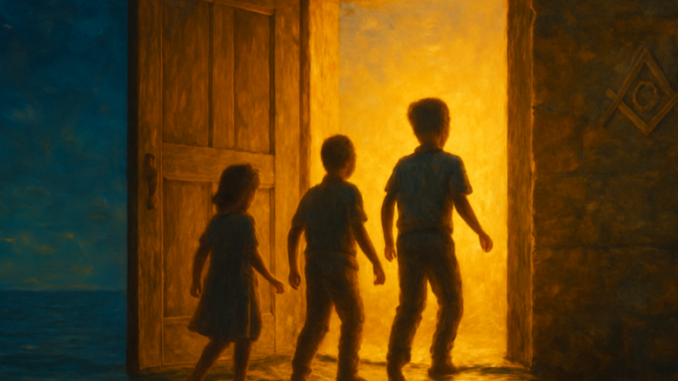
A school principal in Nepal opened the doors of his school in the middle of the night as floodwaters began to rise. Nearly nine hundred students found safety on the upper floors. It was a simple act — a door swinging open — yet within that movement lies something far deeper than practical emergency response. What does it mean to open a door in a moment of crisis? And what does this gesture reveal about spirituality in the most concrete sense of the word?
The Door as a Symbol of Transition
A door is never merely a physical object. In virtually every spiritual tradition, a door marks a transition — a threshold between two worlds. Think of the temple gates in ancient mystery schools, or the threshold the initiate crosses to enter a new life. Plato, in his Allegory of the Cave, described how the philosopher leaves the cave and steps toward the light. That exit is a door — an opening into a different level of reality.
In Freemasonry, the door plays a strikingly similar role. The candidate seeking admission to the lodge knocks upon a closed door and waits until entry is granted. It is a ritual moment symbolizing the transition from the outer world into a space of reflection and brotherhood. Opening a door for another person, then, is never a neutral act. It is an invitation — a gesture of trust and connection.
Acting from Inner Necessity
The school principal in Nepal acted in the dead of night, while most people were still asleep. He could have waited for instructions from the authorities. He could have questioned whether he had the authority to make such a decision. But he didn’t. He opened the door.
This kind of action does not arise from calculation or self-interest. It springs from what the Stoics called the hegemonikon — the guiding principle of the soul that operates in harmony with reason and nature. Marcus Aurelius wrote in his Meditations that a person should fulfill their duty without hesitation, just as a bee makes honey without wondering whether it will be praised for doing so. This is a form of spirituality that is not separate from daily life but deeply rooted within it. The school principal was not a mystic in a temple. He was a man with a key and a sense of responsibility.
True spirituality reveals itself not in lofty words, but in opening a door when others desperately need it opened.
The Other as a Mirror of the Self
In Freemasonry, much is said about working the rough stone — shaping one’s own character through deliberate effort. But this work does not happen in isolation. The other person — the fellow brother, the stranger in need — serves as the mirror in which we come to know ourselves. Spinoza, whose philosophy was studied by many Freemasons, argued that the highest virtue is the knowledge of God, and that this knowledge expresses itself through love for one’s fellow human beings. For Spinoza, spirituality was not an escape from the world but a deeper understanding of the connections that bind all things together.
The nine hundred students who poured into the school were not merely individuals in distress to the principal. They were, in a very real sense, a manifestation of the same reality of which he himself is a part. Opening the door was not just about saving them — it was about connecting himself to something greater than the personal. This lies at the heart of what spirituality means in Freemasonry: not the pursuit of otherworldly experiences, but the recognition of the sacred within the everyday.
The Water and the Purification
Water is a symbol of purification and transformation across countless traditions. The floods in Nepal were devastating, but in symbolic terms, water also represents the force that washes away old forms and creates space for renewal. In Freemasonry, water is not as explicitly central as fire or light, yet the idea of purification through trial is unmistakably present. The candidate is tested before being admitted to the lodge. Life itself tests us constantly.
The school principal was tested by the rising waters, and he withstood that trial — not by conquering the water, but by working through it, by acting at the precise moment action was required. Aristotle called this phronesis, or practical wisdom: the capacity to do the right thing in a specific situation. It is a virtue that cannot be learned from books alone. It is forged in the practice of living.
The Silent Witness
The story of the school principal reached the international press, but how many similar stories remain untold? How many doors are opened without anyone watching? In Freemasonry, great value is placed on work done in silence — on the good deed that seeks no audience. It is a spirituality of humility, where the act itself is the reward.
Montaigne wrote in his essays about the art of living in harmony with oneself, of not depending on the approval of others. The school principal almost certainly did not act with thoughts of fame or recognition. He acted because the situation demanded it, because the door was there and the people needed him. This may be the purest form of spirituality there is: acting from an inner necessity that requires no justification.
A door opening in the night. A group of children finding safety. A man doing what must be done. In these simple elements lies a deeper truth about what it means to live a spiritual life. It is not about elevated ideas or mystical experiences, but about the willingness to act when the moment calls for it. Freemasonry invites its members to cultivate precisely this attitude: to remain alert, to be available, to open the door when another knocks. Because in that gesture — however small it may seem — the human and the sacred become one.
Copyright text & image: devrijmetselaar.nl
Texts are based on the ideas and content of the author of devrijmetselaar.nl, reviewed, corrected, and supplemented with the assistance of OpenAI. Images are created based on the ideas of the author of devrijmetselaar.nl using OpenAI/DALL-E.
Frequently Asked Questions
What is the symbolic meaning of a door in Freemasonry?
In Freemasonry, a door represents a threshold and transition between two worlds. The candidate seeking admission knocks upon a closed door and waits for entry, which is a ritual moment symbolizing the transition from the outer world into a space of reflection and brotherhood. A door is never merely a physical object but marks a spiritual passage into a new level of reality, similar to temple gates in ancient mystery schools.
How does the article connect the school principal's actions to Stoic philosophy?
The article explains that the principal's decision to open the school doors during the flood demonstrates what the Stoics called the hegemonikon—the guiding principle of the soul that operates in harmony with reason and nature. Like Marcus Aurelius's example of a bee making honey without seeking praise, the principal acted from inner necessity and a sense of responsibility rather than calculation or self-interest, revealing true spirituality rooted in daily life.
What does the article suggest about the relationship between spirituality and practical action?
The article argues that true spirituality is not separate from daily life but is deeply rooted within it. It reveals itself through concrete acts of service, such as opening a door when others desperately need it opened, rather than through lofty words or mystical contemplation. The school principal exemplifies this by fulfilling his duty without hesitation in a moment of crisis.


Be the first to comment