
An open door at night symbolizing spiritual passage and Masonic transition
Spiritual Traditions

The Door That Opens: Rescue as a Spiritual Act

A school principal in Nepal opened the doors of his school in the middle of the night as floodwaters began to rise. Nearly nine hundred students found safety on the upper floors. It was a simple act — a door swinging open — yet within that movement lies something far deeper than practical emergency response. What does it mean to open a door in a moment of crisis? And what does this gesture reveal about spirituality in the most concrete sense of the word? The Door as a Symbol of Transition A door is never merely a physical object. In virtually every spiritual tradition, a door marks a transition — a threshold between two worlds. Think of the temple gates in ancient mystery schools, or the threshold the initiate crosses to enter a new life. Plato, in his Allegory of the Cave, described how the philosopher leaves the cave and steps toward the light. That exit is a door — an opening into a different level of reality. In Freemasonry, the door plays a strikingly similar role. The candidate seeking admission to the lodge knocks upon a closed door and waits until entry is granted. It is a ritual moment […]
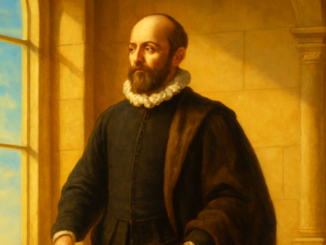
Symbolic bridge representing Masonic connection and Montaigne's philosophy
Michel de Montaigne – Freemasonry & Connection

Montaigne on Ambassadors: The Art of Connection in Masonry

When Michel de Montaigne wrote about diplomats and their conduct in the sixteenth century, he touched on something universal: the art of building connections. How do you convey a message without distorting it? How do you serve as an intermediary without letting your own interests take over? These questions, posed amid political intrigue and religious conflict, find a surprising echo in Freemasonry — a tradition equally concerned with how human beings can connect with one another and with higher values. The Ambassador as a Mirror of Humanity In his brief but incisive essay, Montaigne examines the behavior of ambassadors who interpret their instructions either too literally or too freely. Some cling rigidly to their orders, even when circumstances clearly call for adaptation. Others take so much liberty that they cease to serve their master and begin pursuing their own agenda. Montaigne seeks the middle path: an ambassador must exercise judgment, but always within the boundaries of his commission. This dilemma is timeless. Anyone who carries a message — whether as a diplomat, a friend, or a member of a community — faces the same challenge. How do you remain faithful to the essence of what you are communicating, while also […]