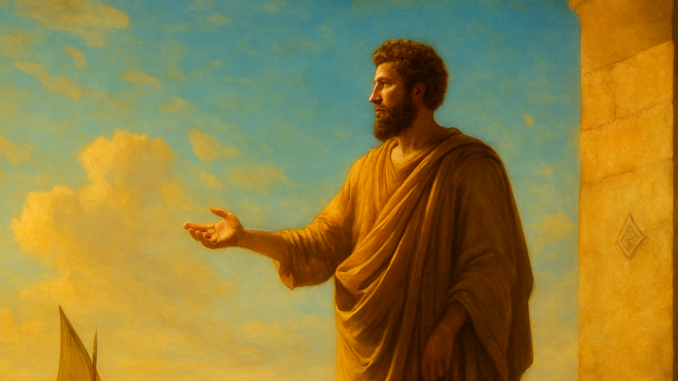
There is a rough stone in every lodge. Unworked, angular, full of irregularities. At first glance, it may look like nothing more than a lump of raw material. But those who truly look will recognize something of themselves in it. It is precisely this dual gaze that Marcus Aurelius teaches us in Book XI of his Meditations, where he writes about evil in human nature — not as condemnation, but as an invitation to understanding. And in that invitation lies a profound kinship with the Masonic path.
The Rough Ashlar as a Symbol of Imperfection
In Freemasonry, the rough ashlar is not a decorative object. It is a mirror. Anyone who contemplates it with genuine attention is confronted with their own imperfection — the sharp edges of character, the unworked places in the soul. The stone does not ask for shame; it asks for work. It is a symbol that says: your journey begins here.
Marcus Aurelius understood this principle, even if he used different words. In Book XI, he writes about people who act out of ignorance or inner confusion. Those who do evil, he argues, often fail to understand what is truly good for them. Their soul is like an unworked stone, full of rough protrusions that wound others — not out of malice, but out of a lack of formation.
Ignorance as the Root of Evil
What makes Marcus Aurelius remarkable is his refusal to demonize evil. For him, evil is not some independent force that invades the human soul. It is the result of clouded judgment. Those who do not understand what is truly valuable reach for things that appear good but ultimately prove harmful. The thief steals because he believes possessions will bring happiness. The liar deceives because he fears he cannot survive without deception.
Evil in human beings is not a darkness that must be driven out, but a rough stone that calls for patient work through self-knowledge and brotherly love.
This vision resonates deeply with Masonic philosophy. The brotherhood does not condemn; it invites growth. The ritual of working the rough ashlar is not a punishment for imperfection but a celebration of the potential hidden within every human being. As the Stoic emperor wrote: every person carries reason within them, and therefore also the capacity for virtue.
Brotherhood as a Workshop for the Soul
Marcus Aurelius never wrote his Meditations for publication. They were personal notes — conversations with himself in the quiet of his tent, far from Rome. Yet every line reveals an awareness of connection with others. Human beings are social creatures, he writes, made to work together like rows of teeth in a mouth.
In Freemasonry, this insight takes concrete form. The lodge is not a collection of isolated individuals but a workshop where brethren help one another shape their stone. When a brother stumbles, a hand is extended. When someone shows rough edges, the response is not rejection but patience. This is precisely what Marcus Aurelius means when he writes that we must bear with, teach, and forgive one another.
The Chisel of Self-Reflection
The Freemason works with tools that are both physical and symbolic. The chisel represents the power of self-reflection — the ability to identify one’s own flaws with precision and carefully remove them. Marcus Aurelius employed a similar instrument: the evening examination of conscience. Every day, he would ask himself a series of questions. Where did I fail? Where did I let emotions carry me away? Where did I forget my connection to others?
This ritual of self-examination is not self-flagellation. It is a loving inward gaze, much like a sculptor studying his work to see where the next stroke of the chisel must fall. The goal is not perfection in a single blow, but steady refinement over the course of a lifetime.
Compassion as the Highest Virtue
What Marcus Aurelius and Freemasonry ultimately share is a deep compassion for the human condition. Both acknowledge that we all struggle, we all fail, and we all begin again. The evil we see in others is often a reflection of what we ourselves still need to work on. Anyone who truly understands this cannot help but respond with gentleness.
This compassion is not weakness. It takes courage to face your own shortcomings honestly. It takes even greater courage to accept those of others without judgment. In the lodge, this is practiced meeting after meeting, ritual after ritual. The rough ashlar does not become smooth in a single session. But with every gathering, every encounter, every brotherly correction, another rough edge is removed.
From Rough Ashlar to Perfect Ashlar
The ultimate goal is the perfect ashlar — a stone that fits into a greater whole, that supports and is supported, that knows its place without losing its individuality. Marcus Aurelius would have recognized this aim. For him, the virtuous person was someone who played their role in the cosmic order — not as a slave, but as a conscious participant in something far greater than themselves.
The journey from rough to perfect ashlar is the journey from ignorance to insight, from impulsiveness to thoughtfulness, from isolation to connection. It is a journey that is never fully completed, yet every step along the way is worth taking. For whoever works on themselves is simultaneously working on the world.
Marcus Aurelius left us no ready-made answers in Book XI, but something far more valuable: a method. Look upon evil with understanding, not indignation. See in others a mirror of yourself. And work, each day anew, on the rough stone that you are. Freemasonry offers the workshop for this labor, a toolbox for the craft, and a brotherhood of fellow workers. Together, stone by stone, we build something that transcends the ages.
Copyright text & image: devrijmetselaar.nl
Texts are based on the ideas and content of the author of devrijmetselaar.nl, reviewed, corrected, and supplemented with the assistance of OpenAI. Images are created based on the ideas of the author of devrijmetselaar.nl using OpenAI/DALL-E.


Be the first to comment