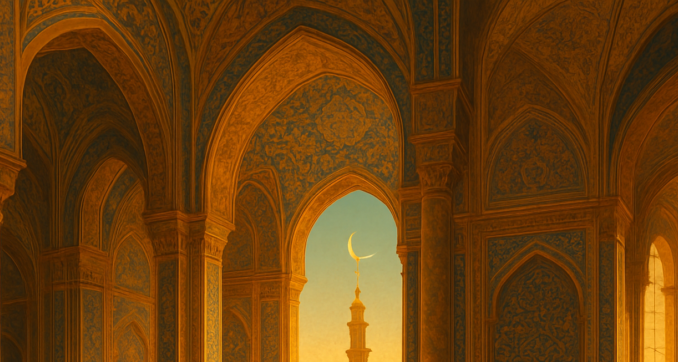
There are moments when the world around you falls away completely. Moments of total darkness, where no horizon is visible and no direction is clear. Surah Yunus — the tenth chapter of the Quran — tells of precisely such a moment: a prophet swallowed into the belly of a great fish, surrounded by three layers of darkness. What initially appears to be a story of despair reveals, upon deeper reflection, a profound lesson in spiritual transformation — one that resonates powerfully with the principles and rituals of Freemasonry.
The Belly of the Fish: A Concrete Darkness
Imagine it: complete severance from light, sound, and orientation. The prophet Jonah — known as Yunus in the Islamic tradition — found himself in what scripture describes as a threefold darkness: the darkness of the night, the darkness of the sea, and the darkness inside the creature’s belly. This is not a metaphor for mild discomfort. It represents the total absence of every familiar reference point. No stars to navigate by. No horizon to orient yourself. No ground beneath your feet.
In our own lives, we encounter comparable moments, though usually less dramatic. The loss of someone we love, a sudden health crisis, the collapse of certainty in our work or relationships. These experiences place us inside our own belly of the fish — a space where our usual strategies no longer function and where we are forced, whether we like it or not, to turn inward.
The Dark Chamber as Ritual Space
Within Freemasonry, there is a tradition that bears remarkable parallels to the story of Jonah. The candidate entering the Lodge for the first time often does so blindfolded — hoodwinked, in Masonic language — stripped of all visual orientation. This ritual blindness is neither punishment nor mere test. It is the deliberate creation of that inner space necessary for transformation. Just as Jonah came to a moment of reckoning in the darkness, the candidate is invited to discover his inner light precisely in the absence of outer light.
The philosopher Plato described something similar in his Allegory of the Cave, where prisoners who had only ever seen shadows were initially blinded by real light when they finally left the cave. Spinoza would later argue that true knowledge does not come from without, but arises from an internal understanding of how all things are connected. In this philosophical and Masonic tradition, darkness is not the enemy of light — it is light’s necessary precondition.
The Prayer from the Depths
What Jonah does inside the belly of the fish is of crucial significance. He prays. Not a prayer of blame or despair, but a recognition of his own shortcomings and a surrender to a higher order. The Quran describes his words as a supplication that reaches through all layers of darkness: he acknowledges that there is no deity but the One, and that he himself had been among the wrongdoers.
True spiritual growth begins where the illusion of control ends — in the darkness that compels us to turn inward.
This acknowledgment is not weakness. It is the first step toward genuine strength. In Masonic terms, one might say that Jonah, in that moment, confronted his own rough ashlar. He saw his imperfection not as something to flee from, but as the raw material with which he had to continue working. The tradition tells us the fish then cast him out onto dry land: the darkness had done its work.
Three Layers: Body, Soul, and Spirit
The threefold darkness in which Jonah found himself can also be read symbolically as three levels on which a person can become lost. The night represents the confusion of the senses. The sea represents the turbulence of the emotions. And the belly of the fish represents the prison of the unconscious ego. Only when all three layers are worked through can genuine liberation take place.
The Night: the domain of the senses and the illusions they create.
The Sea: the domain of the emotions and their unpredictable currents.
The Fish: the domain of the ego that holds us captive in old patterns.
Aristotle might have recognized this threefold division in his own distinction between the vegetative, sensitive, and rational parts of the soul. Freemasonry mirrors these layers in its degree system, where each degree represents a deeper layer of self-knowledge and moral development. The story of Jonah suggests that sometimes we must sink through all three layers before we can rise.
The Return to Nineveh
After his liberation from the fish, Jonah returns to the city of Nineveh — the very place he had fled from. This detail is of essential importance. Spiritual transformation is not an escape from the world; it is a return to the world with new eyes. The city that once seemed an unbearable burden now becomes the field upon which newly won insights can be applied. Goethe would later express this as the necessity to act, not merely to contemplate.
In Freemasonry, this movement is reflected in the ideal of the Brother who, after his work within the Lodge, returns to the outer world to function there as a better human being. The Temple is not built to live inside of forever. It is built as a place from which to work toward the improvement of oneself and of the world at large.
The Fish as Womb
There is yet another layer of symbolism that deserves attention. The belly of the fish can be understood as a kind of womb — a dark, protected space in which something new can grow. Jonah enters it as a fugitive and emerges as a prophet who has accepted his calling. The darkness was not punishment. It was an incubator for transformation.
This reading invites a radically different attitude toward the difficult periods in our lives. What if our darkest moments are not the absence of meaning, but the very presence of possibility? What if the belly of the fish is not the place where we perish, but the place where we are born anew?
The Masonic Chamber of Reflection echoes this symbolism directly. The candidate sits alone in a small, dark room, surrounded by symbols of mortality and introspection. It is not a place of punishment. It is a womb — a space designed to bring about the death of the old self so that a new self may emerge into the light of the Lodge.
Surah Yunus reminds us that the path to light sometimes runs directly through the deepest darkness — not as a detour or a penalty, but as a necessary passage. Freemasonry recognizes this truth in its rituals and symbols: the hoodwink, the Chamber of Reflection, and the journey from darkness to light that lies at the very heart of initiation. The story of Jonah, read through a Masonic lens, assures us that the darkness is not where the journey ends. It is where the real journey begins.
Copyright text & image: devrijmetselaar.nl
Texts are based on the ideas and content of the author of devrijmetselaar.nl, reviewed, corrected, and supplemented with the assistance of OpenAI. Images are created based on the ideas of the author of devrijmetselaar.nl using OpenAI/DALL-E.
Frequently Asked Questions
What is the significance of the three layers of darkness in Surah Yunus?
According to the article, the three layers of darkness—the darkness of night, the darkness of the sea, and the darkness inside the fish's belly—represent a complete severance from all familiar reference points. This threefold darkness symbolizes total absence of light, sound, and orientation, serving as a metaphor for life's profound moments of crisis and spiritual challenge when our usual coping strategies fail and we are forced to turn inward.
How does the Masonic ritual of blindfolding relate to the story of Jonah?
The article explains that when a Masonic candidate is blindfolded (hoodwinked) upon entering the Lodge for the first time, this mirrors Jonah's experience in the belly of the fish. The deliberate removal of visual orientation creates an inner space necessary for spiritual transformation, allowing the candidate to discover inner light precisely through the absence of outer light, similar to Jonah's moment of reckoning in darkness.
What is the philosophical basis for viewing darkness as necessary for enlightenment?
The article references both Plato's Allegory of the Cave and Spinoza's philosophy to support this idea. Plato illustrated how prisoners initially blinded by real light after seeing only shadows must adjust to find true understanding, while Spinoza argued that true knowledge arises from internal understanding rather than external sources. In this tradition, darkness is not light's enemy but rather its necessary precondition for genuine spiritual awakening.

Be the first to comment