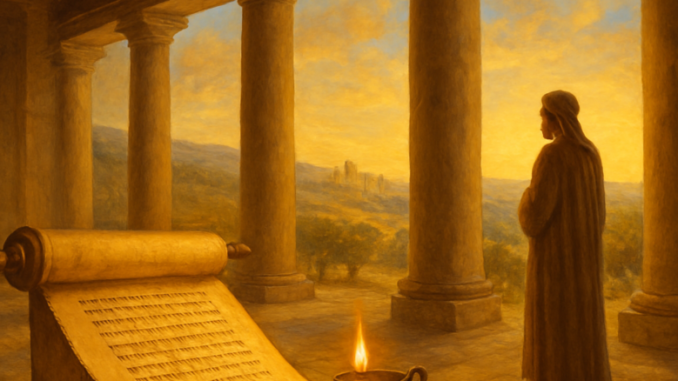
In a small lodge room somewhere in a quiet provincial town, silence falls as the Worshipful Master speaks the opening words. The brethren listen to ancient texts that speak of light, law, and the journey of the soul. Thousands of years earlier, a people stood at the edge of a promised future while their leader recited the law one final time. Two worlds, two eras — and yet the same search for wisdom and direction.
Deuteronomy: The Repetition of the Law
Deuteronomy, the fifth book of the Old Testament, literally means “second law” or “repetition of the law.” It forms the capstone of the Five Books of Moses and contains his final addresses to the people before they entered the Promised Land. No new laws are given here. Instead, the commandments already received are restated — this time with an urgent call to preserve them and pass them on to future generations.
The central theme of Deuteronomy revolves around remembrance and transmission. The people had wandered through the desert for forty years, and a new generation stood ready to continue the work of their forebears. The law is not presented merely as regulation but as a living heritage meant to be inscribed upon the heart. “Hear, O Israel” resounds again and again — a summons to attentive listening and deep internalization.
The Masonic Perspective: Symbolism as Language
For the Freemason, symbolism is the universal language through which deeper truths are conveyed. Where Deuteronomy speaks in words and precepts, the lodge speaks in images and ritual. Yet both share a fundamental conviction: wisdom must not merely be understood — it must be lived and handed down. The rough ashlar shaped into a perfect cube, the light kindled in the darkness, the winding staircase leading to higher knowledge — all are means of expressing the inner journey of the human soul.
In Freemasonry, the Volume of the Sacred Law occupies a central place upon the altar. This book — often the Bible, though other sacred texts may be used depending on the tradition — symbolizes the moral foundation upon which the Craft is built. Deuteronomy, as part of that foundation, resonates with particular strength in the Masonic tradition because of its emphasis on law, conscience, and the responsibility to transmit knowledge.
Two Perspectives on the Law
From the perspective of the faithful reader, Deuteronomy is divine revelation — a direct guideline for living in covenant with the sacred. The law is not a human construction but a gift from above, intended to lead a people toward righteousness and well-being. The repetition is not redundancy; it is a loving reminder of the source of all wisdom.
The Freemason approaches the same texts through a different lens. For him, the laws and precepts are symbols of universal moral principles that recur across every culture and age. The specific commandments are not followed literally but are understood as expressions of deeper truths about human dignity, brotherhood, and the search for light. These two perspectives — the devotional and the symbolic — do not exclude each other. Rather, they complement one another.
Shared Themes: Light, Journey, and Transmission
Despite their differing approaches, Deuteronomy and the Masonic tradition share striking themes. The first is light as a metaphor for knowledge and insight. Deuteronomy calls on the faithful to carry the law as a lamp, while the Freemason strives toward the light that dispels darkness and ignorance.
Then there is the desert journey as an inner journey. Both the people in Deuteronomy and the Freemason undergo a transformation from a rough to a refined state. Ritual repetition serves as a teacher: it anchors wisdom in the heart, whether through weekly lodge meetings or the annual reading of the law. And both traditions insist that knowledge only becomes truly valuable when it is passed on to the next generation.
“Fix these words of mine in your hearts and minds; tie them as symbols on your hands and bind them on your foreheads.” This verse from Deuteronomy captures precisely what the Freemason experiences in his rituals: the internalization of symbolic truths until they become an inseparable part of who he is.
What We Learn from Both Paths
Comparing Deuteronomy with Masonic symbolism reveals a universal human need: the search for a moral compass that gives direction to life. Where religious tradition finds that compass in divine revelation, the Freemason seeks it in the collective wisdom of humanity, expressed through symbols and ritual.
Neither path claims to possess the only truth. Deuteronomy speaks to the heart of the believer, while the lodge offers space to seekers from all backgrounds. What they share is the understanding that we do not live by bread alone, but by every word, every act, and every symbol that reminds us of our higher calling. In that shared conviction, two worlds — however different they may appear — find a common light.
Deuteronomy and the Masonic tradition each speak in their own language, yet they ultimately tell the same story: that of a human being on a journey, seeking wisdom, guided by a law greater than himself. Whether one takes the words literally or reads them as symbols, the message endures — preserve what is precious, pass it on, and walk in the light. In that shared charge, the desert traveler and the lodge brother meet one another across the centuries and cultures that separate them.
Copyright text & image: devrijmetselaar.nl
Texts are based on the ideas and content of the author of devrijmetselaar.nl, reviewed, corrected, and supplemented with the assistance of OpenAI. Images are created based on the ideas of the author of devrijmetselaar.nl using OpenAI/DALL-E.
Frequently Asked Questions
What is the connection between Deuteronomy and Freemasonry?
Both Deuteronomy and Freemasonry emphasize the transmission of wisdom, moral law, and spiritual knowledge across generations. While Deuteronomy conveys these truths through written commandments and teachings, Freemasonry uses symbolism and ritual to express the same universal principles of light, conscience, and personal transformation. Together, they represent complementary paths to understanding deeper spiritual truths.
Do Freemasons follow the laws in Deuteronomy literally?
Freemasons do not interpret Deuteronomy's specific commandments literally, but rather view them as symbols of universal moral principles that apply across all cultures and ages. The specific precepts in Deuteronomy are understood as expressions of deeper truths about human dignity, brotherhood, and the eternal search for light and wisdom.
Why is the Volume of the Sacred Law important in Freemasonry?
The Volume of the Sacred Law, often the Bible or other sacred texts depending on tradition, sits at the center of the Masonic altar as a symbol of the moral and spiritual foundation upon which the Craft is built. It represents the lodge's commitment to wisdom, law, and ethical principles that guide the journey of each Mason toward greater understanding and enlightenment.
How does Freemasonry use symbolism to teach moral lessons?
Freemasonry employs rich symbolic imagery—such as the rough ashlar being shaped into a perfect cube, the kindling of light in darkness, and the winding staircase to higher knowledge—to convey deeper truths about the human soul's inner journey. These symbols serve as a universal language that allows Masons to internalize and live out moral principles in a way that connects to both ancient wisdom and personal experience.
What does Freemasonry teach about passing down knowledge to future generations?
Like Deuteronomy's emphasis on remembrance and transmission, Freemasonry stresses that wisdom must not only be understood intellectually but also lived and passed on to the next generation of members. The Craft views itself as a living tradition where each Mason becomes both a keeper and a transmitter of ancient truths, ensuring that the light of knowledge continues to illuminate the path for those who follow.



Be the first to comment