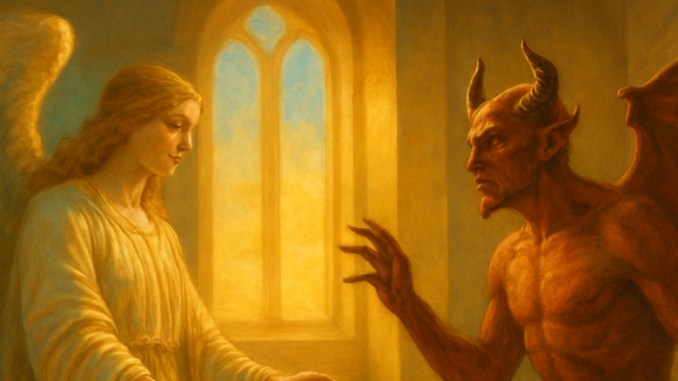
Imagine a word that reads exactly the same when you flip it upside down — symmetrical, mysterious, and seemingly impossible. In Dan Brown’s bestselling thriller Angels & Demons, these typographic designs called ambigrams play a starring role as alleged secret symbols of an ancient brotherhood. But what does the novel actually claim? And how do those claims hold up against what we genuinely know about symbols, secret societies, and Freemasonry?
What Exactly Are Ambigrams?
Let’s start at the beginning. The word “ambigram” derives from the Latin ambi (both sides) and gramma (letter). An ambigram is a typographic design that can be read in more than one way — most commonly by rotating it 180 degrees. It is an art form that truly came into its own during the twentieth century, developed by graphic designers and calligraphers experimenting with symmetry and legibility.
Here’s the critical question: if ambigrams are a modern invention, how could they possibly be the secret signs of an eighteenth-century secret society? That contradiction takes us straight to the heart of what the novel claims.
What Does the Novel Actually Claim?
In Angels & Demons, ambigrams are presented as authentic, historical symbols of the Illuminati — the Bavarian society founded by Adam Weishaupt in 1776. The story suggests that this group used ambigrams as secret identifying marks, branded into the flesh of their victims. The words “Earth,” “Air,” “Fire,” and “Water” supposedly existed in ambigram form as part of an ancient ritual.
The novel goes even further, claiming these symbols were designed by the Illuminati as proof of their mastery over language, science, and the hidden order of things. The book presents them as so ingeniously crafted that only initiates would recognize their dual readability.
The reality is quite different: ambigrams are not historical Illuminati symbols but modern typographic artworks developed in the twentieth century.
What Do We Actually Know About the Historical Illuminati?
This is where things get interesting. The historical Bavarian Illuminati did indeed exist and were founded in 1776 by Weishaupt, a professor at the University of Ingolstadt. The society pursued Enlightenment ideals: rationality, equality, and resistance to superstition. They certainly used symbols — but not ambigrams. Their signs were far more conventional: the Owl of Minerva, geometric figures, and classical allegories.
The society was banned by the Bavarian Elector in 1785 and subsequently fell apart. There is no historical evidence whatsoever that the Illuminati continued to exist as an organized group after that point, let alone that they kept using secret symbols for centuries.
How Does Freemasonry Fit Into This?
Here we touch on a common source of confusion. The novel blurs the line between the Illuminati and Freemasonry, as though they were one and the same organization. In reality, they are two distinct societies with different origins, objectives, and traditions.
Freemasonry does indeed possess a rich symbolic tradition. Think of the Square and Compasses, the All-Seeing Eye, the Rough and Perfect Ashlars. However, these symbols have absolutely nothing to do with ambigrams. They trace their origins to the medieval stonemason guilds and serve as teaching tools for moral and spiritual growth. Each symbol invites the Freemason to self-reflection:
The Compasses symbolize the restraint of one’s passions. The Square represents acting with integrity and fairness. The Rough Ashlar stands for the individual who has yet to grow. The All-Seeing Eye refers to conscience or the divine.
None of these symbols are meant to conceal secrets or intimidate outsiders. They function as mirrors, reflecting lessons back to the person contemplating them.
Why Does This Kind of Fiction Captivate Us?
This may be the most fascinating question of all. Why do millions of readers so readily believe that ambigrams are ancient, secret symbols? The answer lies partly in our deep-seated fascination with the hidden. We want to believe there is more than meets the eye, that beneath the surface lies a deeper meaning waiting to be uncovered.
Freemasonry actually understands this impulse well. Its symbols invite contemplation — not because they conceal secrets, but because they encourage the seeker to discover meaning for themselves. This is fundamentally different from the conspiracy logic of the novel, where symbols serve as evidence of sinister plots.
What Can We Learn From This?
The distinction between fictional and authentic symbolism is essential. Genuine symbols — whether Masonic, religious, or philosophical — function as mirrors for the soul. They ask questions rather than provide answers. They invite growth, not fear.
The ambigrams in Angels & Demons are beautiful graphic designs, created by contemporary artist John Langdon specifically for the novel. They are clever, but they are not old. Mysterious in appearance, but not mystical in origin. They tell us more about our hunger for secrets than about any historical society.
Fiction has its own value and can inspire us to think more deeply about symbols, power, and meaning. But it is important to recognize where the story ends and history begins. Freemasonry uses symbols not to conceal but to reveal — not to wield power, but to help the seeker find themselves. That may be the real secret: a symbol speaks only to those who are willing to listen.
Copyright text & image: devrijmetselaar.nl
Texts are based on the ideas and content of the author of devrijmetselaar.nl, reviewed, corrected, and supplemented with the assistance of OpenAI. Images are created based on the ideas of the author of devrijmetselaar.nl using OpenAI/DALL-E.
Frequently Asked Questions
What is an ambigram and when were they actually invented?
An ambigram is a typographic design that reads the same when rotated 180 degrees, derived from the Latin words ambi (both sides) and gramma (letter). Ambigrams are a modern art form that truly developed during the twentieth century through experiments by graphic designers and calligraphers with symmetry and legibility. This modern origin creates a fundamental contradiction with Dan Brown's claim that they were used by the eighteenth-century Bavarian Illuminati.
Does the historical Bavarian Illuminati actually use ambigrams as symbols?
No. The historical Bavarian Illuminati, founded by Adam Weishaupt in 1776, did use symbols but not ambigrams. Their actual symbols were far more conventional and included the Owl of Minerva, geometric figures, and classical allegories. Since ambigrams are a twentieth-century invention, they could not have been used by an eighteenth-century society, making Dan Brown's fictional claims historically inaccurate.
What were the real goals and beliefs of the historical Bavarian Illuminati?
The historical Bavarian Illuminati were founded by Weishaupt, a professor at the University of Ingolstadt, and pursued Enlightenment ideals including rationality, equality, and resistance to superstition. The society was banned by the Bavarian Elector in 1785. Their actual historical mission was grounded in rational philosophy rather than the mystical, secretive agenda depicted in Angels & Demons.

Be the first to comment