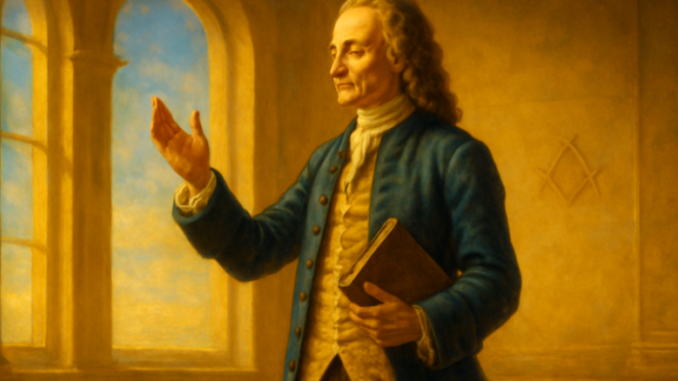
What drives a person to stand up against injustice when the rest of society looks the other way? In 1762, Jean Calas — a Protestant merchant from Toulouse — was sentenced to death on the strength of religious prejudice alone. Voltaire took up his pen and wrote his famous Treatise on Tolerance. But what does this eighteenth-century plea for humanity have to do with Freemasonry today? Far more than you might expect.
What Actually Happened in the Calas Affair?
Let’s start with the facts. Marc-Antoine Calas, Jean’s son, was found dead in the family home. In all likelihood, he had taken his own life. But a rumor spread quickly through Toulouse: that his father had murdered him to prevent his conversion to Catholicism. Without credible evidence, Jean Calas was tortured and broken on the wheel — a judicial murder driven by religious hysteria.
Voltaire learned of the case and launched a years-long campaign for Calas’s posthumous rehabilitation. His Treatise on Tolerance is no dry legal argument. It is a passionate appeal for basic human decency. The question he posed remains just as relevant today: how can we call ourselves civilized while condemning our fellow human beings on the basis of belief alone?
Why Does This Resonate So Deeply with Freemasons?
Freemasonry emerged during an era when religious division was tearing Europe apart. Protestants and Catholics fought each other with weapons and words. In the midst of this chaos, Freemasons chose a different path: the lodge as a space where men of different faiths could meet as brothers — not in spite of their differences, but with genuine respect for them.
Tolerance, in the Masonic sense, is not weakness. It is strength: the ability to recognize the dignity of another person, even when their convictions differ from your own.
Voltaire was not yet a Freemason when he wrote the Treatise on Tolerance, but his ideas aligned seamlessly with Masonic values. Later, in 1778, shortly before his death, he was initiated into the Parisian lodge Les Neuf Sœurs. The brethren recognized in him a kindred spirit who had been defending their ideals for decades.
How Does Tolerance Relate to the Search for Truth?
This is where things get truly interesting. The Freemason strives for truth and light. But doesn’t that require judging what is true and what is false? Voltaire shows us that the genuine search for truth begins with acknowledging your own limitations. No one possesses the whole truth. The judges in Toulouse believed they knew the truth — they were so certain of it that they killed an innocent man.
Through his rituals, the Freemason learns that knowledge comes in stages. Each degree reveals new insights, but also new questions. This is not relativism — as if all opinions are equally valid. It is intellectual humility. You can pursue truth with all your heart and still respect that someone else walks the same path in a different way.
What Does Brotherhood Mean When It Gets Difficult?
Brotherhood is easy when everyone agrees. The real test comes when tension arises. Voltaire describes how entire communities turned against the Calas family. Neighbors, friends, people who had known them for years — all abandoned them the moment the rumor took hold.
At his initiation, the Freemason pledges to support his brethren. But that promise extends far beyond the lodge walls. It is a commitment to stand for justice, even when doing so is uncomfortable. Voltaire risked his reputation and personal safety by involving himself in the Calas affair. He did it because he believed that silence was complicity.
What Lessons Can We Still Draw Today?
The Calas affair lies more than 250 years in the past, yet the underlying mechanisms are painfully familiar. People are still judged on the basis of their background, faith, or identity. Communities still allow themselves to be swept along by fear and prejudice. The question Voltaire asked is still ours: do we dare raise our voices when injustice is done?
The Freemason cultivates self-reflection in order to recognize his own prejudices. He seeks truth without claiming to possess it fully. He practices brotherhood across the boundaries of faith and background. And he speaks out against injustice, even when silence would be the easier choice.
Voltaire ended his treatise with a prayer for tolerance, addressed to a God who created all people equally. It is a text every Freemason can endorse, regardless of personal belief. Because its essence is universal: see others as your equals, treat them as you wish to be treated, and have the courage to stand up when that equality is violated.
The Calas affair was the moment when philosophy became practice for Voltaire. His plea for tolerance is not an abstract ideal — it is a call to concrete action. For the Freemason, this is deeply recognizable: he too is invited to transform the values he learns in the lodge into daily conduct. Tolerance, brotherhood, and the search for truth are not words reserved for ritual occasions alone. They are a compass for life beyond the temple doors. And sometimes, they demand courage.
Copyright text & image: devrijmetselaar.nl
Texts are based on the ideas and content of the author of devrijmetselaar.nl, reviewed, corrected, and supplemented with the assistance of OpenAI. Images are created based on the ideas of the author of devrijmetselaar.nl using OpenAI/DALL-E.
Frequently Asked Questions
What was the Calas Affair and why did Voltaire become involved?
In 1762, Jean Calas, a Protestant merchant from Toulouse, was tortured and executed based on false accusations that he murdered his son Marc-Antoine to prevent his conversion to Catholicism. In reality, Marc-Antoine likely took his own life. Voltaire learned of this judicial murder driven by religious prejudice and launched a years-long campaign for Calas's posthumous rehabilitation, writing his famous Treatise on Tolerance as a passionate appeal for basic human decency and against condemning people based on their beliefs.
What is the connection between Voltaire's ideas and Freemasonry?
Although Voltaire was not a Freemason when he wrote the Treatise on Tolerance, his ideas aligned seamlessly with core Masonic values. Freemasonry emerged as a space where men of different faiths could meet as brothers with genuine respect for their differences. Voltaire was initiated into the Parisian lodge Les Neuf Sœurs in 1778, shortly before his death, and the brethren recognized him as a kindred spirit who had been defending Masonic ideals for decades.
How does tolerance relate to the Masonic search for truth?
Voltaire demonstrates that the genuine search for truth begins with acknowledging your own limitations—no one possesses the whole truth. For Freemasons striving for truth and light, tolerance is not weakness but strength: the ability to recognize the dignity of another person even when their convictions differ from your own. This approach contrasts with the judges in Toulouse who wrongly believed they possessed absolute truth.




Be the first to comment