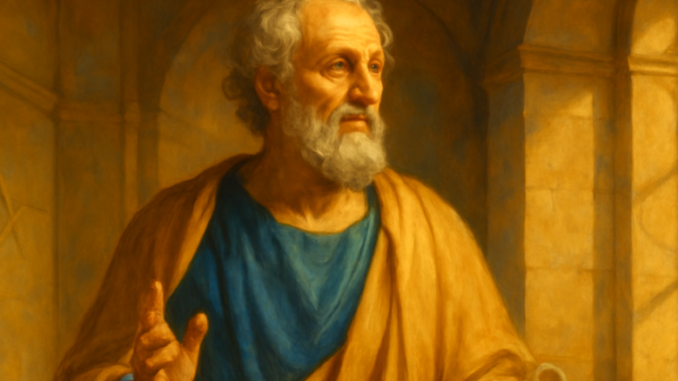
What does it truly mean to live in accordance with your beliefs? Lucius Annaeus Seneca posed this question to his student Lucilius nearly two thousand years ago — and it is precisely the same question that Freemasons continue to ask themselves on their journey toward inner truth. In his twentieth letter from the Epistulae Morales, the Stoic philosopher explores how simplicity and consistency form the foundation of an authentic philosophical life. These ancient insights resonate deeply with the timeless principles of Freemasonry, and they deserve a closer look.
Why Does Seneca Consider Simplicity a Foundation?
Seneca opens his twentieth letter with an urgent appeal: let your words and your actions align. He criticizes those who profess philosophy with their lips yet deny it through their daily conduct. For Seneca, simplicity is not poverty or deprivation — it is a deliberate choice to release what is unnecessary. The real question he poses is this: do you live according to what you preach?
This principle of harmony between the inner life and outward behavior is far from an abstract philosophical exercise. Seneca asks Lucilius to test himself honestly: can you be content with little? Could you endure the loss of wealth and status without losing your character? The answers to these questions reveal the true depth of a person’s philosophical development — and their readiness to face themselves without pretense.
How Does This Relate to Masonic Values?
Freemasonry teaches the concept of the rough ashlar that must be shaped into a perfect ashlar. This symbolic transformation represents the inner growth of the individual — from unrefined to polished, from confusion to clarity. Seneca’s call to simplicity aligns seamlessly with this idea: both traditions speak of stripping away the superfluous to reveal what is essential.
True simplicity is not the absence of possessions, but the absence of attachment to what is not essential to the soul.In the lodge, the Freemason learns that outward display and social status mean nothing when the gavel sounds three times. All brethren are equal, regardless of their position in the outside world. This is exactly what Seneca means when he writes that the philosopher must be willing to live with little — not because poverty is virtuous in itself, but because true freedom lies in not being dependent on externals.
What Does Seneca Mean by Fidelity to Philosophy?
For Seneca, fidelity to philosophy is a daily practice, not a Sunday conviction. He warns Lucilius against the danger of inconsistency: speaking of virtue today and surrendering to greed or fear tomorrow. The philosopher must embody his teachings, not merely proclaim them.
This resonates powerfully with the Masonic ideal of practicing what you profess. The rituals and symbols of the lodge are not decoration — they are reminders of the obligations the Freemason has made to himself. Every meeting is an exercise in self-reflection: have I lived as I promised to live? Have my actions matched my words since I last sat in lodge?
What Practical Exercises Does Seneca Propose?
Seneca is no armchair philosopher theorizing from an ivory tower. He proposes concrete exercises to train the mind and strengthen the will:
- Live a few days each month as though you were poor — eat simple food, sleep on a hard bed, and strip away every comfort.
- Ask yourself regularly: could I defend my current behavior before a wise mentor?
- Practice releasing one luxury or habit to test your attachment to it.
- End each day with an honest examination of your own actions and motives.
These exercises are strikingly similar to the Masonic practice of the Chamber of Reflection, where the candidate is left alone before initiation to contemplate his life and his motivations. The confrontation with oneself — without distraction or excuse — is at the heart of both Seneca’s philosophy and the Masonic path. It is in that silence that genuine self-knowledge begins.
How Does Brotherhood Strengthen Fidelity to Principles?
Seneca did not write his letters to Lucilius as dry treatises. They were personal messages to a friend. The bond between teacher and student, between the wise and the seeker, strengthens commitment to the philosophical path. It is far easier to stray when you walk alone.
Freemasonry recognizes this principle through its emphasis on brotherhood. The lodge is not a collection of individuals who happen to share the same ideals — it is a community that supports and, where necessary, corrects one another. Just as Seneca encouraged Lucilius to remain steadfast, brethren encourage each other to stay true to the shared ideals of truth, virtue, and humanity. This mutual accountability is one of the most powerful yet underappreciated aspects of the Craft.
What Can We Learn from This Ancient Wisdom Today?
In an age of abundance and constant distraction, Seneca’s message is more relevant than ever. The question he asks is not: how much do you have? Rather: how much do you need in order to be yourself? The Freemason who looks in the mirror and honestly reflects on his day is walking exactly the path Seneca envisioned.
Simplicity and philosophical fidelity are not destinations — they are daily exercises. They do not require spectacular sacrifices, but small, consistent choices. Every time we choose authenticity over appearance, inner worth over external recognition, we work on the rough ashlar of our character. And every small choice, compounded over a lifetime, shapes the person we ultimately become.
Seneca’s twentieth letter reminds us that philosophy, like Freemasonry, is not a theory — it is a way of life. The question is not whether we know the right words, but whether we have the courage to live them. In the silence of the lodge and in the silence of our own conscience, the same invitation echoes: be simple, be consistent, be faithful to what you have recognized as true. That is the path to genuine connection — with ourselves and with one another.
Copyright text & image: devrijmetselaar.nl
Texts are based on the ideas and content of the author of devrijmetselaar.nl, reviewed, corrected, and supplemented with the assistance of OpenAI. Images are created based on the ideas of the author of devrijmetselaar.nl using OpenAI/DALL-E.
Frequently Asked Questions
What is Seneca's definition of simplicity in Letter XX?
Seneca defines simplicity not as poverty or deprivation, but as a deliberate choice to release what is unnecessary. It is about achieving harmony between inner life and outward behavior, testing oneself honestly to see if one can be content with little and maintain character without wealth or status.
How does Seneca's concept of simplicity relate to Freemasonry?
Both Seneca's philosophy and Freemasonry teach the importance of stripping away the superfluous to reveal what is essential. The Masonic symbol of the rough ashlar being shaped into a perfect ashlar mirrors Seneca's call for inner growth and refinement. In the lodge, all brethren are equal regardless of worldly status, embodying Seneca's principle that true freedom lies in not being dependent on externals.
What does Seneca criticize in his twentieth letter?
Seneca criticizes those who profess philosophy with their words but deny it through their daily conduct. He emphasizes that true philosophical development requires alignment between what one preaches and how one actually lives, demanding that words and actions be consistent rather than contradictory.



Be the first to comment