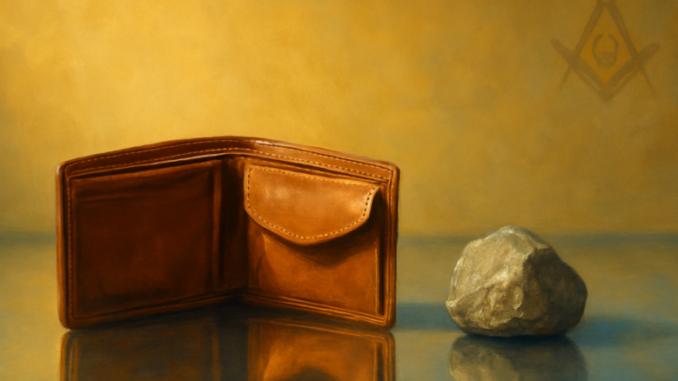
A wallet. Leather, stitching, a slot for coins. We open it dozens of times a week, check its contents, calculate what’s possible. Reports keep telling us that a growing number of people struggle to make ends meet — even as wages rise. The numbers don’t match the feeling. And perhaps that disconnect is precisely the invitation to look deeper, beyond the figures, toward what wealth truly means for who we are.
The Mystery of the Growing Gap
Imagine a bucket. You fill it with more water than last year. Yet the bottom stays dry. Somewhere there’s a hole that grows along with the filling. This is the paradox many households experience: wages go up, but the sense of abundance never arrives. Economists point to inflation, rising fixed costs, and shifting consumption patterns. These explanations make perfect sense on paper. But there’s something no spreadsheet can capture.
The wallet is more than an object. It’s a mirror. What we put into it — and how quickly it disappears — reveals something about our relationship with needs, desires, and the question of who we want to be. Financial pressure doesn’t just affect the bank account. It touches our personality, the way we see ourselves and present ourselves to the world.
The Rough Stone and the Longing for More
In Freemasonry, we work with the image of the rough ashlar — the unworked stone. Every person begins as an uncut block, full of potential but also full of imperfections. The work of self-improvement consists of slowly chiseling away what is superfluous, moving ever closer to one’s true form. This process demands discernment: what truly belongs to me, and what has been grafted on by habit, expectation, or the gaze of others?
Financial stress can be an unexpected teacher in this kind of discernment. When the money runs out before the month does, we’re forced to choose. Not everything is possible. And in that choosing, we reveal something of our deeper values. Do we prioritize comfort, status, security, or connection? The wallet forces us into honesty about what we truly consider important.
Personality as a Building Under Construction
The Freemason sees personality as a building perpetually under construction — not static, but constantly being adjusted. Every experience adds a stone or removes one. Financial worries, seen from this perspective, can be understood as a phase of rebuilding. They compel us to inspect the foundation: does this house stand on solid ground, or on the shifting sandbar of external validation?
It is not what you possess that defines who you are, but how you deal with what you lack.
This thought is far from new, but it becomes painfully relevant when the bills pile up. It’s easy to claim inner peace when basic needs are met. The real test comes when the margins shrink. That’s when we discover whether our sense of calm is rooted in something deeper than the balance in our account.
The Difference Between Having and Being
The philosopher Erich Fromm drew a distinction between two fundamental orientations: the mode of having and the mode of being. The first revolves around possession, control, and accumulation. The second centers on experience, growth, and presence. Our society is saturated with the having mode. Success is measured by what we collect — diplomas, properties, experiences we can display.
When higher wages fail to produce greater peace of mind, we’re touching a deep human question. Perhaps it’s not just inflation that grows, but also the expectation of what we should have in order to be happy. The yardstick shifts along with our income. And so the wallet keeps feeling too empty, regardless of what’s actually inside.
The Lodge as a Training Ground for Inner Freedom
In the enclosed space of the lodge, the Freemason practices letting go — letting go of titles, social positions, and the urge to impress. Everyone wears the same apron, regardless of what’s in their bank account. This ritual gesture of equality serves as a reminder that personality is not the same as possession.
Wealth can mask inner poverty. Scarcity can be a teacher in discernment. The true value of a person lies not in what they have, but in who they are becoming.
These are not hollow consolations for those in genuine need. Real poverty is devastating and demands concrete help, not philosophy. But for the many who inhabit the gray zone — between getting by and falling short — a symbolic perspective can offer relief. Not as a denial of reality, but as a complement to it.
The Wallet Reconsidered
Pick up your wallet. Feel its weight — or the lack of it. What does this object tell you about your life right now? Not just about your finances, but about your choices, your priorities, your fears and desires. The wallet is a small altar of daily life, a place where values become visible in the form of transactions.
The growing number of people struggling to make ends meet calls for more than economic solutions. It calls for a reconsideration of what we, as a society, understand by prosperity. And it invites each of us to examine where our own true wealth really lies.
The empty wallet is not an endpoint but a beginning question. It forces us to distinguish between what we think we need and what we truly are. In that distinction lies the possibility of inner freedom — a wealth that knows no inflation and that no one can take from us. The Freemason recognizes in every setback an invitation to go deeper. And so even financial pressure becomes a hammer and chisel with which we can work upon ourselves.
Copyright text & image: devrijmetselaar.nl
Texts are based on the ideas and content of the author of devrijmetselaar.nl, reviewed, corrected, and supplemented with the assistance of OpenAI. Images are created based on the ideas of the author of devrijmetselaar.nl using OpenAI/DALL-E.
Frequently Asked Questions
What does Freemasonry teach about the relationship between wealth and personal identity?
Freemasonry teaches that true identity comes not from what you possess, but from how you respond to challenges and what you choose to prioritize. The craft uses the metaphor of the rough ashlar—an unworked stone—to represent the ongoing process of self-improvement and discernment, helping members distinguish between their authentic values and those imposed by external expectations or social pressure.
How can Masonic philosophy help me deal with financial stress?
Masonic principles encourage viewing difficulties as opportunities for self-discovery and spiritual growth. Financial pressure can serve as an unexpected teacher, forcing honest reflection about your true values and what truly matters to you. This perspective transforms hardship into a constructive phase of personal building and foundation-strengthening.
What is the significance of the 'rough ashlar' in Freemasonry?
The rough ashlar represents each person at the beginning of their Masonic journey—full of potential but also imperfections. Through the work of self-improvement, Masons slowly chisel away what is superfluous, moving closer to their true form. This metaphor teaches that personal development is an ongoing process requiring discernment about what truly belongs to your authentic self.
Does Freemasonry encourage the pursuit of wealth?
Freemasonry does not discourage honest prosperity, but it emphasizes that wealth should not define one's character or worth. The craft teaches that personality and integrity are like buildings under perpetual construction, built on the solid foundation of inner values rather than external possessions or status. True fulfillment comes from being, not from having.

Be the first to comment