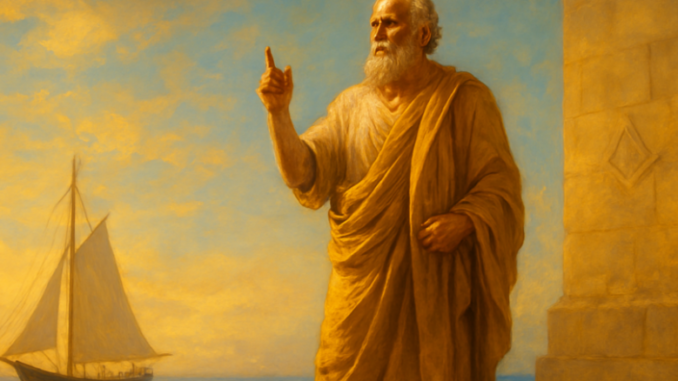
Can a list of rules truly make a person good? In Letter XCV of his extensive correspondence with Lucilius, the Roman Stoic philosopher Seneca poses a question that remains as provocative today as it was two thousand years ago. Rules and regulations surround us — in legal codes, workplaces, religious traditions, and everyday social life. Yet Seneca argues that all such prescriptions remain hollow without a deeper philosophical foundation. Genuine care for others does not begin with a commandment; it begins with an inner disposition. This insight strikes at the heart of a principle that also occupies a central place in Freemasonry.
The Core of Letter XCV: Rules Versus Wisdom
Letter XCV is one of the longest and most detailed letters in the collection known as the Epistulae Morales ad Lucilium. Here, Seneca addresses a fundamental debate within Stoic philosophy: is it enough to give people concrete rules of conduct, or do they need a deeper philosophical education to live a truly virtuous life? He takes a firm stand against the idea that a collection of isolated precepts — what the Stoics called praecepta — can suffice on its own. According to Seneca, such rules are like medicines that merely treat symptoms while leaving the underlying disease untouched.
Seneca draws a clear distinction between praecepta (precepts or rules) and decreta (foundational principles). Precepts tell a person what to do in a given situation: be hospitable, help the sick, speak the truth. But foundational principles go further. They form the bedrock from which a person can act rightly in any situation — including those that are entirely unforeseen. Without that bedrock, Seneca argues, a person is like a sailor with detailed sailing directions but no understanding of wind and current.
The Inadequacy of Rules Without Understanding
The central argument Seneca develops is paradoxical in its simplicity: the more rules a society needs, the further it has strayed from genuine virtue. In a world where people naturally acted with care and justice, laws and prescriptions would be unnecessary. Seneca evokes a mythical past — a golden age — when human beings were not yet driven by greed and self-interest, and mutual care was simply second nature. This reference to an ideal past is not meant as nostalgia but as a philosophical device: a contrast that sharpens our analysis of the present human condition.
Seneca illustrates his point with vivid examples from everyday life. He describes how a physician who merely follows prescriptions without understanding the nature of the disease will ultimately fail to heal the patient. A judge who applies only the letter of the law without grasping the spirit of justice may perpetuate injustice. In the same way, someone who dutifully follows every rule of conduct without understanding the values behind them will be utterly lost when an unexpected situation arises. Seneca’s aim is not to abolish rules, but to recognize their limitations.
Care for Others as a Philosophical Principle
What makes Letter XCV truly remarkable is the way Seneca elevates the concept of caring for others into a philosophical principle. He writes that the human being is by nature a social creature, destined for community. This idea — which traces back to Aristotle and was later developed further by Marcus Aurelius in his Meditations — forms the ethical backbone of Stoicism. Care for another person is not an obligation imposed from outside; it is an expression of true human nature. Those who have been philosophically educated, Seneca argues, recognize a kindred being in every fellow human and act accordingly.
For Seneca, caring for others is not a matter of obedience to rules but the natural consequence of philosophical insight into the interconnectedness of all people. In this context, he invokes a famous formulation that he attributes to the Stoic tradition: “I am a human being, and nothing human is alien to me.” Although this line originally comes from the Roman playwright Publius Terentius Afer (Terence), Seneca embraces it as a defining statement of the Stoic way of life. The human lot is shared, and anyone who truly understands this cannot help but be compassionate.
The Mirror of Ritual: Freemasonry and Inner Transformation
The tension Seneca exposes between outward prescriptions and inner formation resonates powerfully with the practice of Freemasonry. In lodge work, rituals are performed that may at first glance appear to be purely formal acts: prescribed words, prescribed movements, a prescribed sequence of events. But those who participate over time discover that the ritual is not the essence — it is a vehicle. The goal is not the flawless execution of a ceremony, but the inner transformation brought about through repetition and reflection.
Just as Seneca argues that rules have value only when they are grounded in philosophical understanding, Freemasonry regards its rituals as means toward self-knowledge and human connection. The care for others that Seneca advocates finds concrete expression in the lodge: in brotherly interaction, in genuine attention to one another, and in the aspiration to live as a better person beyond the lodge walls. The parallel is striking: both Seneca and the Masonic tradition warn that form without substance is empty.
Key Themes and Timeless Lessons
To summarize, Seneca addresses several core themes in Letter XCV that remain deeply relevant — both to philosophy and to the Masonic path:
Precepts versus principles: The distinction between praecepta (specific rules) and decreta (foundational principles) as the basis for ethical action. Rules tell us what to do; principles teach us why and how to think about what we do.
The medical analogy: A physician must understand the cause of a disease, not merely the treatment. Similarly, a moral agent must understand the roots of virtue, not merely its outward expressions.
The golden age as philosophical mirror: Seneca’s reference to a mythical past serves not as escapism but as a powerful contrast to the moral condition of his own time — and, by extension, ours.
Humanity as inherently social: The conviction that human beings are made for community, and that genuine care for others flows naturally from understanding this truth, lies at the heart of both Stoic ethics and Masonic brotherhood.
Seneca’s Letter XCV offers far more than an academic philosophical argument. It is an urgent call to move beyond mere compliance with rules and toward a life rooted in understanding, empathy, and genuine care. For Freemasons, this message holds particular resonance. The lodge teaches through symbol and ritual, but these are always means to a deeper end: the cultivation of an inner life that naturally expresses itself in care for others. Seneca reminds us that no list of commandments can substitute for the philosophical — and deeply human — work of becoming truly good. It is a lesson worth revisiting, in the lodge and in life.
Copyright text & image: devrijmetselaar.nl
Texts are based on the ideas and content of the author of devrijmetselaar.nl, reviewed, corrected, and supplemented with the assistance of OpenAI. Images are created based on the ideas of the author of devrijmetselaar.nl using OpenAI/DALL-E.
Frequently Asked Questions
What is the main difference between praecepta and decreta in Seneca's Letter XCV?
Praecepta are specific rules or precepts that tell a person what to do in given situations, such as being hospitable or helping the sick. Decreta are foundational principles that form the deeper bedrock from which a person can act rightly in any situation, even unforeseen ones. Seneca argues that decreta are essential because precepts alone are insufficient without understanding the underlying principles.
Why does Seneca argue that rules alone cannot make a person good?
Seneca contends that rules without a deeper philosophical foundation remain hollow and merely treat symptoms rather than addressing the underlying disease. He argues that genuine care for others does not begin with a commandment but with an inner disposition. A person with only rules to follow is like a sailor with sailing directions but no understanding of wind and current.
How does Seneca's philosophy connect to Freemasonry?
According to the article, Seneca's insight that genuine care for others requires an inner philosophical foundation strikes at the heart of a principle that occupies a central place in Freemasonry. Both emphasize that true virtue and moral conduct stem from deeper wisdom and personal development rather than from rules and regulations alone.



Be the first to comment