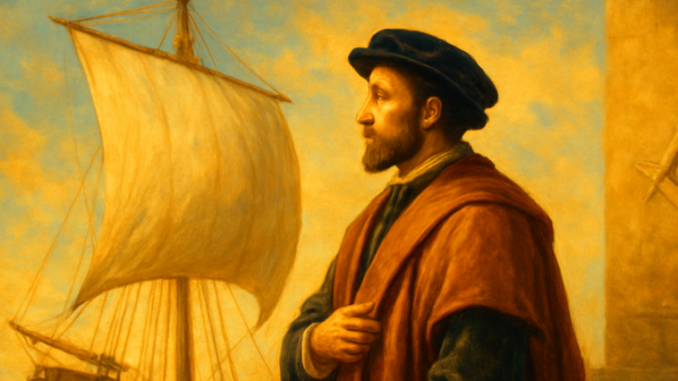
You probably recognize this scenario: someone with the best of intentions lectures others about how they should live, while quietly struggling with those very same shortcomings. Or perhaps you’ve caught yourself offering unsolicited advice when your own house was far from being in order. In the sixteenth century, Michel de Montaigne wrote a remarkably short but incisive essay on this very phenomenon — that preaching virtue can itself become a kind of vice. His observation touches on something that also lies at the heart of Freemasonry: true wisdom begins with self-reflection, not with correcting others.
The Paradox of Moral Admonition
Montaigne observed that some people are so busy proclaiming virtue that they forget to practice it themselves. Preaching becomes a form of self-deception — a way of masking personal failings behind a façade of moral superiority. The philosopher from Bordeaux had little patience for this kind of posturing. He saw clearly how rhetorical display so often substitutes for genuine character development.
This is not a cynical observation but a call for honesty. Montaigne genuinely believed in virtue, yet he understood that true virtue is quiet work. It is the daily discipline of self-examination, the willingness to face your own shadow side. Those who constantly tell others how to live are often avoiding the far more difficult confrontation with themselves.
Self-Reflection as the Foundation
In Freemasonry, the principle of self-reflection forms the bedrock of all further growth. The rough ashlar that the Entered Apprentice must symbolically work upon is not a project you can outsource to others. It represents your own character, your own imperfections. The gavel and chisel are tools for inner work — not for chipping away at your brethren.
Montaigne would have appreciated this symbolism deeply. Throughout his essays, he continually returns to the Delphic maxim “Know thyself” — not as a casual philosophical exercise, but as a way of life. He did not write to tell others how to live; he wrote to understand himself more honestly. His essays are not sermons but candid explorations of his own thoughts, contradictions, and weaknesses.
True virtue is not proclaimed through words — it reveals itself in the silence of your deeds and the honesty of your self-examination.
Brotherhood Without Condescension
One of the most admirable aspects of Masonic brotherhood is the equality inherent in the shared search. Brethren do not meet as teacher and pupil in any conventional sense, but as fellow travelers on a common path. This does not mean that wisdom goes unshared or experience untransmitted. It means that no one elevates himself above others by claiming to possess the truth.
Montaigne implicitly warned against the danger of spiritual arrogance. When someone presents himself as the embodiment of virtue, it creates distance rather than connection. Genuine brotherhood emerges when people dare to acknowledge together that they are still on the journey — that they make mistakes, that they still have much to learn. That vulnerability is not weakness; it is the very foundation of authentic human connection.
The Search for Truth and Light
Freemasonry speaks of the search for light and knowledge. This light is not an external authority that can be claimed or transmitted through words alone. It is an inner illumination that arises through honest inquiry, through the willingness to question your own assumptions. Montaigne embodied this attitude in his famous question: Que sais-je? — What do I actually know?
This intellectual humility stands in sharp contrast to the moral crusader who constantly measures others against his own standard. Montaigne understood that genuine wisdom begins with acknowledging your own ignorance. Those who believe they know everything have stopped learning. Those who consider themselves morally perfect have stopped growing.
Virtue as a Living Practice
Both Montaigne and the Masonic tradition emphasize that virtue is not a theoretical concept but a living practice. It is not about what you profess to believe, but about how you behave when no one is watching. It is about the small daily choices, those moments when your integrity is tested without an audience.
Consider these practical dimensions of virtue: honesty with yourself, even when it is painful; restraint in judging others; the willingness to acknowledge your own mistakes and learn from them; and compassion for the shortcomings of your fellow human beings. These are not abstract ideals — they are concrete attitudes that must be practiced anew every single day.
Montaigne would say that it is far easier to write about virtue than to be virtuous. And that is precisely why his warning remains so valuable: beware the moment when your words begin to replace your deeds.
Connection Through Authenticity
What makes Montaigne’s insight so relevant for today’s Freemason is his emphasis on authenticity as the prerequisite for real connection. You cannot build genuine brotherhood on a foundation of performed perfection. Only when you dare to show who you truly are — with all your imperfections — can there be sincere human connection.
The lodge is not a place for moral competition or spiritual display. It is a space where people can work together on their inner growth, knowing that no one has arrived at the destination. That shared imperfection is, paradoxically, the basis of true fellowship. Montaigne understood this well: the person who knows his own weakness stands closer to wisdom than the preacher who believes he must save others.
Michel de Montaigne’s brief but powerful essay reminds us that the path to virtue does not run through admonishing others but through honest work on ourselves. For Freemasons, this message resonates profoundly: the rough ashlar that needs shaping is always your own stone. The gavel is in your hand not to strike at your brother’s faults, but to refine the person you are becoming — quietly, humbly, and with unflinching self-honesty.
Copyright text & image: devrijmetselaar.nl
Texts are based on the ideas and content of the author of devrijmetselaar.nl, reviewed, corrected, and supplemented with the assistance of OpenAI. Images are created based on the ideas of the author of devrijmetselaar.nl using OpenAI/DALL-E.

Be the first to comment