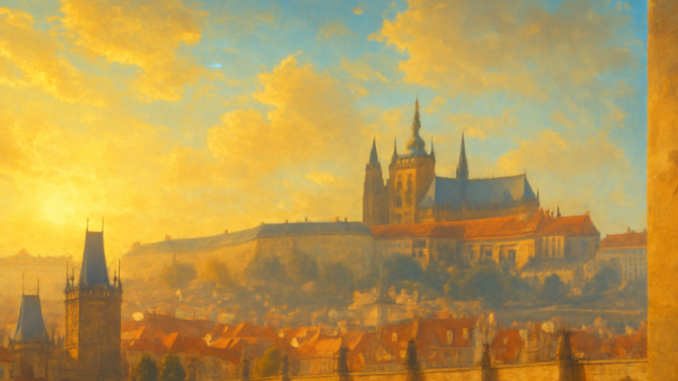
Why did Dan Brown choose Prague as the setting for The Secret of Secrets? And what mystical claims does he make about a city that for centuries attracted alchemists, astronomers, and seekers of hidden truth? The novel paints the Bohemian capital as far more than a picturesque backdrop — it becomes a character in its own right, steeped in secrets. Let’s explore what the book suggests about Prague, and why those claims both fascinate and demand closer scrutiny.
What Makes Prague So Special in the Story?
In The Secret of Secrets, Dan Brown presents Prague not merely as scenery but as an active participant in the mystery. The novel positions the city as a kind of spiritual nexus where different esoteric traditions converge. Prague is portrayed as a place where the boundary between the visible and the hidden is thinner than anywhere else — a city built on secrets.
Is there historical truth behind this? To some extent, yes. Under Emperor Rudolf II, who reigned from 1576 to 1612, Prague genuinely became a magnet for mystics, alchemists, and scholars. Johannes Kepler worked there on his astronomical calculations, while figures like John Dee and Edward Kelley sought the emperor’s favor with their occult experiments. This historical reality forms the foundation upon which Brown constructs his fictional claims.
Which Specific Locations Play a Role?
Brown focuses on well-known locations and imbues them with layers of symbolic meaning. The Charles Bridge, with its thirty statues of saints, is interpreted in the novel as a path of initiation. The Old Jewish Cemetery and the legends surrounding Rabbi Judah Loew and the Golem are given a central place. And then there is the Golden Lane at Prague Castle, where alchemists supposedly searched for the Philosopher’s Stone.
What The Secret of Secrets does is connect these historical locations into a coherent network of hidden knowledge. The book suggests that these sites are not coincidentally where they are, but rather form part of a larger design — a coded message written in stone and street.
How Does Brown Weave Freemasonry into Prague’s Story?
This is where things get particularly interesting. In The Secret of Secrets, Brown suggests that Masonic lodges in Prague became the custodians of older, pre-modern mysteries starting in the eighteenth century. The book claims that the urban planning and architecture of certain Prague neighborhoods contain Masonic symbolism — hidden from the untrained eye but legible to those who possess the key.
There is a thought-provoking line to consider here: Freemasonry does not guard Prague’s secrets; rather, it is itself one of many chapters in the city’s book of mysteries.
The historical reality is more nuanced. Freemasonry did indeed arrive in Bohemia during the eighteenth century, and lodges attracted enlightened minds interested in philosophy, science, and brotherhood. However, the direct link that Brown draws between medieval alchemy, Kabbalistic traditions, and later Masonic lodges is primarily a literary construction — not an established historical fact.
What Does the Book Claim About Hidden Knowledge?
A central theme in The Secret of Secrets is the idea that an “original wisdom” has been preserved in Prague — a body of knowledge older than Christianity, rooted in Hermetic and Neoplatonic traditions. Brown suggests that this knowledge was passed down from generation to generation through various channels, including alchemical circles and later Masonic lodges.
The book cleverly builds on real historical developments. The Renaissance did indeed see a revival of interest in Hermetic writings attributed to the mythical Hermes Trismegistus. Scholars such as Marsilio Ficino and Pico della Mirandola in Florence, and later figures at the court of Rudolf II, studied these texts intensively. Brown’s fiction builds on this historical foundation but extrapolates toward conclusions that no serious historian would endorse.
Is There a Kernel of Truth?
As with much of Dan Brown’s work, the power lies in the blending of fact and fiction. Prague truly was a center of intellectual and spiritual exploration in the sixteenth and seventeenth centuries. The city attracted thinkers who wanted to push beyond established frameworks. And yes, Freemasonry has historically maintained a special relationship with symbolism, architecture, and the pursuit of self-knowledge.
But the specific claims in The Secret of Secrets — about coded messages embedded in city plans, about direct lines connecting Rudolf II to later Masonic societies, about Prague as the guardian of an ancient secret — belong to the realm of fiction, not historiography.
Why Does This Narrative Continue to Captivate?
Perhaps because there is something in all of us that yearns for hidden meaning. The idea that beneath the surface of everyday life lies a deeper layer of truth speaks powerfully to the imagination. Freemasonry itself plays into this dynamic: the rituals and symbols of the Craft invite reflection and encourage the search for what is not immediately visible.
What Dan Brown does with Prague in The Secret of Secrets is ultimately what every skilled storyteller does — he takes elements from reality and weaves them into a narrative that is greater than the sum of its parts. Whether you take that story literally or use it as a springboard for further study remains entirely up to you as a reader.
The mystical claims about Prague in The Secret of Secrets are fascinating, but they call for careful nuance. The city has an undeniable and rich history as a crossroads of esoteric traditions, and Freemasonry is one of many threads in that tapestry. Anyone reading Dan Brown’s novel would do well to see it as a doorway to questions, not a source of answers. The real journey begins where the fiction ends.
Copyright text & image: devrijmetselaar.nl
Texts are based on the ideas and content of the author of devrijmetselaar.nl, reviewed, corrected, and supplemented with the assistance of OpenAI. Images are created based on the ideas of the author of devrijmetselaar.nl using OpenAI/DALL-E.

Be the first to comment