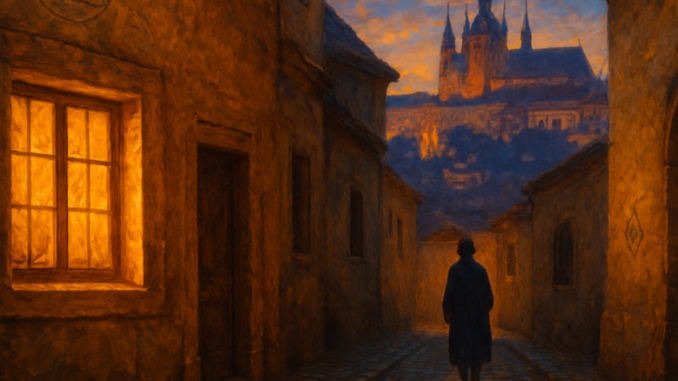
In his thriller The Secret of Secrets, Dan Brown takes readers to Prague — a city he portrays as the beating heart of European esotericism. But how much of this mystical reputation is rooted in historical fact, and where does the novelist begin weaving his own narrative? This deep dive places the book’s claims alongside the real history of the Czech capital, exploring what holds up to scrutiny and what belongs firmly in the realm of fiction.
The Novelist’s Perspective
Dan Brown has built a career on a distinctive method: he interweaves historical facts with speculation and outright invention to create irresistible page-turners. In The Secret of Secrets, Prague takes center stage as a gathering place for alchemists, Hermeticists, and secret societies. The city appears as a kind of permanent treasure vault of hidden knowledge, where initiates guarded their mysteries for centuries. It’s a compelling image — but one that deserves careful examination against what historians can actually substantiate.
From the perspective of a thriller writer, this kind of embellishment makes perfect sense. A novelist seeks drama and mystery, not academic nuance. Brown cherry-picks the most colorful episodes from the city’s history and connects them into a cohesive narrative of secrecy and intrigue. The real question is: where does documentable history end and literary license begin?
The Historian’s Perspective
Historical research confirms that Prague did indeed play a remarkable role in European intellectual history. Under Emperor Rudolf II (1552–1612), the city became a magnet for scholars, artists, and — yes — alchemists. This is no fiction: archival records show that figures such as the English mathematician John Dee and the alchemist Edward Kelley resided at the Prague court. The famous Golden Lane (Zlatá ulička) is still popularly associated with alchemical practices, though modern research reveals the lane originally housed castle guards rather than gold-makers.
Prague’s astronomical tradition is equally well documented. Tycho Brahe and Johannes Kepler carried out their groundbreaking observations there. The famous Astronomical Clock on the Old Town Square dates back to 1410 and is one of the oldest still-functioning astronomical clocks in the world. These are verifiable facts that rightly earn the city a place in the history of European science and culture.
What Is Exaggerated or Unproven
Where The Secret of Secrets crosses the boundary of the demonstrable is in its suggestion of an unbroken, organized network of initiates that supposedly operated in Prague for centuries. While Masonic lodges have verifiably existed in Prague since the eighteenth century, there is no historical evidence for the kind of large-scale, hidden organization Brown implies. Freemasonry in Bohemia developed along the same pattern as elsewhere in Europe: as a network of local lodges with gradual growth — not as a secret power pulling strings behind the scenes.
Fact: Rudolf II did indeed collect art treasures and occult manuscripts, including the enigmatic Voynich Manuscript.
Exaggerated: The suggestion that this collection was part of a larger, coordinated mystery school system lacks historical evidence.
Fiction: The invented locations and tunnel systems Brown describes have no archaeological confirmation whatsoever.
Where Both Perspectives Agree
What’s striking is that both the novelist and the historian acknowledge that Prague exerted a genuine pull on seekers of knowledge. The city sat at a crossroads of cultures — a meeting point between East and West, Catholic and Protestant, Slavic and Germanic. This geographic and cultural position made it a natural breeding ground for intellectual exchange. This fact needs no embellishment to be impressive.
Prague was a real meeting place for scholars and seekers, but the organized mystical underground Dan Brown suggests remains literary fantasy. The truth is compelling enough on its own terms.
Lessons in Separating Fact from Fiction
The comparison between the novel’s version and historical reality teaches us something essential about how mystery works. Dan Brown builds on a genuine core of extraordinary history and amplifies it into a story that captivates millions of readers. The historian sticks to what is provable and typically arrives at more modest conclusions. Neither approach is inherently superior: the novel inspires curiosity, while historical research provides solid ground.
For those interested in the actual esoteric traditions of Prague, academic studies on the court of Rudolf II and early Freemasonry in Central Europe offer a far more nuanced picture. Works by historians such as R.J.W. Evans (Rudolf II and His World) document the genuine cultural flourishing without the sensationalism of conspiracy theories.
The Value of Reading Critically
Dan Brown’s The Secret of Secrets is entertaining fiction that makes effective use of real historical elements. The book invites readers to investigate further on their own — and that may be its greatest merit. But anyone who truly wants to understand Prague as a historical city would do well to distinguish the novel’s version from documentable facts. The real history may be less spectacular than the fiction, but it is no less fascinating for those willing to dig deeper.
Prague deserves its reputation as a remarkable European city with a rich intellectual history. The mystical sheen Dan Brown gives it in The Secret of Secrets is partly based on facts but largely magnified to literary proportions. For the critical reader, this tension between fact and fiction offers a valuable invitation: to explore for yourself where history ends and the story begins. And in doing so, you may discover that the real Prague — with its Masonic heritage, its scientific legacy, and its centuries of cultural exchange — is every bit as captivating as any novel.
Copyright text & image: devrijmetselaar.nl
Texts are based on the ideas and content of the author of devrijmetselaar.nl, reviewed, corrected, and supplemented with the assistance of OpenAI. Images are created based on the ideas of the author of devrijmetselaar.nl using OpenAI/DALL-E.
Frequently Asked Questions
How much of Dan Brown's portrayal of Prague in The Secret of Secrets is historically accurate?
While Prague did play a significant role in European intellectual history, particularly under Emperor Rudolf II (1552-1612) when alchemists and scholars like John Dee and Edward Kelley resided there, Dan Brown embellishes historical facts with speculation and invention for dramatic effect. Verifiable elements include Prague's astronomical tradition with figures like Tycho Brahe and Johannes Kepler, and the famous Astronomical Clock dating to 1410. However, popular associations—such as the Golden Lane being a center for alchemical practices—are exaggerated; historical records show it originally housed castle guards rather than alchemists.
What is the difference between how novelists and historians approach Prague's mystical reputation?
Novelists like Dan Brown cherry-pick the most colorful historical episodes and connect them into a cohesive narrative of secrecy and intrigue to create compelling fiction. Historians, by contrast, examine documentable evidence and archival records to establish what can be substantiated. Brown's method prioritizes drama and mystery over academic nuance, intentionally blurring the line between historical fact and literary invention to create page-turning thrillers.
Which historical figures and landmarks in Prague have genuine connections to esoteric knowledge?
Documented historical facts include the residence of English mathematician John Dee and alchemist Edward Kelley at the Prague court under Emperor Rudolf II, Prague's well-documented astronomical tradition with observers like Tycho Brahe and Johannes Kepler, and the Astronomical Clock on Old Town Square (dating to 1410), one of the oldest functioning astronomical clocks in the world. However, the Golden Lane's popular association with alchemy is largely unproven, as research reveals it originally housed castle guards.

Be the first to comment