
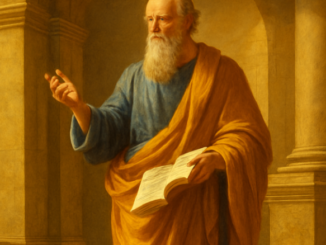
You’re facing a difficult choice. Everyone around you is doing things differently, but deep down you know there’s a better path. How do you find the courage to walk it? The Epistle to the Romans, written by the apostle Paul to the early community in Rome, offers surprisingly practical guidance for moments like these. As the sixth installment in our series on the New Testament, this article explores how the core message of Romans connects with principles that lie at the heart of Freemasonry: moral growth, inner transformation, and the ongoing work of building a better self.
The Heart of Romans: Renewal From Within
Paul wrote this letter around the year 57 AD to a community he had never visited. Yet the text contains his most fully developed thoughts on what it truly means to change. The central message is not about following rules — it’s about a fundamental reorientation of your inner compass. In chapter 12, Paul writes his famous exhortation about the renewing of the mind, so that you may discern what is truly good.
This theme of inner transformation resonates immediately within Freemasonry. Where the rough ashlar symbolizes the unrefined self, the Epistle to the Romans points toward the same process: you are not bound by who you were — you can actively work on who you are becoming. Not through outward display, but through inner labor.
When Old Habits Hold You Back
In chapter 7, Paul describes a struggle that every human being recognizes: you know what is right, yet you do the opposite. You resolve to be patient, and before you know it you’ve snapped at someone. You want to live more consciously, but you reach for distraction on autopilot. This tension between intention and action is a universal part of the human condition.
The Stoic philosopher Marcus Aurelius, whose writings are widely read in Masonic circles, described very similar struggles in his personal meditations. The gap between knowing and doing is exactly where real growth takes place. The Epistle to the Romans doesn’t offer a magic fix, but it does provide a realistic perspective: acknowledge the struggle, and work through it step by step.
Practical Steps From Paul’s Letter
What makes Romans so practically applicable? In the final chapters, Paul offers concrete guidance that you can translate directly into daily life:
- Let your love be sincere — without hidden agendas or calculation.
- Honor others above yourself — not from weakness, but from conscious choice.
- Be diligent in whatever you do — never let laziness govern you.
- Live at peace with everyone, as far as it depends on you.
- Overcome evil with good — not through retaliation.
These principles find clear parallels in Freemasonry. The compasses remind us to keep our actions within the bounds of what is morally right. The square calls for honesty and integrity in our dealings with others. Paul’s letter and the symbolism of the lodge point toward the same daily practice: consciously choosing the better path.
The Body as Temple: Building Yourself
One of the most striking images in Romans is the idea of the body as a living sacrifice — a place where goodness takes shape. This connects beautifully with the Masonic concept of the self as a temple under construction. Just as King Solomon’s Temple, whose symbolism is central to Masonic ritual, was not built in a single day, your own inner development requires patience and perseverance.
You don’t build the inner temple with grand gestures, but with the small stones of daily choices.
In practical terms, this means choosing anew each morning. When you wake up, take a moment to set your intention for the day. When conflict arises, ask yourself which response builds and which one tears down. It is these moments of conscious choice that shape your character over time.
Brotherhood Beyond Boundaries
The Epistle to the Romans also addresses the tension between different groups within the early community. Paul advocates for unity without uniformity. He acknowledges that people hold different convictions and customs, and he calls for mutual respect rather than judgment over each other’s choices.
This principle of tolerance is a cornerstone of Freemasonry. In the lodge, people from different backgrounds, faiths, and worldviews come together — not to change each other’s minds, but to work side by side on shared values. Paul’s letter reminds us that true brotherhood emerges when we can embrace difference without condemning it.
Motivation for the Long Road
Transformation is not a sprint — it’s a marathon. Paul understood this when he wrote to people he had never met. The power of Romans lies not in spectacular promises but in the realism with which it describes the human condition. You will stumble. You will fall back into old patterns. But every time you get up and begin again, you build further.
The philosopher Augustine, who read the Epistle to the Romans centuries later, described how it was precisely this realism that moved him so deeply. Not the expectation of perfection, but the recognition of imperfection as the starting point for growth. This is not a license for complacency — it is an invitation to be gentle with yourself while remaining firm in your intentions.
The Epistle to the Romans is not detached theology — it is a practical guide for anyone serious about personal development. The connections with Masonic principles are abundant: the inner temple, the moral labor, brotherhood across boundaries, and the daily choice of light over darkness. Take one concrete point from this letter today and put it into practice. Start small, but start. Because the rough ashlar does not shape itself.
Copyright text & image: devrijmetselaar.nl
Texts are based on the ideas and content of the author of devrijmetselaar.nl, reviewed, corrected, and supplemented with the assistance of OpenAI. Images are created based on the ideas of the author of devrijmetselaar.nl using OpenAI/DALL-E.
Frequently Asked Questions
How does the Epistle to the Romans relate to Freemasonry?
Both Romans and Freemasonry emphasize inner transformation and moral growth rather than outward display. Paul's message about renewing your mind and actively working toward self-improvement mirrors the Masonic journey from the rough ashlar to the perfected stone, teaching us that we are not bound by who we were but can consciously build who we are becoming.
What practical advice does Paul offer in Romans that I can use in daily life?
Paul provides concrete guidance including practicing sincere love without hidden agendas, consciously choosing to honor others above yourself, maintaining diligence in your work, living at peace with everyone, and overcoming evil with good rather than through retaliation. These principles align directly with Masonic virtues symbolized by the square and compasses, helping you navigate ethical choices every day.
How does Romans address the struggle between knowing what's right and actually doing it?
Paul acknowledges this universal human tension in chapter 7, recognizing that the gap between intention and action is where real growth occurs. Rather than offering quick fixes, Romans encourages you to work through this struggle step by step, a perspective that resonates with the patient, deliberate self-improvement emphasized in Freemasonry.
Why is Romans considered Paul's most complete teaching on personal transformation?
Romans contains Paul's most fully developed thoughts on fundamental inner change, emphasizing a reorientation of your inner compass rather than mere rule-following. This depth of insight into genuine personal renewal makes it particularly valuable for Freemasons seeking to understand the spiritual and practical dimensions of their work.



Be the first to comment