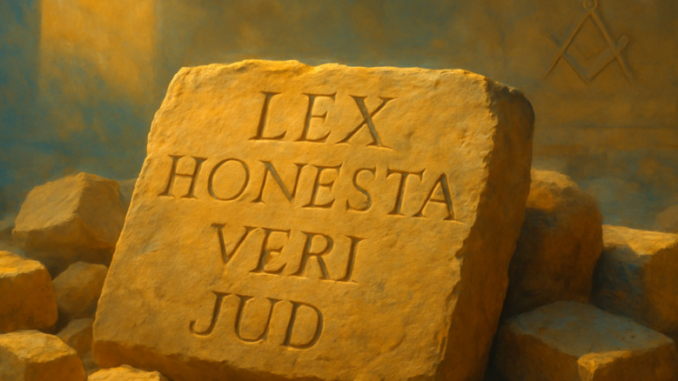
In July 2026, news broke of a tragic traffic accident in Suriname in which five people lost their lives at the hands of a driver who had no license. The court sentenced him to prison. But behind the headlines lies a deeper story — one about human responsibility, guilt, and the possibility of moral reconstruction. These are questions that have occupied humanity for centuries, and they hold a central place in the teachings of Freemasonry.
The Roman Foundation of Personal Accountability
In ancient Rome, legal scholars developed a concept that continues to shape our justice systems to this day: culpa — guilt through negligence. Roman jurists distinguished between different degrees of fault. A person who knowingly took a risk beyond their control bore a heavier responsibility than someone who caused harm by pure accident. A driver who knows he is not authorized to operate a vehicle, yet gets behind the wheel anyway, falls squarely into the first category.
The Lex Aquilia, dating from 286 BC, established that anyone who causes damage to another through their own actions must compensate for that damage. But the Romans also understood that money alone cannot suffice when human lives are lost. That is why they developed the concept of poena — punishment as society’s formal acknowledgment of the wrong committed. This dual approach — restitution and retribution — still forms the backbone of criminal law across the world.
Medieval Guilds and the Proof of Competence
A driver’s license is, at its core, a modern certificate of competence. But the idea behind it is far older than the automobile. In the medieval trade guilds, no one was permitted to practice a craft without first proving their mastery as an apprentice and journeyman. A mason who built a wall without authorization — and that wall collapsed — was not only held liable for the damage but also permanently stripped of the right to work in that trade.
The operative masons who built the great cathedrals and castles of Europe took this responsibility with the utmost seriousness. A poorly constructed arch or buttress could cost lives. It was from this tradition of craftsmanship and accountability that the speculative Masonic lodges eventually emerged — places where it was not stone that was shaped, but character. The underlying principle remained the same: anyone who takes on a task must first acquire the competence to carry it out safely.
Guilt as the Starting Point for Inner Work
Freemasonry holds a fundamental insight that may seem at odds with contemporary culture. Where modern society often looks for mitigating circumstances, external factors, or systemic failures, Masonic ethics begins with the individual. The rough ashlar — the symbol of a person at their initiation into the lodge — must be shaped through one’s own labor into a perfect cube.
Know thyself, read the inscription above the Temple of Delphi. This ancient wisdom reminds us that self-knowledge is the beginning of all wisdom — including the recognition of one’s own shortcomings.
This does not mean that a person should be reduced to their worst act. Quite the opposite. The acknowledgment of guilt opens the door to what eighteenth-century Enlightenment thinkers called moral reconstruction. A prison sentence, viewed through this lens, can serve as a period of enforced reflection — a dark chamber in which the convicted person, much like the candidate in the Masonic initiation ritual, is confronted with themselves.
The Community and the Individual
Five people lost their lives. Five families were scarred forever. The scale of this suffering is almost impossible to comprehend. In the eighteenth century, the Italian legal philosopher Cesare Beccaria wrote an influential treatise on crime and punishment, arguing that the severity of a penalty should be measured by the harm inflicted upon the community. The purpose of punishment, he maintained, should not be revenge but the restoration of social equilibrium.
Freemasonry takes a comparable view. Every Brother is connected to the greater whole, just as every stone in a cathedral has its designated place within the structure. When one stone fails, the entire building suffers. But the solution is not to discard that stone. The solution is to understand why it failed and to work toward a stronger foundation.
What History Teaches Us Today
The tragic accident in Suriname confronts us with questions as old as civilization itself: How do we weigh personal responsibility against societal factors? Can a person who has gravely failed ever be fully rehabilitated? What is the purpose of punishment — retribution, protection, or transformation? How do we honor the victims without dehumanizing the offender?
History offers no simple answers, but it does offer perspective. From the Roman jurists to the medieval guild masters, from the Enlightenment philosophers to today’s ethicists, all recognized that responsibility begins with the individual but does not end with the punishment. The true challenge lies in what comes after.
A prison sentence does not mark the end of a story — it marks a turning point. The question that history poses, and that stands at the heart of Freemasonry, is not merely how we punish the guilty, but how we as a society create space for remorse, restoration, and ultimately rebuilding. For every rough ashlar, no matter how damaged, contains within it the possibility of a perfect cube. To deny that possibility would be to abandon our very humanity.
Copyright text & image: devrijmetselaar.nl
Texts are based on the ideas and content of the author of devrijmetselaar.nl, reviewed, corrected, and supplemented with the assistance of OpenAI. Images are created based on the ideas of the author of devrijmetselaar.nl using OpenAI/DALL-E.
Frequently Asked Questions
What does Freemasonry teach about personal responsibility?
Freemasonry teaches that personal responsibility begins with the individual and self-knowledge. Rather than looking for external excuses, Masonic ethics emphasizes that each person must examine themselves and take accountability for their actions, using this awareness as the foundation for moral growth and character development.
How does Freemasonry connect to medieval trade guilds?
Freemasonry evolved from the operative masons of medieval guilds, who were required to prove their competence before practicing their craft. This tradition of accountability and mastery carried over into speculative Freemasonry, where the focus shifted from shaping stone to shaping character through rigorous self-improvement and moral instruction.
What is the significance of the 'rough ashlar' symbol in Freemasonry?
The rough ashlar represents a person at the beginning of their Masonic journey—unrefined and imperfect. Through dedicated work and self-discipline, it must be shaped into a perfect cube, symbolizing the transformation that occurs when an individual takes responsibility for their own moral and spiritual development.
How does Freemasonry view guilt and moral mistakes?
Freemasonry views guilt not as something to be avoided or minimized, but as the starting point for inner work and self-improvement. Rather than seeking excuses, Masonic teaching encourages individuals to acknowledge their failures, learn from them, and use this knowledge to rebuild their character and become better members of society.

Be the first to comment