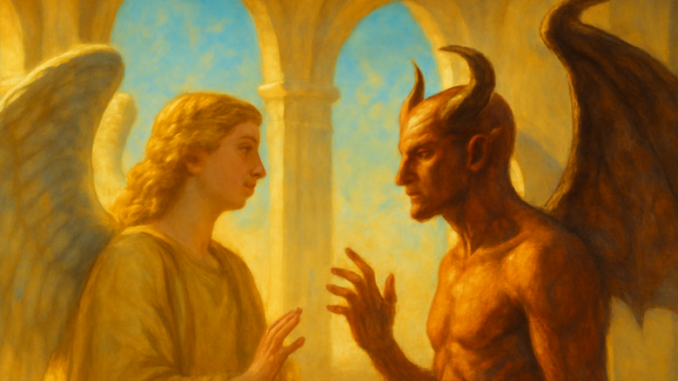
The premise seems airtight at first glance: the ambigrams in Dan Brown’s thriller Angels & Demons prove the existence of an ancient secret society that concealed its messages through ingenious symbols. But what if this premise works in exactly the opposite direction? What if the symbols don’t confirm the fiction — but the fiction invented the symbols? This article examines the boundary between literary imagination and historical symbolism, and asks a question that is seldom posed aloud: what do we actually know about ambigrams, and what have we simply believed because a novel suggested it?
The Claim: Ancient Secret Symbols
In Angels & Demons, Dan Brown presents ambigrams as mysterious marks used by the Illuminati to signal their presence. The story suggests that these symmetrical word-images have existed for centuries and were recognized by initiates as signs of a hidden brotherhood. The protagonist discovers brands bearing words that are legible both right-side up and upside down. The implication is unmistakable: these are authentic historical artifacts of a secret society.
And here is where the trouble begins. Historical reality tells an entirely different story. The ambigrams in the book were not unearthed from archives or excavated from old lodges. They were designed by the contemporary graphic artist John Langdon, specifically for the novel. This is no hidden fact — Dan Brown thanks Langdon explicitly in his book and even named his protagonist, Robert Langdon, after him. The symbols are not seventeenth-century discoveries; they are creations from the 1990s.
Ambigrams: A Modern Art Form
The word “ambigram” was only introduced in 1983 by cognitive scientist Douglas Hofstadter. While the art form itself is somewhat older, its systematic practice is a twentieth-century phenomenon. There are no historical sources demonstrating that the historical Illuminati — founded by Adam Weishaupt in 1776 in Bavaria — ever used ambigrams. The archives of this short-lived society, which was banned in 1785, contain correspondence, membership lists, and organizational documents, but no symmetrical word-images.
The ambigrams in Angels & Demons are not historical discoveries. They are modern artworks, specially created for the novel.
That does not mean ambigrams are uninteresting from the perspective of symbolism. On the contrary, they illustrate a fascinating principle: how form and meaning can converge in a visual puzzle. But their origin lies in graphic art, not in esoteric traditions. The confusion arises because fiction and presentation blend so convincingly that readers lose sight of where one ends and the other begins.
What the Historical Illuminati Actually Used
The real Bavarian Illuminati did indeed employ symbols and codes, but these were of an entirely different order. They used pseudonyms drawn from classical antiquity: Weishaupt called himself Spartacus, while others adopted names like Cato or Brutus. Their communication relied on coded letters using cipher systems — not graphic artworks. The Owl of Minerva appears in some of their documents as a symbol of wisdom, but this was a common Enlightenment emblem, not an exclusive Illuminati sign.
The historical Illuminati existed as a formal organization for only nine years. Their influence has been enormously exaggerated by later conspiracy theories. Historians such as Reinhard Markner and Monika Neugebauer-Wölk have conducted extensive research into the primary sources. Their conclusion is unambiguous: the Illuminati were a radical Enlightenment movement with political ideals, not an occult order trafficking in mystical symbols.
Fiction as a Source of Misconceptions
The phenomenon Dan Brown illustrates extends far beyond a single novel. Fiction has the power to spread pseudo-history as though it were proven fact. Freemasonry knows this phenomenon all too well. Countless misunderstandings about lodges, rituals, and symbols can be traced back to literary sources that were never intended as historical documents. The square and compasses, the all-seeing eye, the pyramid — all symbols that have acquired meanings in popular culture which diverge significantly from their actual context.
This raises a philosophical question that reaches beyond mere fact-checking. When a symbol is recognized by millions of people as a sign of something, does it still matter what the original meaning was? The ambigrams from Angels & Demons now exist as cultural objects, independent of their fictional origin. They have been tattooed on bodies, printed on merchandise, and studied by graphic designers. Their fictitious provenance changes nothing about their visual power.
Symbolism and the Search for Truth
For anyone seriously engaged in the study of symbols, this case offers a valuable lesson. Symbols derive their power not exclusively from their historical origins, but also from the meaning that communities assign to them. Freemasonry works with symbols that are sometimes centuries old, sometimes much younger, but always living. A symbol that is no longer understood or used is dead. A symbol that is misunderstood but alive in the collective consciousness raises questions of a different kind entirely.
Dan Brown’s ambigrams are not forgeries in the conventional sense. They were never presented as archaeological finds outside the context of the novel. It is the reception — the way readers blended fiction with reality — that led to misunderstanding. This perhaps says more about our hunger for mystery than about the author or his artist.
Here, something remains unresolved. If we know that the ambigrams are modern, that the Illuminati never used such symbols, that the novel is a work of fiction — why does the fascination endure? Perhaps because symbols appeal to something deeper than historical accuracy. They speak to our longing for hidden meaning, for patterns beneath the surface, for the possibility that the world contains more than meets the eye. And that longing, whether we encounter it in a Masonic lodge or in the pages of a bestselling thriller, may be the most powerful symbol of all.
Copyright text & image: devrijmetselaar.nl
Texts are based on the ideas and content of the author of devrijmetselaar.nl, reviewed, corrected, and supplemented with the assistance of OpenAI. Images are created based on the ideas of the author of devrijmetselaar.nl using OpenAI/DALL-E.

Be the first to comment