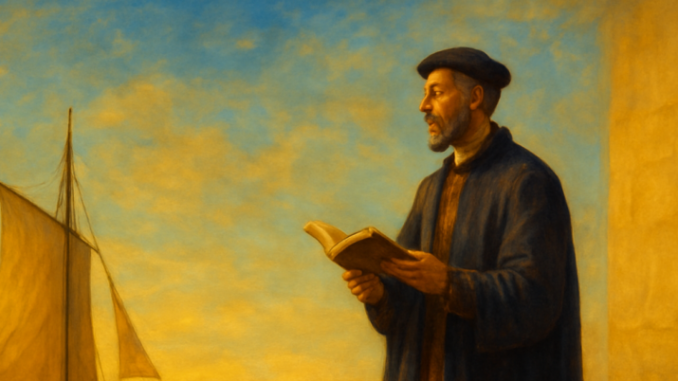
A mirror shows more than just a face. Gaze long enough, and you begin to see what lies behind it — expectations, prejudices, unexamined certainties. In his famous essay on the inhabitants of the New World, Michel de Montaigne holds up exactly this kind of mirror. He describes people whom his contemporaries dismissed as primitive savages, then quietly turns the question around: who, exactly, is the barbarian here? This challenge strikes at the very heart of what Freemasons seek in their work — not the judgment of others, but the courage to see oneself reflected in the other and arrive at deeper self-knowledge.
The Mirror as a Tool for Self-Insight
When Montaigne writes about the peoples of Brazil, he does something unexpected. Rather than depicting them as inferior, he describes their customs with genuine curiosity and respect. He observes that their society functions without written laws, without private property, without deception. Their so-called cannibalism — however horrifying to European sensibilities — he places in sharp perspective by pointing to the cruelties his own countrymen committed during the Wars of Religion.
Here the symbolic power of the mirror reveals itself. Montaigne uses his description of the other to make the familiar visible. His message is clear: do not look at them to feel superior — look at them to better understand yourself. This reflective way of thinking is also the foundation of Masonic labour. In the lodge, every brother is invited to examine himself, not out of vanity, but out of a sincere desire for authentic self-knowledge.
Prejudice as the Rough Stone
The rough ashlar is one of Freemasonry’s most enduring symbols — the human being in an unworked state, full of imperfections, sharp edges and uneven surfaces that still need to be smoothed. Montaigne’s essay reveals just how deeply our prejudices are embedded. We call something barbaric because it is unfamiliar, not because it is objectively worse than what we ourselves do. The Brazilian peoples consumed the flesh of their enemies after battle as a ritual act of honour. Europeans burned living human beings at the stake over theological disagreements.
Working the rough stone means chipping away at these prejudices — not by denying them, but by confronting them honestly. Montaigne wrote that we may freely call something monstrous, but let us then also acknowledge the monsters we ourselves produce. This demands courage. It demands the willingness to endure the discomfort that arises when our certainties begin to crumble.
Brotherhood Beyond Borders
Through Montaigne’s essay, the concept of brotherhood takes on a deeper dimension. Brotherhood is not limited to those who resemble us, speak our language, or share our customs. True connection emerges precisely when we are able to recognise the humanity in someone who is different. Montaigne describes how the Brazilian peoples possessed a highly developed sense of honour, loyalty, and community — values that also stand at the centre of Masonic tradition.
To truly understand another person, you must first be willing to turn the mirror toward yourself.
This attitude of openness and curiosity is what Freemasonry strives for. In the lodge, people from diverse backgrounds come together not to criticise each other’s convictions, but to work collectively toward inner growth. Montaigne’s essay reminds us that genuine connection begins with the suspension of judgment.
The Light of Knowledge Dispels the Shadows
In Freemasonry, light is frequently used as a symbol of knowledge and insight, while darkness represents ignorance — the unseen. Montaigne’s method works in precisely this way: he shines a light on what remained hidden behind walls of prejudice. By carefully describing what he had heard and read about the New World, he compelled his readers to look beyond the surface.
This search for light is not a one-time act. It is an ongoing process of asking questions, of refusing to settle for the first answer. Montaigne was a master of keeping questions open. His essays rarely end with firm conclusions. Instead, they invite further thought — a continued grinding against the rough stone of our understanding.
The Ritual of Encounter
Montaigne recounts how he once met three Brazilian men who had been brought to France. He asked them what they found most astonishing about French society. Their answers were revelatory: they could not understand why grown, armed men would obey a child as their king. And they could not comprehend why some people lived in extravagant wealth while others begged at their gates.
In this encounter, a ritual of mutual reflection unfolded. Montaigne looked at them; they looked at his world; and both sides saw something that had previously been invisible. This is the power of genuine connection — it reveals the blind spots in our own vision. Freemasons recognise this principle from their rituals, where every encounter with the unknown is also an encounter with the self.
The Virtue of Humility
Perhaps the most important lesson of Montaigne’s essay is one of humility. Not the false humility that claims to know nothing while asserting everything, but the sincere acknowledgment that our perspective is limited. That our customs are not the measure of all things. That what we call civilisation is sometimes nothing more than habit we have stopped questioning.
For Freemasons, this humility is not a weakness but a prerequisite for growth. Only those who admit they are not yet complete can continue to work on themselves. Montaigne demonstrated that this labour begins with the willingness to look at the other without immediately passing judgment — and to see in that other a mirror for the parts of ourselves that still need refining.
Montaigne’s essay on the inhabitants of the New World is far more than a historical curiosity. It is an invitation to self-reflection that remains as vital today as it was centuries ago. For Freemasons, it serves as a powerful reminder that the work on the rough stone never truly ends — and that the mirror we find in the other is one of the most valuable tools on the path toward light. Every encounter, every moment of genuine curiosity about another person’s world, brings us closer to understanding our own. And in that understanding lies the foundation of true brotherhood.
Copyright text & image: devrijmetselaar.nl
Texts are based on the ideas and content of the author of devrijmetselaar.nl, reviewed, corrected, and supplemented with the assistance of OpenAI. Images are created based on the ideas of the author of devrijmetselaar.nl using OpenAI/DALL-E.

Be the first to comment