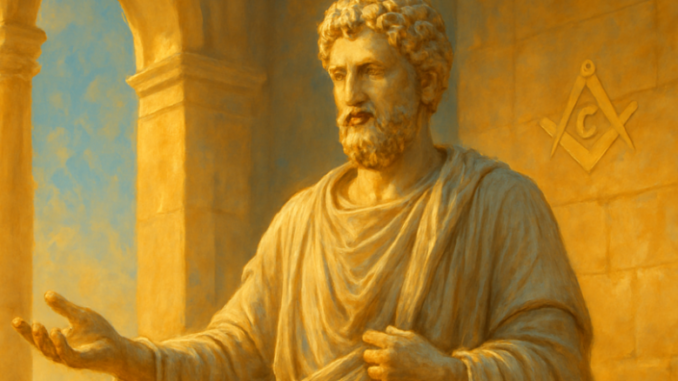
The twelfth and final book of Marcus Aurelius’ Meditations serves as the capstone of his philosophical journal. Here, at the close of his reflections, the Roman emperor confronts the most fundamental question any person can face: how do you prepare for the end of life? Far from being a gloomy meditation on death, Book XII is a powerful call for clarity and inner peace. For those familiar with the Masonic symbolism of the polished stone, much in these thoughts on completion and fulfillment will feel deeply familiar.
The Heart of Book XII: Acceptance as Wisdom
Marcus Aurelius never wrote his Meditations for publication. They were private exercises in Stoic philosophy — a conversation with himself. Book XII stands apart from the earlier volumes because of its unmistakable thematic focus: the approach of death and the question of how a person can live with dignity while knowing that everything is finite.
The emperor reminds himself that dying is not something to be feared but rather understood as a natural process. Just as the seasons turn and rivers flow toward the sea, every life returns to its source. This perspective is not fatalism — it is liberation. By accepting the inevitability of death, the anxiety that holds so many people captive simply falls away. Marcus Aurelius urges himself, and by extension every reader, to live today as though it were the last. Not in panic or despair, but with a clarified view of what truly matters.
Two Perspectives on Mortality
When we examine this book closely, we can identify two fundamentally different ways people deal with their own mortality. The first approach — what we might call the fleeing posture — is characterized by distraction, denial, and the relentless pursuit of external recognition. A person living this way accumulates possessions, chases fame, and avoids any thought of the end. The second approach, the one Marcus Aurelius advocates, is the contemplative posture: a deliberate consideration of death in order to live more clearly.
In Freemasonry, we find a striking parallel. The rough ashlar symbolizes the individual in an unworked state — full of unconscious patterns and fears. The perfect ashlar, by contrast, represents the person who, through self-reflection and labor upon themselves, has arrived at a state of completion. Book XII invites precisely this kind of work: the polishing of one’s own character in the light of finitude.
Key Themes: Fame, Dust, and the Unity of All Things
In this final book, Marcus Aurelius returns to several core themes that run through all of the Meditations. First, he emphasizes the transience of fame and status. He recalls great emperors and generals of the past who are now completely forgotten — or whose names survive only as hollow echoes, stripped of any real meaning. What remains of Alexander the Great or Julius Caesar? Stories, interpretations, and ultimately dust.
The true completion of a life lies not in what others will say about it, but in the inner peace with which it is concluded.
Second, Marcus Aurelius speaks of the unity of all things. The individual is not an isolated being but part of a greater whole. Just as a drop of water returns to the ocean, so the human soul returns to the cosmic order. This idea of interconnectedness offers profound comfort: the individual life ends, but the larger tapestry of which we are a part continues.
The Symbolism of Completion
For those acquainted with symbolic traditions, the thoughts of Marcus Aurelius resonate on a deeper level. The perfect ashlar, already mentioned, is just one example. Consider also the symbolism of the circle: no beginning, no end, but a continuous movement that returns to itself. Book XII functions as just such a circle. It closes what was begun, bringing the reader back to the fundamental questions that were already posed in Book I.
The symbolism of light and darkness also plays an important role. Marcus Aurelius writes about the clarity of mind that must not be obscured by passions or fears. This clarity — this inner light — is what distinguishes a person of purpose and what enables them to live and die with dignity. The Masonic journey from darkness to light mirrors this aspiration perfectly: it is not an event but a continuous process of illumination.
Where Both Perspectives Meet
Interestingly, both the fleeing and the contemplative approaches share a common starting point: the awareness that life is finite. The difference lies entirely in the response. The first flees into action and distraction; the second moves toward reflection and acceptance. Yet we cannot simply say one is entirely wrong and the other entirely right. Marcus Aurelius himself was a man of action — an emperor who waged wars and governed a vast empire. His wisdom lay not in withdrawal from the world, but in the combination of acting and reflecting.
This is perhaps the most important lesson of Book XII: completion does not mean passivity. It means the integration of doing and thinking, of living and letting go. The perfect ashlar is not a stone that lies idle — it is a stone that has found its place in a greater edifice.
Practical Wisdom for the Modern Reader
The contemporary reader can draw remarkably practical wisdom from Book XII. The awareness of mortality need not paralyze — it can liberate. When we truly understand that our time is limited, many trivial worries fall away. The question shifts from “What do others expect of me?” to “How do I wish to fill my days?” This is not a selfish question but an ethical one: it is about leading a life that aligns with our deepest values.
Accept that everything is transient — including fame and possessions. Focus on what lies within your power: your own thoughts and actions. See life as a whole that only reveals its true shape at the end. Treat every day as an opportunity to move closer to inner completion.
Marcus Aurelius invites us to see life not as a problem to be solved, but as a work of art to be crafted — one day, one decision, one reflection at a time.
Book XII of the Meditations is more than a philosophical farewell. It is a distillation of everything Marcus Aurelius believed about the good life: that clarity comes from acceptance, that dignity is forged through self-knowledge, and that true completion is found not in accumulation but in integration. For Freemasons and seekers alike, these ancient reflections remain as relevant as ever — a reminder that the work on our inner stone is never finished until the very last moment, and that even the approach of the end can be met with light rather than shadow.
Copyright text & image: devrijmetselaar.nl
Texts are based on the ideas and content of the author of devrijmetselaar.nl, reviewed, corrected, and supplemented with the assistance of OpenAI. Images are created based on the ideas of the author of devrijmetselaar.nl using OpenAI/DALL-E.

Be the first to comment