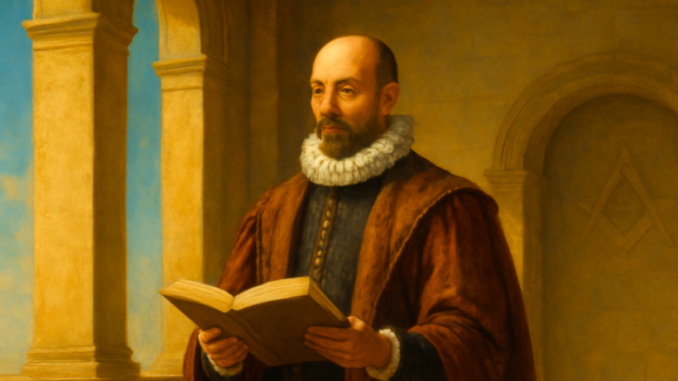
A letter is more than ink on paper. For Michel de Montaigne, a letter was a mirror of the soul — a window into the inner life of its writer. In his essay ‘A Consideration upon Cicero,’ he examines what letters reveal about character and authenticity. Behind this seemingly simple reflection lies a rich philosophical tradition stretching from the Roman Stoa to Renaissance humanism. Understanding the sources of Montaigne’s thought unlocks a timeless wisdom about sincerity and self-knowledge — one that speaks directly to the Masonic pursuit of inner truth.
The Legacy of Classical Rhetoric
Montaigne grew up speaking Latin as his first language — a deliberate choice by his father, who immersed him in the classical world from birth. For Renaissance thinkers, Marcus Tullius Cicero was the supreme model of eloquence and wisdom. His letters to Atticus were celebrated as masterworks of personal correspondence. Yet Montaigne questions their sincerity. Was Cicero truly as candid as he appeared, or was he performing for posterity?
This question of authenticity connects Montaigne to the Skeptical tradition. The Pyrrhonists, followers of Pyrrho of Elis, taught that certainty about the true nature of things lies beyond our reach. Sextus Empiricus, whose work Montaigne knew well, argued that we should suspend our judgments. When Montaigne doubts Cicero’s motives, he applies this Skeptical stance to the written word itself. The letter becomes an object of philosophical inquiry rather than a transparent window into its author’s heart.
Seneca and the Art of Personal Writing
Alongside Cicero, Lucius Annaeus Seneca plays a central role in this essay. Where Cicero’s letters are often political and strategic in nature, Seneca’s Epistulae Morales offer direct philosophical instruction to his friend Lucilius. Montaigne values this openness. Seneca’s letters are not showcases for reputation but workshops for the soul. The Stoic tradition in which Seneca stands emphasizes inner freedom over external recognition.
Stoicism taught that virtue is the only path to happiness and that external goods — fame, possessions, even the opinions of others — belong to the realm of indifferent things. Seneca’s letters embody this principle: they are instruments of moral formation, not of self-glorification. Montaigne recognizes in them an authenticity he finds lacking in Cicero. The true value of a letter, he suggests, lies not in what it says about the world, but in what it reveals about the writer.
Renaissance Humanism and the Rediscovery of the Self
Montaigne wrote at a time when Europe was rediscovering the classics. The humanism of Francesco Petrarca and Desiderius Erasmus had breathed new life into the study of Greek and Latin texts. But where earlier humanists often treated the ancients as untouchable authorities, Montaigne takes a freer approach. He reads Cicero and Seneca not as masters to be obeyed, but as conversation partners to be engaged.
This attitude reflects a broader shift in thinking about individuality. Medieval identity was defined primarily through one’s place in community and cosmic order. The Renaissance brought a new focus on the unique individual. Montaigne’s Essays are the ultimate expression of this shift: he writes about himself — with all his contradictions and doubts — as a legitimate subject of philosophical investigation. In doing so, he pioneers a literary form that remains vital to this day.
Plutarch as Silent Teacher
Behind Montaigne’s method stands the influence of Plutarch, the Greek biographer and moralist. In his Parallel Lives, Plutarch compared Greek and Roman heroes to draw moral lessons. His Moralia offered short essays on ethical questions. Montaigne admired Plutarch’s ability to make wisdom accessible without descending into academic jargon.
In the essay on Cicero, we see this influence clearly. Montaigne does not merely compare Cicero with Seneca — he weighs their characters and intentions against each other. Like Plutarch, he seeks not abstract truths but practical wisdom about how to live and how to write. The comparison becomes a tool for understanding, not a verdict of judgment.
The Letter as a Symbolic Tool
For the Freemason, this essay offers a striking parallel. In the Lodge, brethren work with symbols to arrive at self-knowledge. The rough ashlar that must be shaped, the compasses and square that give measure and direction, the plumb line that reveals the vertical line of uprightness — each serves as a concrete tool for inner development. The letter, as Montaigne examines it, functions as a comparable symbol: a tangible form in which the inner life becomes visible.
Cicero’s letters, Montaigne suggests, are like a polished stone that conceals its original form. The surface gleams, but the core remains hidden. Seneca’s letters, by contrast, show the chisel marks — the struggle, the honest imperfection of someone still working on himself. This distinction touches on a central question of spiritual development: do we write for the applause of others, or to come to know ourselves?
The Relevance of Montaigne’s Question Today
In an age of social media and carefully constructed online identities, Montaigne’s essay resonates more powerfully than ever. Every post, every message, every update is a letter to an invisible audience. The question Montaigne posed to Cicero, we may now pose to ourselves: are we presenting an image we wish to leave behind, or do we dare to show ourselves as we truly are?
The philosophical traditions that inform Montaigne’s thinking each offer a vital lesson. Skepticism teaches us to question apparent certainties. Stoicism points us toward the value of inner integrity over outward success. Humanism invites dialogue with tradition rather than slavish imitation. And Plutarch’s method of comparison shows how placing ideas side by side can lead to genuine wisdom.
Montaigne did not read his classical predecessors as monuments to be admired from a distance. He treated them as living voices. He conversed with them, doubted them, and found in that dialogue his own path toward self-knowledge. His essay on Cicero is not literary criticism — it is an exercise in philosophical honesty.
The philosophical background of Montaigne’s essay on Cicero reveals a rich interplay between Skepticism, Stoicism, humanism, and the moral tradition of Plutarch. For those who walk the Masonic path, these same themes echo through the Lodge: the call to honest self-examination, the refusal to mistake polished surfaces for genuine worth, and the understanding that true wisdom begins not with certainty but with the courage to question. Montaigne’s centuries-old inquiry into authenticity remains an essential guide for anyone committed to the lifelong work of shaping the inner self.
Copyright text & image: devrijmetselaar.nl
Texts are based on the ideas and content of the author of devrijmetselaar.nl, reviewed, corrected, and supplemented with the assistance of OpenAI. Images are created based on the ideas of the author of devrijmetselaar.nl using OpenAI/DALL-E.



Be the first to comment