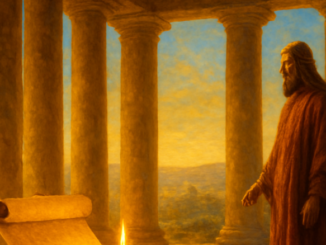
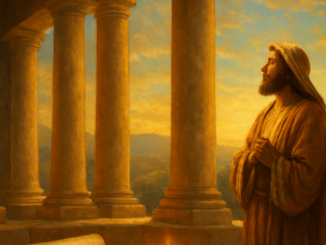
Ancient temple vision symbolizing Ezekiel's connection to Masonic philosophy
Christianity

Ezekiel and Freemasonry: Visions as Inner Building Blocks

What can the enigmatic visions of a sixth-century BCE prophet possibly teach us today? The Book of Ezekiel brims with images that stir the imagination: wheels within wheels, a valley of dry bones, and a temple described down to the smallest measurement. For those who read with a Masonic eye, these ancient texts open up a world of symbolism that turns out to be remarkably relevant. Let’s enter into conversation with this ancient book and discover what it has to offer the modern Freemason. Who Was Ezekiel, and Why Should Freemasons Care? Ezekiel was a priest who was carried into exile in Babylon around 597 BCE, along with many other inhabitants of Judah. There, far from the destroyed Temple in Jerusalem, he received a series of extraordinary visions that he recorded in meticulous detail. But why should a modern person — and especially someone interested in Freemasonry — spend time with these ancient texts? The answer lies in the universal themes woven throughout the book. Ezekiel speaks of destruction and rebuilding, of personal responsibility, of the possibility of starting anew. These are themes that sit at the very heart of Freemasonry: the idea that a human being is like a […]

Vrijmetselarij - De Eerste Graad Vrijmetselarij (Leerling) – Jouw Avontuur Begint
Spiritual Traditions

The First Degree in Freemasonry: Your Journey Begins Here

The First Degree in Freemasonry — known as the Entered Apprentice — is far more than a simple membership ceremony. It marks the beginning of a deeply personal and symbolic journey, one that has the power to fundamentally change how you see the world and your place within it. In this initial stage, you don’t just learn about Freemasonry — you begin to discover yourself. The First Degree lays the foundation upon which everything that follows is built. It is your starting point, your call to awareness, and the first step in a profound transformation. The Entered Apprentice: A Gateway to Deeper Understanding Freemasonry is built upon three foundational degrees: the Entered Apprentice, the Fellowcraft, and the Master Mason. The First Degree is the most crucial beginning. As an Entered Apprentice, you learn what it truly means to live consciously — to ask questions rather than chase answers, and to examine your own behavior with honesty and humility. From the moment of your initiation, you gain access to a rich world of symbolism, ritual, and reflection. But none of this is passive or theoretical. It is an active invitation to work on your own rough ashlar — to shape yourself […]

Ruined temple stones with light breaking through symbolizing Masonic rebuilding
Christianity

Lamentations and Freemasonry: Building After Destruction

You probably know the feeling: something valuable has been lost, and the void left behind seems impossible to bridge. A relationship, a dream, a certainty you always took for granted. In moments like these, you wonder whether anything new can ever grow on the rubble of what once was. The ancient Book of Lamentations speaks to exactly this kind of devastation — and yet, hidden within its raw poetry lies a surprising message that has inspired Freemasons for centuries: it is precisely in the ruins that rebuilding begins. A City in Ruins, a Soul in Mourning Lamentations is a collection of five poems describing the destruction of Jerusalem. Written after the fall of the city in 586 BCE — when the Temple was razed and the people driven into exile — the texts are raw, unpolished, and filled with despair. Streets that once bustled with life lie abandoned. The Temple, the spiritual heart of an entire people, is reduced to scorched stone. But here is something remarkable: these laments are not chaotic wailing. They follow a strict alphabetical structure — an acrostic in which each verse begins with a successive letter of the Hebrew alphabet. In the midst of the […]

Ancient potter shaping clay symbolizing Jeremiah and Masonic transformation
Christianity

Jeremiah and Freemasonry: The Prophet as Inner Builder

In 586 BCE, an event unfolded that would shake the Jewish people to their very core: the destruction of the Temple in Jerusalem by the Babylonians. At the center of this historical catastrophe stood a figure who had been sounding warnings for decades. The prophet Jeremiah, whose name has become synonymous with lamentation and prophecy of doom, also carried within him a message of profound hope. For those willing to look beyond the rubble, his vision of rebuilding extended far beyond walls of stone — it reached into the very depths of the human heart. A Prophet in Times of Decline Jeremiah’s prophetic calling began around 627 BCE, during a period when the kingdom of Judah was slowly sliding toward political and moral collapse. What makes the Book of Jeremiah so remarkable is its deeply personal tone. Unlike many other prophetic writings, Jeremiah reveals a man who struggles with his mission, who doubts and suffers. He was called to uproot and tear down, but also to build and to plant. This dual commission forms the very heart of his message. Understanding the historical context is essential to grasping Jeremiah’s significance. The Assyrian Empire had collapsed, Egypt and Babylon were vying […]

Vrijmetselarij - Symbolism and Rituals in Freemasonry: Why They Matter
Symbolism & Rituals

Symbolism and Rituals in Freemasonry: Why They Matter

In a world obsessed with speed, directness, and measurable results, symbolism operates on an entirely different wavelength. A symbol doesn’t explain — it invites. It says: “Feel, experience, ask questions.” This is precisely why symbolism and rituals hold such a central place in Freemasonry, and why their impact runs far deeper than most people expect. Why Symbolism Is Anything but Optional Freemasons work with symbolism the way artists work with color — not to decorate, but to build layers of meaning. The compasses are not a measuring instrument. They are an invitation to examine your own boundaries. The rough ashlar is not just a stone. It represents your character, your potential, your ongoing process of growth. Symbolism functions as a mirror. And mirrors are rarely comfortable — but they are always valuable. When you stand before a symbol and allow it to speak to you without rushing toward a single interpretation, something shifts. You move from passive observation to active self-inquiry. That shift is at the heart of the Masonic experience. Rituals as Consciousness Training A ritual in Freemasonry is neither a theatrical performance nor a “secret act.” It is a carefully constructed process in which you literally take the […]

Clock striking midnight on New Year's Eve with Masonic symbolism
Symbolism & Rituals

The Symbolic Countdown of New Year’s Eve in Freemasonry

The countdown on New Year’s Eve is one of the most powerful collective rituals in modern society. It marks far more than the turning of a calendar page — it speaks to deeper currents of time, transformation, and reflection. For Freemasons, this annual moment carries an additional layer of meaning, one rich in symbolism and introspection that resonates with the very heart of the Craft. Time and Symbolism in Freemasonry Freemasons have always placed great value on symbolism and ritual. The countdown to midnight on New Year’s Eve mirrors a universal longing for renewal and harmony — themes that run deep through Masonic philosophy. Just as the Masonic calendar is cyclical, beginning each year with a fresh building season, the New Year’s countdown offers us a chance to recalibrate our inner compass and set a new course. The clock is a recurring symbol within Freemasonry, representing not just the linear passage of time but also the awakening of awareness. As we count down those final seconds, we feel the urgency of each fleeting moment — a vivid reminder to be fully present and to appreciate the gift of the “now.” The Countdown as a Masonic Ritual Freemasonry embraces rituals that […]

Golden oliebollen on a plate symbolizing Masonic tradition and brotherhood
Symbolism & Rituals

The Oliebol: Tradition, Symbolism and Masonic Brotherhood

There is no Dutch New Year’s Eve without the irresistible aroma of freshly fried oliebollen — golden, round balls of dough that mark the turn of the year. This humble pastry is a symbol of tradition, abundance, and togetherness. For Freemasons, however, the oliebol can carry an even deeper meaning: a celebration of brotherhood and the cyclical nature of life itself. A Rich History The oliebol — literally “oil ball” — traces its roots back to at least the 17th century in the Netherlands. During the cold, dark winter months, this nourishing fried dough provided warmth and energy in harsh times. In Freemasonry, where symbolism plays a central role, the round shape of the oliebol can remind us of the circle of life and the eternal quest for perfection. Just as Freemasons work on the rough ashlar to shape it into a perfect cube, the oliebol invites us to transform the ordinary — a simple batter of flour, yeast, and milk — into something extraordinary. It is a small but powerful metaphor for the transformative work at the heart of the Craft. The Ritual of Baking Baking oliebollen is remarkably similar to performing a ritual. The batter must be carefully […]

Candlelit Masonic lodge with checkered floor evoking the Exodus journey
Religion

Exodus: The Journey to Freedom and Inner Growth

Picture a lodge draped in silence, candlelight flickering across the black-and-white checkered floor. A brother reads aloud from the Book of Exodus — the story of a people who cast off their chains in the dead of night and set out into the wilderness, moving toward something they cannot yet name. The words hang in the air, and everyone in the temple feels it: this story is not merely about an ancient people in a distant land. It is about us. What makes the story of Exodus so indelible? Why does this tale of slavery, liberation, and an endless trek through the desert still move us, thousands of years after it was first told? And what does a Freemason gain by returning to this ancient narrative again and again — not as a historical document, but as a mirror for the soul? Egypt as Inner Captivity In the Book of Exodus, everything begins with slavery. The Israelites groan under the yoke of Pharaoh, trapped in a system that reduces them to mere instruments. Within Freemasonry, this image is far more than a historical fact — it is a powerful allegory. Egypt symbolizes every form of inner captivity: the chains of […]

Open ancient book with Masonic rough ashlar stone symbolizing inner growth
Christianity

The Book of Job: Suffering as a Building Block for Inner Growth

You know the feeling: a season when everything falls apart. Loss, setback after setback, and the people around you don’t seem to understand. In moments like these, a question surfaces — one that humanity has grappled with for thousands of years: why is this happening to me? The Book of Job from the Old Testament confronts us with exactly this question. But it also offers a surprisingly practical framework for anyone willing to look deeper. For Freemasons in particular, this ancient book of wisdom contains symbols that speak directly to the inner journey every Brother or Sister undertakes. The Heart of the Story: A Righteous Man Put to the Test Job is a prosperous, upright man who loses everything — his possessions, his children, his health. His friends insist he must have done something wrong to deserve such misfortune. But Job knows he is innocent. The book isn’t really about whether suffering is a punishment. It’s about how you respond when life hits you with incomprehensible adversity. Job refuses to surrender his integrity, even when everything is stripped away from him. That is the first practical lesson: character stands firm when comfort disappears. The Symbolism of the Rough Ashlar In […]

Football hitting the net symbolizing a decisive Masonic moment of meaning
History

The Decisive Moment: Symbolism of the Winning Goal

A ball rolls into the net. A stadium erupts. A name is etched into club history. Then, years later, that same name surfaces again — this time surrounded by silence. The story of a young footballer who scored a decisive goal against a powerhouse and then passed away at the age of twenty-eight raises questions that reach far beyond sport. What remains of a person after they are gone? What is the true value of that single, seemingly fleeting moment when everything comes together? Freemasonry, with its centuries-old contemplation of mortality and meaning, offers a surprisingly illuminating perspective on these questions. The Ball as a Symbol of Fate On the surface, a football is nothing more than an object of leather and air. Yet it carries within it the potential for triumph and defeat, for heroes and forgotten names. In Freemasonry, we are familiar with the concept of working tools that transcend their material form. The gavel, the compasses, the square — they represent inner qualities and life lessons. In much the same way, the ball can be seen as a symbol of fate itself: round, without beginning or end, unpredictable in its movements, yet ultimately subject to the laws […]