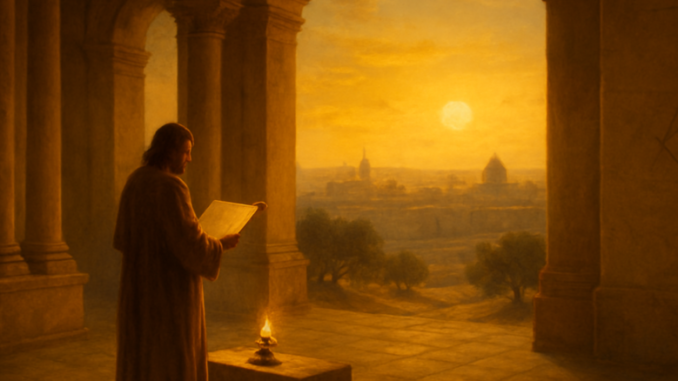
Why does the Gospel of Mark begin so abruptly — no birth narrative, no genealogy — just a voice crying out in the wilderness? And what does that raw, urgent opening have to do with the path walked by every seeker of truth? In this second installment of our series on sacred texts, we examine the Gospel of Mark through the lens of symbolism and inner transformation.
What Makes Mark Different from the Other Gospels?
It is a fair question. Where Matthew dwells on lineage and Luke on angelic announcements, Mark plunges straight into the story. No family tree, no shepherds, no wise men. Just a voice in the desert and a baptism in the river. This is the shortest gospel, the fastest, and the most action-driven. The Greek word euthys — meaning “immediately” or “at once” — appears dozens of times. Mark is less concerned with telling us who Jesus was than with showing us what he did.
For those familiar with the symbolism of inner development, this emphasis on action is deeply significant. It is not about origin or theory — it is about the steps you take. The journey is the destination. And that journey begins, as Mark so powerfully shows, in the wilderness: a place of emptiness, of deprivation, of confrontation with oneself.
Why Does the Journey Begin in the Wilderness?
The wilderness is a universal symbol. Across spiritual traditions, it represents the dark night of the soul — the phase of trial and testing that must precede any form of enlightenment. Mark describes the central figure spending forty days in the desert, tempted by dark forces, surrounded by wild beasts, and attended by heavenly beings. It is an image that resonates with every seeker who has faced the confrontation with their own shadow.
In Freemasonry, there is a strikingly parallel moment: the Chamber of Reflection, where the candidate sits alone with his thoughts before being brought into the light. The wilderness in Mark serves the same function. It is the space where the old self dies and makes room for growth. Without this stripping away, no genuine transformation can occur.
Which Symbols Stand Out?
Mark is rich with imagery that echoes throughout Masonic and broader esoteric symbolism. Consider the heavens tearing open at the baptism, the voice speaking from above, the dove descending. Light breaks through darkness; a new identity is proclaimed. Later in the gospel, the veil of the temple is torn in two at the very moment of the crucifixion. What was hidden is laid bare; the innermost sanctum is revealed.
These moments of revelation fit into a larger pattern: the inner temple being built, layer by layer, until the holiest of holies becomes accessible. Mark does not tell this story in the abstract. He tells it through concrete events that serve as mirrors for the reader — inviting self-examination at every turn.
“Whoever wants to save their life will lose it, but whoever loses their life for the sake of the good news will find it.”
This central verse from Mark speaks to the heart of every spiritual tradition that places transformation at its core. The old must yield to the new. The rough stone must be shaped and worked.
What Does the Secrecy Motif Mean?
One of the most striking features of Mark’s gospel is the so-called Messianic Secret. Again and again, the central figure commands people to remain silent about what they have seen or experienced. Healings must be kept quiet; revelations must not be shared. Why?
Some biblical scholars view this as a literary device. But symbolically, it points to something deeper: true knowledge is not immediately accessible to everyone — not because it is elitist, but because it must be earned. One must be ready to receive. This principle of gradual initiation will be familiar to anyone acquainted with the degrees and rituals of fraternal orders that work with symbols and ceremonies.
The secret is not exclusion — it is an invitation. It says: come closer, but prepare yourself. The light blinds those who have not yet learned to see in the dark.
How Does Action Relate to Knowledge?
Mark places unmistakable emphasis on the deed. Where other gospels contain lengthy discourses, Mark primarily shows the teacher in action. He heals, he touches, he breaks bread, he walks on water, he endures suffering. Words are secondary to example.
This aligns with the conviction that moral growth does not arise from reading texts alone, but from applying principles in daily life. The working tools of the Mason are not merely symbolic — they are practical. They invite action: to measure, to weigh, to align, to build. Mark’s gospel carries the same imperative. Understanding without action is incomplete.
Consider these key themes woven throughout the gospel:
- The wilderness as a space of inner testing
- The tearing of barriers as a symbol of breakthrough
- The secret as an invitation to deeper understanding
- The deed as the true measure of character
What Can We Take Away from This Gospel?
Mark invites self-examination — not through lengthy contemplation, but through the example of someone who acts, suffers, and remains steadfast. It is a text that asks: what do you do when things become difficult? Can you endure the wilderness? Do you dare to tear through the veil?
In our series on sacred texts, Mark occupies a distinctive place. Where Matthew emphasized the building of the inner temple, Mark highlights the journey that precedes it. Both are necessary. Without the journey, there is no temple. Without the temple, there is no home.
The Gospel of Mark speaks to those who are willing to take the first step, even when the path ahead is uncertain. Its symbolism of wilderness, breakthrough, and action resonates with every seeker who understands that growth demands courage. Let this short, powerful gospel serve not as a call to believe without questioning, but as an invitation to act with conviction.
Copyright text & image: devrijmetselaar.nl
Texts are based on the ideas and content of the author of devrijmetselaar.nl, reviewed, corrected, and supplemented with the assistance of OpenAI. Images are created based on the ideas of the author of devrijmetselaar.nl using OpenAI/DALL-E.
Frequently Asked Questions
What is the connection between the Gospel of Mark and Freemasonry?
Both Mark's Gospel and Freemasonry emphasize inner transformation through action and symbolic experience rather than abstract theory. The wilderness journey in Mark parallels the Chamber of Reflection in Freemasonry, where candidates face themselves in solitude before experiencing enlightenment. These traditions share a common understanding that genuine spiritual growth requires confronting one's shadow self and moving through trials to reach higher understanding.
Why does Mark's Gospel begin without a birth narrative or genealogy?
Mark prioritizes action and immediate spiritual experience over lineage and origin stories, reflecting the philosophy that the journey itself is the destination. This approach resonates with Masonic teachings, which focus on what seekers do and become rather than who they were before initiation. By beginning in the wilderness with urgency and movement, Mark invites readers to embark on their own transformative journey rather than merely learning about someone else's past.
What does the wilderness symbolize in Mark's Gospel and spiritual practice?
The wilderness represents the necessary trial and stripping away of the old self that must precede genuine spiritual growth—what mystics call the dark night of the soul. In both Mark's narrative and Freemasonry, this confrontation with emptiness and one's shadow is essential before illumination can occur. Without this challenging phase of self-examination and testing, authentic transformation cannot take place.
How do the symbols in Mark's Gospel relate to Masonic symbolism?
Mark uses powerful imagery such as torn heavens, descending doves, and veiled sanctums being revealed to depict the progressive unveiling of inner truth and spiritual illumination. These symbols mirror Masonic progression through degrees, where candidates gradually move from darkness into light and gain access to increasingly sacred chambers of knowledge. Both traditions use concrete symbolic moments to invite self-examination and reflect the building of an inner temple, layer by layer.
What is the central message of Mark's Gospel for spiritual seekers?
Mark teaches that true spiritual life requires letting go of the ego-self and surrendering to something greater—a principle echoed throughout Masonic teaching and initiatic traditions. The gospel emphasizes that losing one's old identity is paradoxically the path to finding one's true self and purpose. This message invites all seekers to embrace transformative action and inner work as the genuine measure of spiritual progress.

Be the first to comment