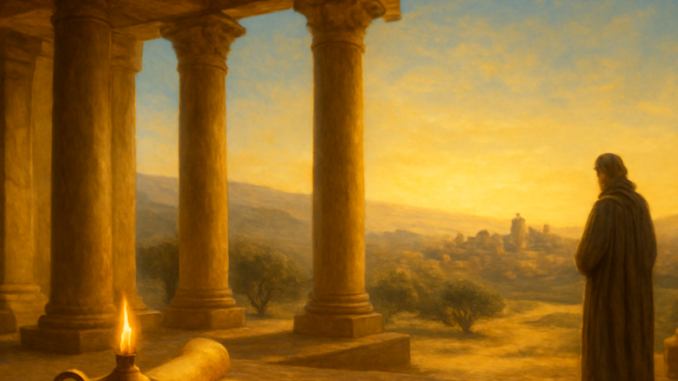
In the Book of Zechariah, there stands a lampstand. Not an ordinary one, but a golden lampstand with seven lamps, fed by two olive trees that channel their oil directly into its reservoir. This striking image from the fourth chapter of the prophetic text invites us to pause and reflect. What does it mean to receive light without effort of your own? And what might this ancient vision tell us about the way we build ourselves — and the world around us — today?
A Lampstand That Feeds Itself
Imagine a lamp that never needs refilling. The oil flows on its own; the flame never dies. In Zechariah’s vision, this golden lampstand stands at the center, flanked by two olive trees. The prophet asks what it all means, and the answer is profound: “Not by might, nor by power, but by my Spirit.” With those words, the focus shifts away from human effort toward a deeper, inexhaustible source. The lampstand becomes a symbol of what happens when we open ourselves to something greater than our own will.
In Freemasonry, light plays a central role. The search for light is the search for knowledge, for insight, for that which was hidden and is now made visible. But the golden lampstand in Zechariah goes beyond mere illumination. It speaks of a continuous flow — a connection to a source that does not depend on human fuel. This raises a compelling question: how much of our inner light springs from our own effort, and how much from surrendering to a wisdom that existed long before we went looking for it?
Rebuilding the Temple
Zechariah prophesied during a time of return. The Jewish people had come back from exile in Babylon and faced the immense task of rebuilding their destroyed temple. His prophecies are steeped in images of restoration, purification, and new beginnings. In one vision, the high priest Joshua is stripped of his filthy garments and clothed in fine robes. Here we see transformation as ritual — a passage from an old state into a new one.
For those familiar with the symbolism of building, this resonates powerfully. The temple is never merely a structure of stone. It is equally a metaphor for the inner self, for the soul that is perpetually under construction. The Freemason works the rough ashlar, shaping it into a perfect cube that fits into a greater whole. Zechariah’s message of rebuilding speaks to the same aspiration: what seemed destroyed can be restored. What was defiled can be cleansed. Every day offers a new opportunity to pick up the tools and begin building again.
The Two Anointed Ones
The two olive trees flanking the lampstand are called in the vision “the two anointed ones, who stand before the Lord of all the earth.” In Zechariah’s historical context, they likely referred to the high priest and the royal leader — the two pillars of restored communal life. But symbols are never confined to a single meaning.
The two pillars that marked the entrance to Solomon’s Temple bear names that speak of strength and establishment. Across many traditions, they point to the dualities that define human existence: day and night, action and contemplation, severity and mercy. The two olive trees in Zechariah’s vision can be read in a similar way — as a reminder of the necessity of balance. The lampstand’s light does not spring from one source alone but from the cooperation of two. This echoes the Masonic ideal of brotherhood: only in genuine connection with others can the full light shine.
The Flying Scroll and Evil in the Measuring Basket
Zechariah’s visions are not all hopeful. There is also the flying scroll — a symbol of judgment upon lies and theft. And there is the woman in the measuring basket, named “Wickedness,” who is carried away to a distant land. These are uncomfortable, confronting images. They compel us to acknowledge that the road to light passes through darkness, and that rebuilding begins with facing what must first be torn down.
In the moral philosophy that runs through Freemasonry, self-reflection is indispensable. We look into the mirror not to admire ourselves, but to see the shadows that still require work. The flying scroll asks: where have I been dishonest? The woman in the basket asks: what tendencies within me deserve to be removed? These are not comfortable questions, but they are essential for anyone who truly wishes to build.
No King on a War Horse
One of the most well-known passages in Zechariah describes a coming king — not proud and mounted on a war horse, but humble, riding on a donkey. This image speaks of a different kind of strength: not the power that dominates, but the power that serves. Here, the prophecy touches a theme that has inspired builders across the centuries. True leadership reveals itself not in displays of might, but in the willingness to bow, to serve, to subordinate one’s own ego to a higher purpose.
“Not by might, nor by power, but by my Spirit, says the Lord of Hosts.” This single verse encapsulates the thread running through the entire book. The way forward is not paved with weapons or ambition, but with surrender to something that transcends the human scale. For the seeker, the message is clear: the work is necessary, but its fruit does not come from personal strength alone.
The Stone with Seven Eyes
Finally, there is the stone with seven eyes, placed before the high priest Joshua. Seven — the number of completeness. Eyes — the symbol of watchfulness and insight. This stone sees everything and misses nothing. In Zechariah’s context, it refers to divine omniscience, but as a symbol, it speaks more broadly. The stone we work, the inner self we shape, must not be blind. The eyes represent the capacity to discern, to separate truth from falsehood, to see in the darkness what still needs light.
Zechariah offers no easy answers. It is a book of visions — enigmatic, layered, and rich. But for those willing to sit with its imagery, it becomes a mirror. The golden lampstand reflects our own potential to receive and transmit light. The ruined temple reflects the parts of ourselves that await reconstruction. The two olive trees remind us that we cannot do this work alone. And the stone with seven eyes calls us to an ever-deepening awareness — of ourselves, of others, and of the sacred work that lies ahead.
Zechariah’s visions, ancient as they are, remain strikingly relevant for anyone engaged in the inner work of self-improvement. Whether approached through the lens of Freemasonry or personal spiritual practice, the golden lampstand stands as a powerful reminder: the deepest light is not something we manufacture — it is something we learn to receive. And the temple we are called to rebuild is, first and always, the one within.
Copyright text & image: devrijmetselaar.nl
Texts are based on the ideas and content of the author of devrijmetselaar.nl, reviewed, corrected, and supplemented with the assistance of OpenAI. Images are created based on the ideas of the author of devrijmetselaar.nl using OpenAI/DALL-E.
Frequently Asked Questions
What does the golden lampstand in Zechariah represent in Freemasonry?
In Freemasonry, the golden lampstand symbolizes the continuous flow of light and knowledge from a source greater than ourselves. It represents the inner illumination that comes not just from our own effort, but from opening ourselves to divine wisdom and deeper truths. The lampstand reminds us that true light in Masonry comes from surrendering to something transcendent while actively seeking knowledge and self-improvement.
How does the symbolism of rebuilding the temple relate to Freemasonry?
The temple in Zechariah's vision represents both physical restoration and the inner work of self-building that Masons undertake. Just as Freemasons work to refine the rough ashlar into a perfect stone, Zechariah's message teaches that we are constantly under construction, able to be cleansed and renewed. This metaphor of rebuilding speaks to the Masonic journey of perpetual improvement and spiritual transformation.
What do the two olive trees represent in Zechariah's lampstand vision?
The two olive trees, called the 'two anointed ones,' represent the dual pillars of leadership and spiritual authority in Zechariah's time, and symbolize balance and duality in Masonic thought. These pillars echo the two famous pillars at Solomon's Temple entrance, representing strength and establishment. In Masonic symbolism, they remind us of the complementary forces—material and spiritual, strength and stability—that support our work and growth.
Why is the phrase 'Not by might, nor by power, but by my Spirit' important in Masonic understanding?
This profound statement shifts focus from human effort alone to reliance on a higher wisdom and spiritual source. For Masons, it teaches that while we must work diligently on our own development, true enlightenment and inner light come from connecting with something greater than ourselves. This balance between personal labor and spiritual openness is central to the Masonic path of self-discovery and illumination.

Be the first to comment