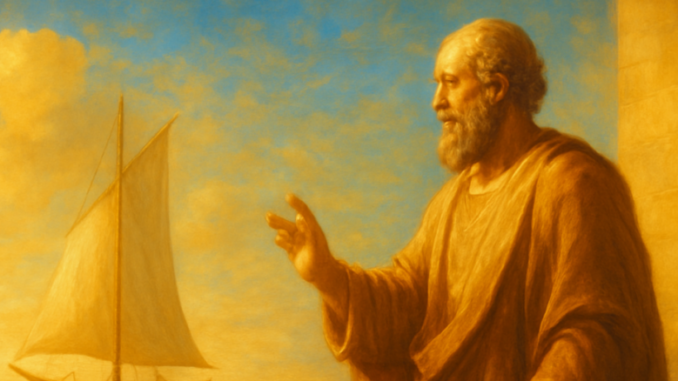
Picture yourself standing in a Lodge surrounded by your brethren — each one shaped by a different background, character, and path through life. Yet together, you form something greater than the sum of your individual parts. How can multiplicity also be unity? This riddle has occupied thinkers for millennia. Plato explored it in his dialogue Parmenides, a work that continues to inspire both philosophers and Freemasons alike. In this article, we’ll uncover the heart of this fascinating conversation and explore what it can offer you in practical terms.
The Setting: Two Great Thinkers Meet
The dialogue Parmenides depicts a fictional conversation between a young Socrates and the elderly philosopher Parmenides of Elea, accompanied by his student Zeno. The historical Parmenides lived around 500 BCE and was famous for arguing that reality is fundamentally one and unchanging. Plato uses this encounter to subject his own Theory of Forms to a rigorous critical test. The result is a dialogue that is at once humble and profoundly deep.
What makes this work so remarkable? Plato allows the elder master Parmenides to expose the weak points in Socrates’ thinking. Rather than mounting a triumphant defense of his own ideas, Plato demonstrates rare intellectual courage: he confronts his philosophy with its most difficult questions. For Freemasons who value the pursuit of truth over the comfort of certainty, this approach carries a powerful lesson.
The Central Question: What Is the One?
The central theme revolves around the relationship between the One and the Many. Socrates initially defends the position that eternal, unchanging Forms exist — the Beautiful itself, the Good itself, the Equal itself. Individual beautiful things in the world derive their beauty by participating in the single Form of Beauty. But Parmenides raises a piercing question: how can many different things share in one and the same Form without that Form itself becoming divided?
The One is not the negation of multiplicity, but the hidden ground upon which all diversity rests.
This problem may seem abstract, but it strikes at the heart of how we understand the world. Consider a Lodge: every member is unique, yet all share in the same ideal of brotherhood. Does that ideal become infinitely divisible? Or does it remain one while being present in many? These are not merely academic questions — they touch the living experience of every Freemason.
Eight Hypotheses: A Gymnasium for the Mind
The second part of the dialogue consists of a series of eight hypotheses in which Parmenides systematically examines what follows if the One does or does not exist, and whether it is or is not truly one. This exercise is far from dry logic — it is a training in dialectical thinking. Plato demonstrates that every position, no matter how certain it may appear, contains its own contradiction.
If the One is completely one, it can have no properties and cannot even exist in any way we recognize. If the One has properties, it becomes multiple and therefore no longer strictly one. And if the One does not exist, it nonetheless remains present in some way within our thinking.
This exercise closely mirrors the work done in a Lodge. By examining a question from every possible angle, you transcend superficial answers and approach a deeper understanding. It is the intellectual equivalent of working the rough stone — chipping away at assumptions until something truer emerges.
Practical Value: Learning to Live with Paradox
What can you actually do with these insights? The Parmenides teaches us that reality cannot be captured in simple formulas. When you encounter contradictions in daily life, it helps to take both sides seriously without immediately choosing one over the other. This is the essence of both philosophical reflection and the ritual work within Freemasonry.
Think of concrete situations: you want to remain faithful to your own convictions while also being open to the perspectives of others. You seek personal growth while also feeling connected to something greater than yourself. The Parmenides shows that these tensions don’t need to be resolved — they can be lived through fruitfully.
Three Steps to Apply This Insight
1. Recognize the paradox. Notice when your thinking runs into contradictions, and name both sides explicitly. Don’t shy away from the discomfort — that friction is where growth begins.
2. Investigate without judgment. Take the time to understand each position from the inside, just as Parmenides did with Socrates. Suspend your conclusions and let each perspective speak on its own terms.
3. Embrace the tension. Allow the unresolved to exist as a source of growth, not as a failure of your reasoning. In Masonic terms, this is the willingness to sit with mystery rather than rushing toward false clarity.
The Symbolism of the One in Freemasonry
The tension between unity and multiplicity resonates deeply in the symbolic language of Freemasonry. The rough ashlar represents the individual with all his imperfections; the perfect ashlar symbolizes the polished character that fits into a greater structure. Yet every stone remains unique. The Great Architect who oversees the whole is not the sum of the parts, but an ordering principle that makes unity possible without destroying diversity.
Plato would have recognized this immediately. His search for the One is not about erasing differences, but about discovering the hidden coherence that sustains all multiplicity. This is not merely an insight you read about — it is something you practice: in conversations, in rituals, and in the way you look at the world around you.
Plato’s Parmenides is not an easy work, but it offers a lasting lesson. The question of the One and the Many is not just philosophically interesting — it speaks directly to how we live together, how we collaborate, and how we find meaning in our existence. By choosing to live through paradoxes rather than flee from them, we develop the ability to perceive unity where others see only division. That is a practical wisdom that proves its worth both in the Lodge and in everyday life.
Copyright text & image: devrijmetselaar.nl
Texts are based on the ideas and content of the author of devrijmetselaar.nl, reviewed, corrected, and supplemented with the assistance of OpenAI. Images are created based on the ideas of the author of devrijmetselaar.nl using OpenAI/DALL-E.


Be the first to comment