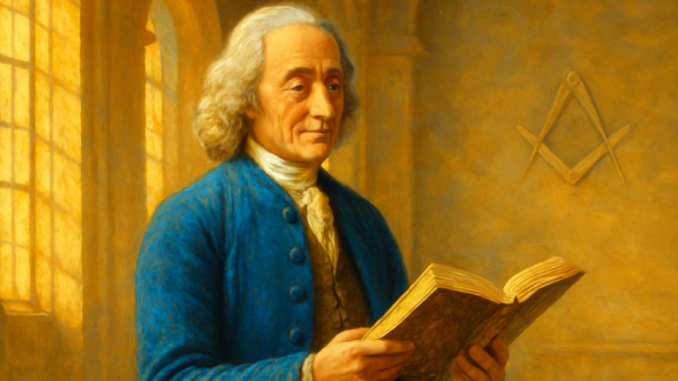
In his second philosophical letter, Voltaire turns his sharp gaze toward the Anglican Church. Having already shared his observations on the Quakers, he now examines an established state church that, despite its official status, displays a remarkable degree of religious tolerance. By placing two worlds side by side — the rigid French Catholicism of his era and the pragmatic English approach to faith and state power — Voltaire reveals not only differences in ecclesiastical organization, but touches on deeper questions about freedom, hierarchy, and the symbolic meaning of religious institutions.
The Heart of Voltaire’s Argument
Voltaire describes the Anglican Church as a curious blend of Protestant theology and Catholic aesthetics. The bishops still wear their mitres, the cathedrals retain their grandeur, and the liturgy carries a solemnity reminiscent of Rome. Yet the doctrine is fundamentally different. The monarch stands at the head of the church, not the Pope. This institutional break with Rome, Voltaire argues, has not led to chaos but rather to a workable order in which religious disagreements are far less likely to result in bloodshed.
The central theme of this letter is the relationship between state power and religious authority. Voltaire observes that the English have found a practical solution to a problem that had torn the European continent apart for centuries. By placing the church under the crown, religious power is curtailed without faith itself being diminished. The devout Englishman can still pray, confess, and take communion — but the church can no longer declare wars or depose kings.
The French Perspective: Centralization and Control
To fully appreciate Voltaire’s observations, we need to picture the France of his time. The Gallican Church operated under strict royal supervision while remaining tied to Rome. This dual loyalty created tensions that regularly spiraled into religious persecution. The revocation of the Edict of Nantes in 1685 by Louis XIV had forced hundreds of thousands of Huguenots to flee their homeland. Voltaire himself would later become a victim of religious intolerance, repeatedly having to escape the threat of arrest.
From this vantage point, Voltaire views the Anglican solution with a mixture of admiration and analytical detachment. He does not idealize England, but he acknowledges that a state church directly answerable to the crown is less prone to the excesses he had witnessed in France. The power of the clergy is restrained by political reality, not by theological argument.
The English Perspective: Pragmatism Over Dogma
The Englishmen Voltaire encountered did not regard their ecclesiastical arrangement as a compromise but as an achievement. After the bloody religious conflicts of the sixteenth and seventeenth centuries, England had learned that religious absolutism leads to civil war. The Glorious Revolution of 1688 had brought not only a new king but also a new relationship between church, state, and individual liberty of conscience.
Religious tolerance arises not from indifference toward faith, but from the understanding that coercion can never reach the conscience.
Voltaire notes that the Anglican clergy are generally well educated and display a certain intellectual openness. The clergymen read the classics, discuss natural philosophy, and engage in public debate. This stands in stark contrast to the image of the ignorant village priest that was common in France at the time — a difference that left a lasting impression on the philosopher.
What Both Worlds Share
Despite their organizational differences, Voltaire identifies commonalities that run deeper than institutional structures. Both the French Catholic and the English Anglican seek meaning, community, and moral direction. The rituals may differ and the vestments may carry different colors, but the human need for transcendence remains universal. Voltaire acknowledges this without cynicism. He does not criticize faith itself, but rather the ways in which religious power can degenerate into oppression.
Both traditions also employ symbolism to convey their message. The cathedral, the altar, the procession — these forms speak to the imagination and create a sense of connection with something greater than the individual. Voltaire understands the power of these symbols, even as he remains critical of the institutional authority they sometimes serve to legitimize.
Lessons for the Searching Mind — and for Freemasonry
What can we, as modern readers, learn from Voltaire’s comparison? First, that religious tolerance is not a weakness but a hallmark of civilization. A society that makes room for diverse beliefs demonstrates trust in the reasonableness of its citizens. Second, that symbols and rituals can be deeply valuable without needing to be imposed by force. The cathedral invites — it does not compel.
For those with an affinity for Freemasonry, Voltaire’s message resonates in a particularly meaningful way. Freemasonry, too, works with symbols that invite reflection without dogmatic coercion. The square and compasses, the rough and smooth ashlar — these are images that gain their meaning through personal interpretation, not through imposed doctrine. In this sense, the Freemason shares something with both the Anglican and the Quaker that Voltaire describes: a preference for inner conviction over outward display.
The Enduring Relevance of Voltaire’s Observation
Nearly three centuries after its publication, Voltaire’s second philosophical letter remains strikingly relevant. The tension between religious freedom and social order has not disappeared. If anything, in a world of increasing diversity, the questions Voltaire raised have become more pressing than ever. How do we create space for different convictions without losing social cohesion? How do we honor tradition while remaining open to new insights?
Voltaire did not provide definitive answers to these questions — and perhaps that is precisely the point. Like the best Masonic teachings, his writings invite us to think for ourselves, to weigh competing truths, and to seek the light of understanding rather than the comfort of certainty. In an age that often demands simple answers to complex questions, that invitation remains as vital as ever.
Voltaire’s examination of the Anglican Church is far more than a historical curiosity. It is a meditation on the eternal struggle between authority and conscience, between the need for order and the right to think freely. For Freemasons and seekers alike, his second letter serves as a powerful reminder that true tolerance is not the absence of belief — it is the courage to let others find their own path to the light. In the space between the cathedral and the lodge room, between the mitre and the square, lies a shared conviction: that the human spirit flourishes best when it is free.
Copyright text & image: devrijmetselaar.nl
Texts are based on the ideas and content of the author of devrijmetselaar.nl, reviewed, corrected, and supplemented with the assistance of OpenAI. Images are created based on the ideas of the author of devrijmetselaar.nl using OpenAI/DALL-E.
Frequently Asked Questions
What is Voltaire's main argument about the Anglican Church in his philosophical letter?
Voltaire argues that the Anglican Church represents a practical solution to religious conflict by blending Protestant theology with Catholic aesthetics while placing the church under the monarch's authority rather than the Pope's. This arrangement curtails religious power without diminishing faith itself, and crucially, prevents the church from declaring wars or deposing kings—a stark contrast to the religious violence he witnessed in France.
How does Voltaire compare the Anglican Church to French Catholicism?
Voltaire contrasts the pragmatic English approach to faith and state power with the rigid French Catholicism of his era. While the French Gallican Church operated under dual loyalty to both the crown and Rome, creating tensions and persecution, the English system places the church directly under royal supervision with a clear chain of command. Voltaire views the English solution as less prone to the religious excesses and persecutions he had witnessed in France, including the revocation of the Edict of Nantes.
Why does Voltaire value religious tolerance as demonstrated by the Anglican Church?
Voltaire values religious tolerance because he personally experienced the dangers of religious intolerance in France, facing repeated threats of arrest. He observes that the Anglican model's separation of religious and political power—where the monarch heads the church but the church cannot wage wars or depose rulers—creates a framework where religious disagreements are far less likely to result in bloodshed, making tolerance both a practical and moral virtue essential for a stable society.


Be the first to comment