
Symbolic rough ashlar and polished cube representing Masonic character formation
Personal Development & Leadership

War Fever and Character: Masonic Lessons from History

In 1914, a war broke out across Europe that nobody truly wanted but everyone had prepared for. The mechanisms of escalation, the collective war fever that swept entire nations into its grip, and the failure of individual judgment together form a cautionary tale that feels disturbingly relevant today. As modern defense analysts warn about escalation risks in ongoing conflicts, a deeper question emerges: what determines whether a person is swept along by collective hysteria or remains steadfast? Freemasonry has contemplated precisely this question for centuries — the formation of a character resilient enough to withstand the storms of any age. The Summer of 1914: Anatomy of an Escalation When Archduke Franz Ferdinand was assassinated in Sarajevo on June 28, 1914, almost no one predicted that this single event would spiral into a world war. Yet within six weeks, all of Europe was ablaze. The German philosopher Immanuel Kant had warned more than a century earlier about the tendency of states to let conflicts escalate when national pride and fear dominate the discourse. His 1795 treatise Perpetual Peace analyzed precisely the mechanisms that would prove so disastrous in 1914. What stood out in that fateful summer was how quickly rational statesmen […]
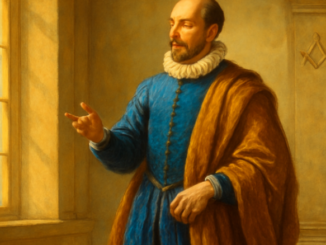
Open book of Montaigne's essays with Masonic symbols representing silence and wisdom
Michel de Montaigne – Freemasonry & Connection

Montaigne on Eloquence: The Masonic Art of the Right Word

In the sixteenth century, a French thinker penned a brief but striking essay on the art of speaking. His observations about eloquence and the speed with which people choose their words touch on something timeless. Centuries later, we can hear in his thoughts an echo of values that also stand at the heart of Freemasonry: the search for truth, the importance of self-reflection, and the understanding that true wisdom often resides in what we choose not to say. A Renaissance Thinker Speaks Michel de Montaigne lived from 1533 to 1592. After an active career in public life, he withdrew to his estate to write and to think. His collection of essays — written in an intensely personal, searching style — ranks among the most influential works in Western literature. In the tenth essay of his first book, he turned his attention to something seemingly simple: the way people speak. Some, he observed, speak quickly and rashly. Others weigh every word with care. Montaigne himself confessed to being one of the slower speakers, someone whose thoughts only reached full maturity after time had passed. This honest self-observation is characteristic of his method. He did not write to lecture others, but to […]